


DISCUSSION OF THIS ASSESSMENT

WASHINGTON DC 26MAR2026
(U) EXECUTIVE SUMMARY
Donald Trump wants to pull off an Inchon.
In September 1950, three months into the Korean War, United Nations forces were pinned inside a shrinking perimeter around the port of Pusan, losing ground daily.[1] General Douglas MacArthur — over the objections of nearly every senior military planner — ordered an amphibious landing two hundred miles behind enemy lines at the port of Inchon, on Korea’s west coast.[2] The tides were among the most treacherous in the Pacific.[3] The approach channel was narrow and mined. The sea wall required scaling ladders. Every conventional risk assessment said it would fail. It did not. The landing caught the North Korean army completely off guard, severed its supply lines, and within two weeks the UN force had recaptured Seoul and reversed the entire course of the war.[4] Inchon became the defining example of a single bold stroke — audacious, high-risk, and brilliantly decisive — that transforms a stalemate into victory. It is also a cautionary tale. MacArthur, intoxicated by his own success, pushed north to the Chinese border. Three months after Inchon, three hundred thousand Chinese soldiers poured across the Yalu River, and the war that had been “won” became a grinding three-year bloodbath that produced an armistice — not a peace treaty.[5] The war never ended. American troops are still on the Korean peninsula seventy-five years later.[6]
The deployment of the Eighty-Second Airborne Division’s headquarters and First Brigade Combat Team, the convergence of two Marine Expeditionary Units on the Persian Gulf, the five-day postponement of strikes on Iranian energy infrastructure, and the fifteen-point ceasefire proposal that Tehran was always going to reject are not four separate stories. They are one story. The pause was never about diplomacy. It was about getting the assault force into position.
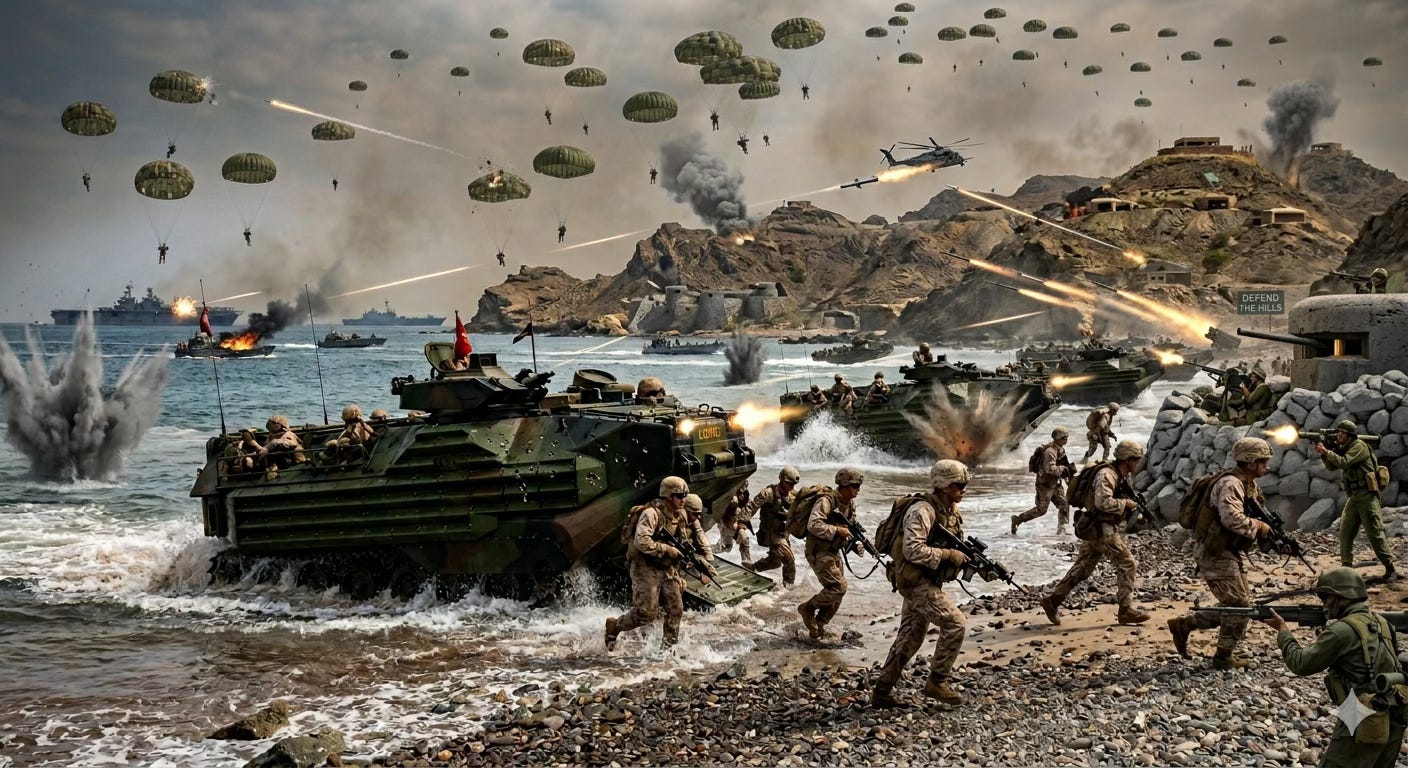
Retired four-star Gen. Jack Keane — Fox News senior strategic analyst and close to the administration — laid out the emerging concept on March 25: simultaneous seizure of Kharg Island by the 82nd Airborne and Marine seizure of the Hormuz Strait islands of Abu Musa, Greater Tunb, and Lesser Tunb (islands Iran seized in 1971 that the UAE still claims). The objective, as Keane stated it: forcibly open and keep open the Strait of Hormuz. Kharg is Iran’s main offshore export terminal and a critical vulnerability in its oil economy, handling the overwhelming majority of crude shipments in recent years.[7-8] Keane described Kharg as “checkmate” — fifty percent of Iran’s budget, sixty percent of revenue, eighty to ninety percent of oil distribution. He stressed timing remains in American hands: “at a time of our choosing.”
Trump told reporters he is “not afraid” to send troops into Iran. Secretary of State Rubio told Congress the United States may need to physically secure nuclear material inside Iran: “People are going to have to go and get it.”NSD assesses: the simultaneous island operation will work. The 82nd Airborne takes Kharg by air assault, bypassing the maritime mine gauntlet. Marines seize the Hormuz Strait islands, suppressing the coastal threat at its source.[9]That is not the problem.The problem is the question that should have been asked before February 28 and must be asked before the first paratrooper lands on Kharg: what then?
(U) SECTION I — THE NSD POSITION
NSD is an Iran hawk publication. In January 2024 — thirteen months before the first bomb fell — NSD published a war plan for Iran through the Military Innovation Lab, targeting Iran’s conventional maritime threat capabilities. It was a limited, proportionate strike designed to degrade the fast-attack craft, coastal missile batteries, and mine-laying assets that constituted the IRGC’s anti-access capability in the Strait of Hormuz. No leadership decapitation. No nine hundred strikes in twelve hours. No existential threat to the regime that would trigger the maximum response. NSD is not defeatist. NSD is against mission creep into forever wars, and against starting wars that should have been limited strike operations.

When Operation Epic Fury began on February 28, NSD assessed on Day 1 that the target sets were correct — the United States was going after exactly what NSD had outlined. But the scale was categorically different. Trump did not execute a limited maritime strike. He executed the Venezuela template applied to a 2,500-year-old strategic culture: change the top of the regime while leaving much of the state apparatus intact.[10] What worked in Caracas against a hollowed-out petrostate with no military tradition was applied to Persia — a civilization that has been at war since Thucydides and before.
NSD has never framed this as a US defeat. Iran HAS suffered catastrophic military degradation. Navy destroyed. Air defenses crippled. Missile stock decimated. Production base wrecked. Supreme leader killed. Ten thousand targets struck, two-thirds of production capacity destroyed, ninety-two percent of major naval vessels sunk. Iran has not shot down a single manned US or Israeli aircraft or sunk a single ship. That is a remarkable military outcome by any historical measure.
What NSD has framed — consistently, from Day 1 — is that the administration is lying about the operational picture, that the time horizon asymmetry between Trump’s political clock and the IRGC’s delay strategy structurally favors Iran, and that boots on the ground is an invitation to the quagmire this administration claimed it would never enter. NSD has warned about mission creep since the first SITREP. This piece explains why that warning is about to be vindicated.
(U) SECTION II — THE OPERATION THAT SHOULD HAVE
After the United States killed Qasem Soleimani in January 2020, Iran launched ballistic missiles at Al Asad Air Base and other targets in Iraq, provided advance warning through intermediaries, and initially produced zero US fatalities.[11] A targeted strike produced a contained response. Proportional escalation. Manageable consequences.[12]
NSD’s plan was designed on that precedent. Degrade the maritime threat. Demonstrate capability and willingness. Allow the IRGC to calibrate a proportional response that would not spiral. Iran would not have closed Hormuz in response to losing fast boats and coastal launchers — because closing Hormuz in response to a limited maritime strike would have been disproportionate to the provocation and would have united the world against Tehran rather than against Washington.
Instead, Trump killed the Supreme Leader and launched nine hundred strikes in twelve hours. The IRGC’s response was proportional — to the scale of the provocation it received. Hormuz closed. Fifteen hundred ballistic missiles launched. Three thousand five hundred drones. Strikes across fourteen countries. Twenty thousand seafarers stranded. Eleven million barrels per day removed from global markets. The Philippines declared a national energy emergency. QatarEnergy declared force majeure on LNG contracts. Brent crude above one hundred dollars. Fertilizer shortages hitting American farmers. Recession warnings from Wall Street.
None of this needed to happen. Every bit of it is a consequence of a strategic choice — not the only choice available, but the choice Trump made. And the question that was not asked before February 28 — what happens when Iran responds at scale? — is the same question that is not being asked now.
(U) SECTION III — WHAT THE CRITICS GET WRONG
Some pro-war commentators are right that the Western analytical class has been too quick to frame this as American defeat. It is not defeat. Iran’s military degradation is real and severe. They are right that Gulf states have been more resilient than expected, that interceptor stocks have not run out, and that the lazy application of Kissinger’s guerrilla formula — “the guerrilla wins if he does not lose” — has been universalized to the point where any Western military action is pre-declared a failure.
But this argument has a hole in it large enough to drive the 82nd Airborne through.
They define success as severely degrading Iran’s capabilities and reopening the Strait of Hormuz. Fine. But at what human cost — and for how long? If the IRGC survives, the threat regenerates. You are on a permanent treadmill. And the operation that is supposed to produce “success” created the very problem the success is defined by solving. There was no Hormuz problem before February 28. That is not defeatism. That is a fact.
The Kissinger point cuts both ways. Follow the logic to its conclusion: if anything short of total regime destruction is unfinished business, then the United States needs to stay until the job is done. The United States is still in Korea. Still in Germany. Still in Japan. Seventy years later.[6] Is that the model for Iran — a permanent garrison in a country with a resistance ideology hardened by forty-seven years of revolution? The pro-war commentariat will not follow its own argument there because it knows where it leads.
And they completely ignore the nuclear narrative incoherence. Weeks ago the administration claimed “complete and total destruction” of Iran’s nuclear capabilities. Now Rubio tells Congress “people are going to have to go and get it.” Both cannot be true. If the program was destroyed, there is nothing to get. If there is something to get, it was not destroyed. NSD identified this on Day 1: “They can’t get their stories straight.” Twenty-seven days later, they still can’t.
(U) SECTION IV — THE SIMULTANEOUS ASSAULT — HONEST ASSESSMENT
The Keane concept is operationally the strongest island-seizure option on the table:
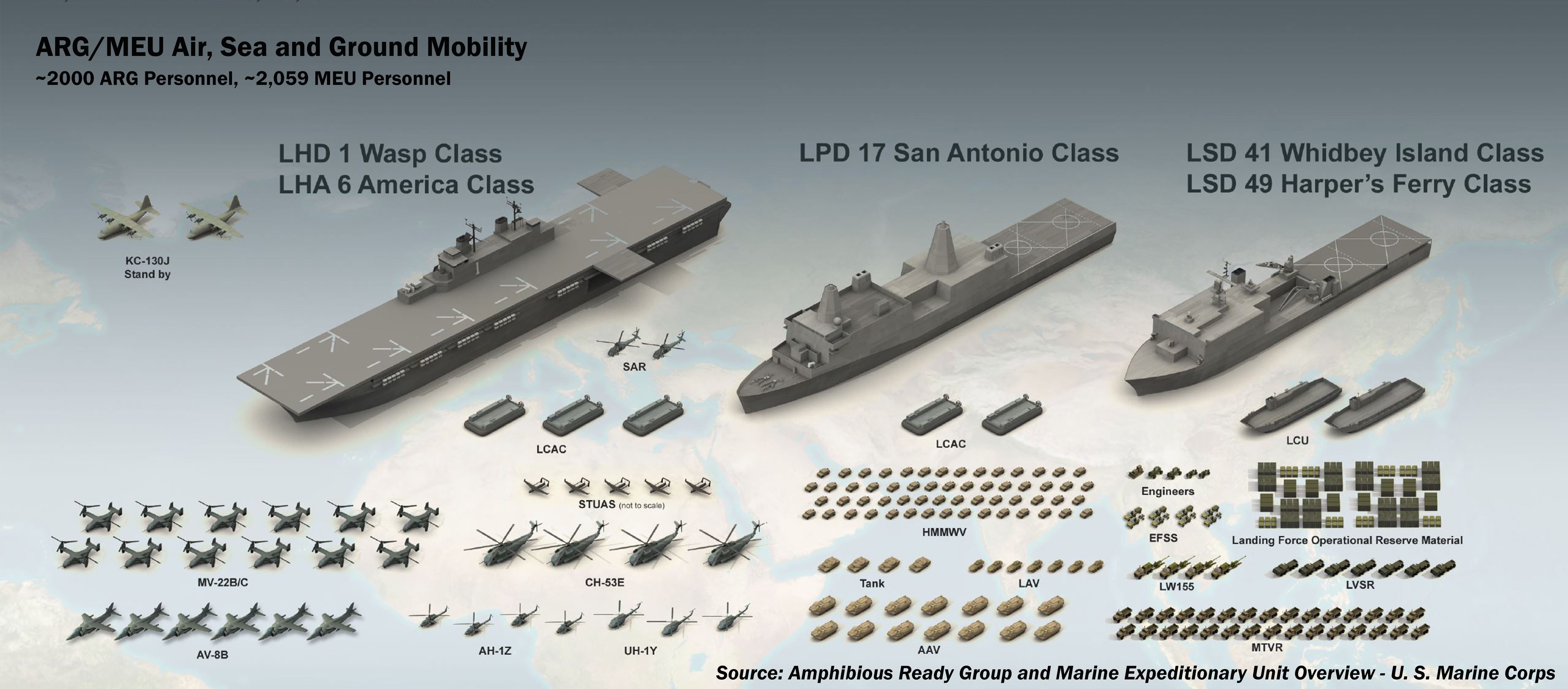
The 82nd Airborne seizes Kharg Island by air assault — parachute drop or MV-22 air landing on the 1.8-kilometer runway — bypassing the mine gauntlet that makes an amphibious approach through the northern Gulf suicidal. Marines from the 31st and 11th MEUs seize Abu Musa, Greater Tunb, and Lesser Tunb at the mouth of the Strait, suppressing the coastal threats that have kept Hormuz closed.[9] The operations run simultaneously, imposing decision-making stress on a fragmented Iranian command that has been operating without confirmed supreme authority for twenty-seven days.
It will work. NSD assesses this with reasonable confidence. Above the waterline, with air superiority established and Aegis destroyers providing integrated air and missile defense against Iran’s attrited launch capability, the US prevails in both seizures. The IRGC is not invincible. They are masters of information warfare, but their actual combat performance has been significantly degraded over four weeks of sustained targeting.
The caveat matters: this assessment holds against Iran’s current degraded launch rate, not against a sudden concentrated salvo of conserved inventory. If Iran has been rationing rather than depleting — which remains the campaign’s most consequential OSINT unknown — a salvo timed to the moment of maximum American exposure on both islands could overwhelm defensive capacity. The gap between “degraded but not out” and “unable to mass fires” is the gap the entire operation turns on.
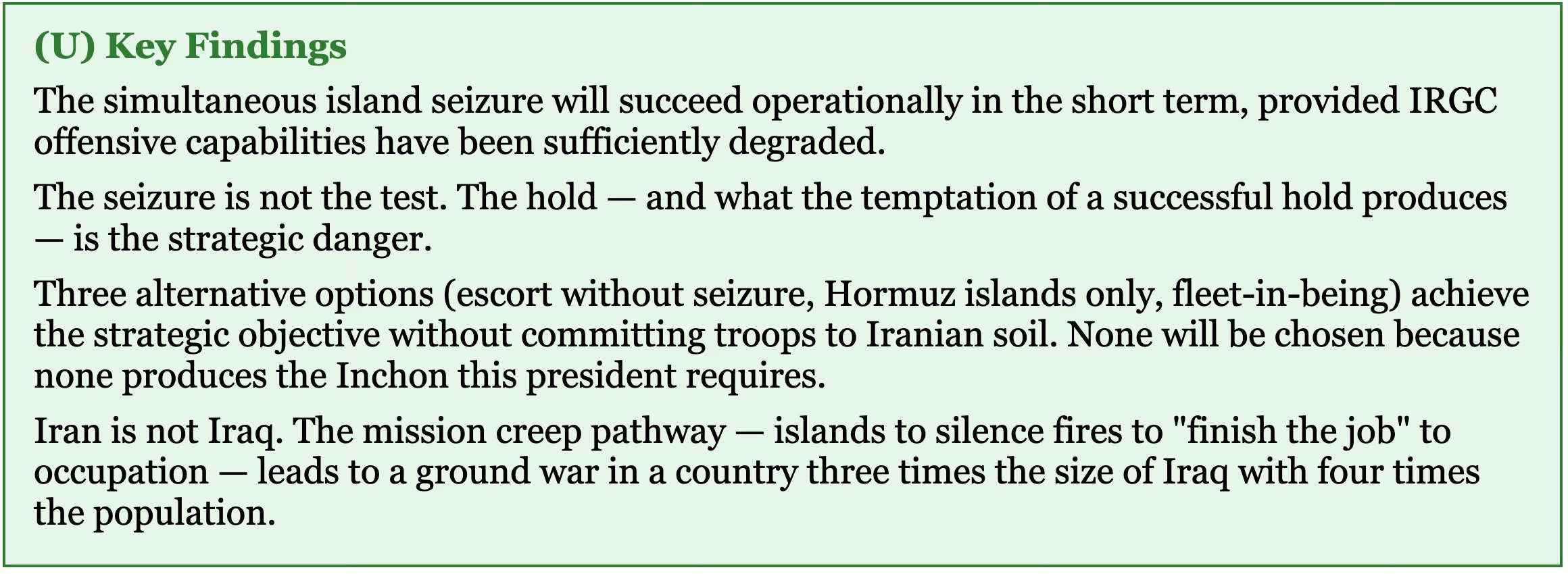
But the seizure is not the test. What follows is.
(U) SECTION V — WHAT THE BLANK PAGE SHOWS
The strategic objective is singular: reopen the Strait of Hormuz to commercial shipping. Everything else — Kharg, oil leverage, regime pressure — is secondary or derivative. If the military operation is designed around that objective alone, rather than around a president’s desire for a dramatic stroke, different options emerge. Three exist that directly serve the stated objective without committing US troops to Iranian soil. The fact that the Keane plan is the frontrunner tells you something about the decision-making environment — it is the most dramatic option, not necessarily the most effective one.

Escort without seizure. Use the converging force — DDGs with SPY radar, carrier air wings, Marine aviation, land-based air from Gulf states — as the most powerful naval and air escort capability in history. Establish a cleared channel through the Strait with mine countermeasure assets working under combat air cover and begin escorted convoy operations.[19] Tankers transit in protected groups. Iran can try to interdict but it attacks into the teeth of Aegis defensive capability and continuous air superiority. No troops on Iranian territory. No static island targets for Iran to attrit. No body bags on Iranian soil. No seven percent boots-on-the-ground problem. No desalination trigger — because nothing has been seized, only passage through an international waterway has been forced, which is legally unimpeachable under UNCLOS.[20] Ships at sea maneuver; troops on an eight-square-mile island do not.
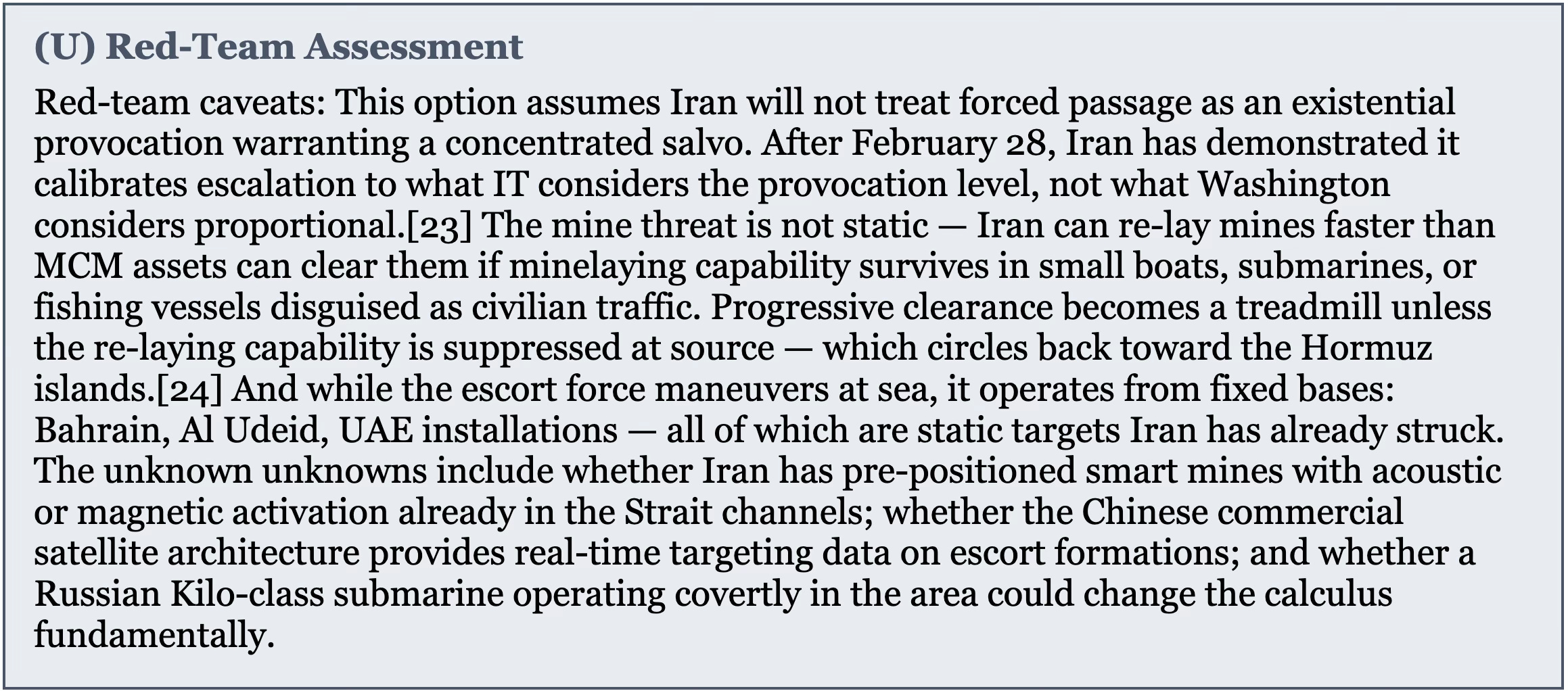
Hormuz islands only — skip Kharg. Seize Abu Musa, Greater Tunb, and Lesser Tunb. Skip Kharg entirely. The Hormuz islands address the actual problem — they suppress the coastal threats keeping the Strait closed. The UAE sovereignty claim provides legal framing.[9] The islands are closer to allied logistics in the UAE and Oman. The operational payoff is direct and immediate: cleared approaches for convoy escort. The Kharg leverage theory — seize Iran’s oil revenue to force a deal — is strategically seductive but operationally a trap. Thousands of American troops are placed on an island fifteen miles off the Iranian mainland, deep inside the weapons engagement zone, and must be defended indefinitely while Iran has every incentive to bleed the force through attrition. The leverage runs in both directions: the US holds Iran’s oil terminal, but Iran holds American troops hostage to the body-bag dynamic. Hormuz-only achieves the strategic objective without the northern Gulf exposure — less dramatic, more defensible, more sustainable.
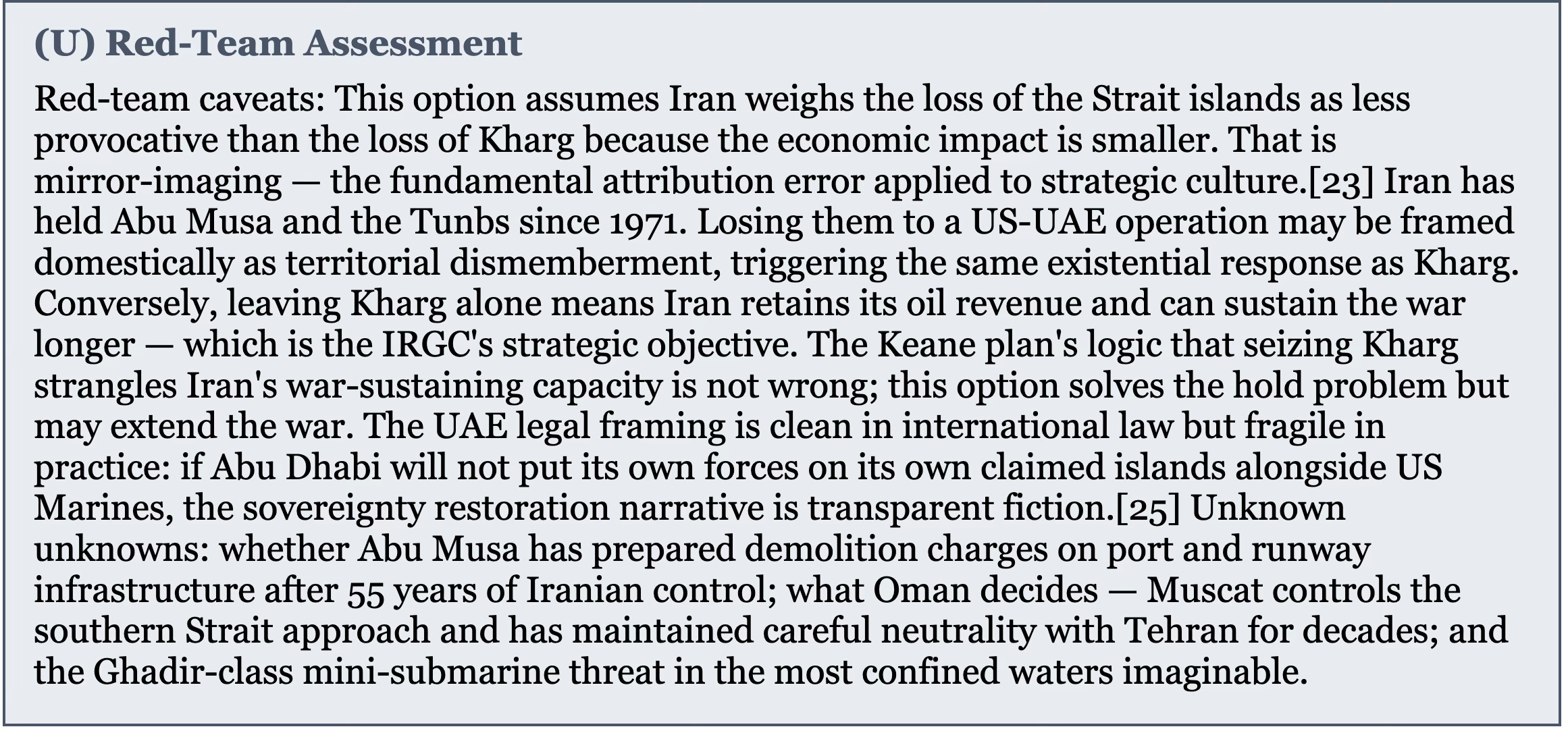
Fleet-in-being. The most unconventional option and possibly the smartest — but not without its own failure modes. The 82nd and the MEUs are not committed to island seizure. They are positioned visibly — everyone knows they are there, everyone knows what they are for — and escort operations begin under their umbrella.[21] The threat of seizure becomes the leverage, not the seizure itself. Iran must choose: let the escorts through and lose the Hormuz chokehold gradually, or attack the escorts and trigger the very seizure the IRGC is trying to prevent. This is a fleet-in-being concept applied to ground forces — a doctrinal principle in which an uncommitted force exerts strategic influence precisely because the adversary must plan against its potential employment.[22]
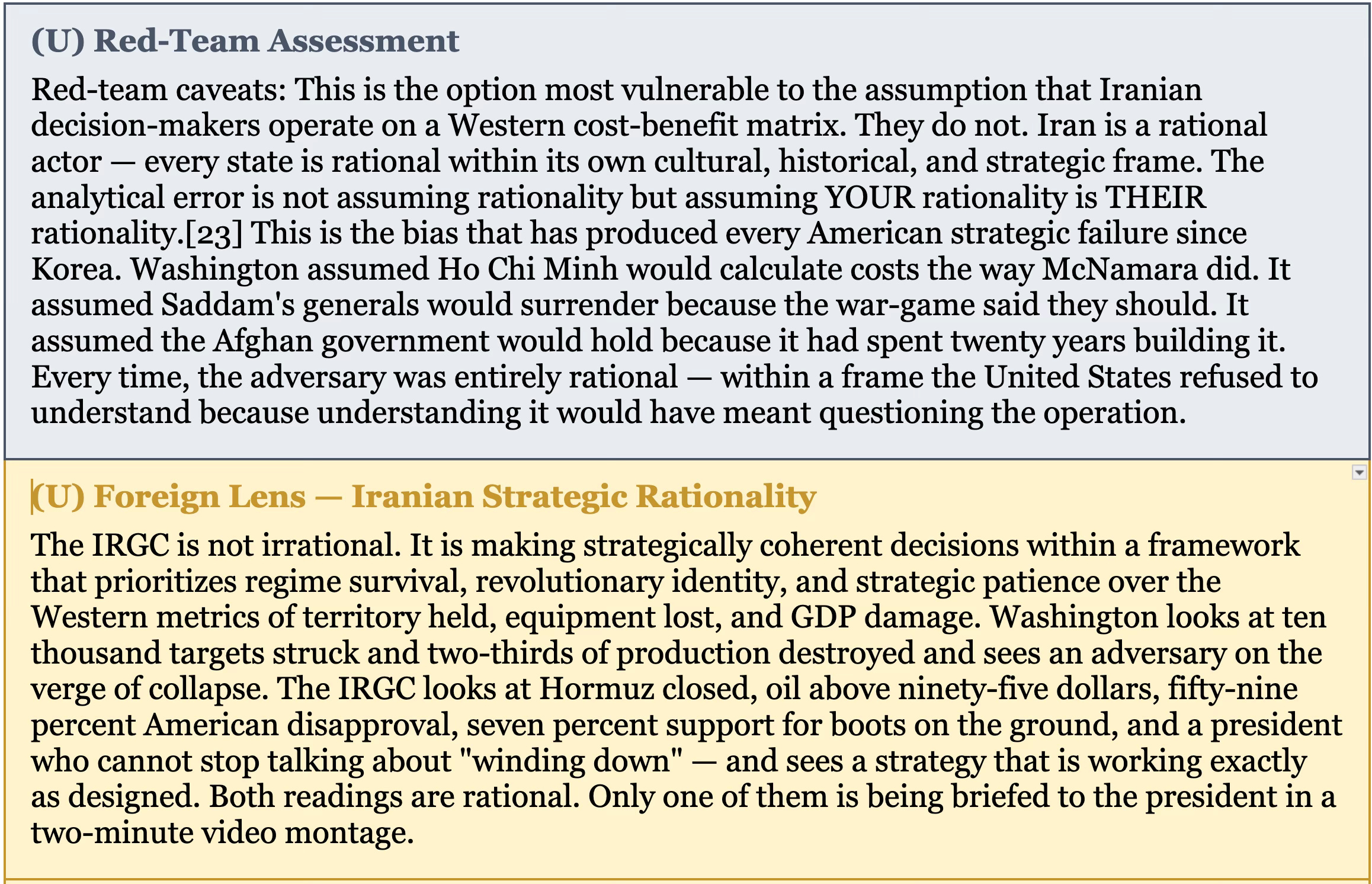
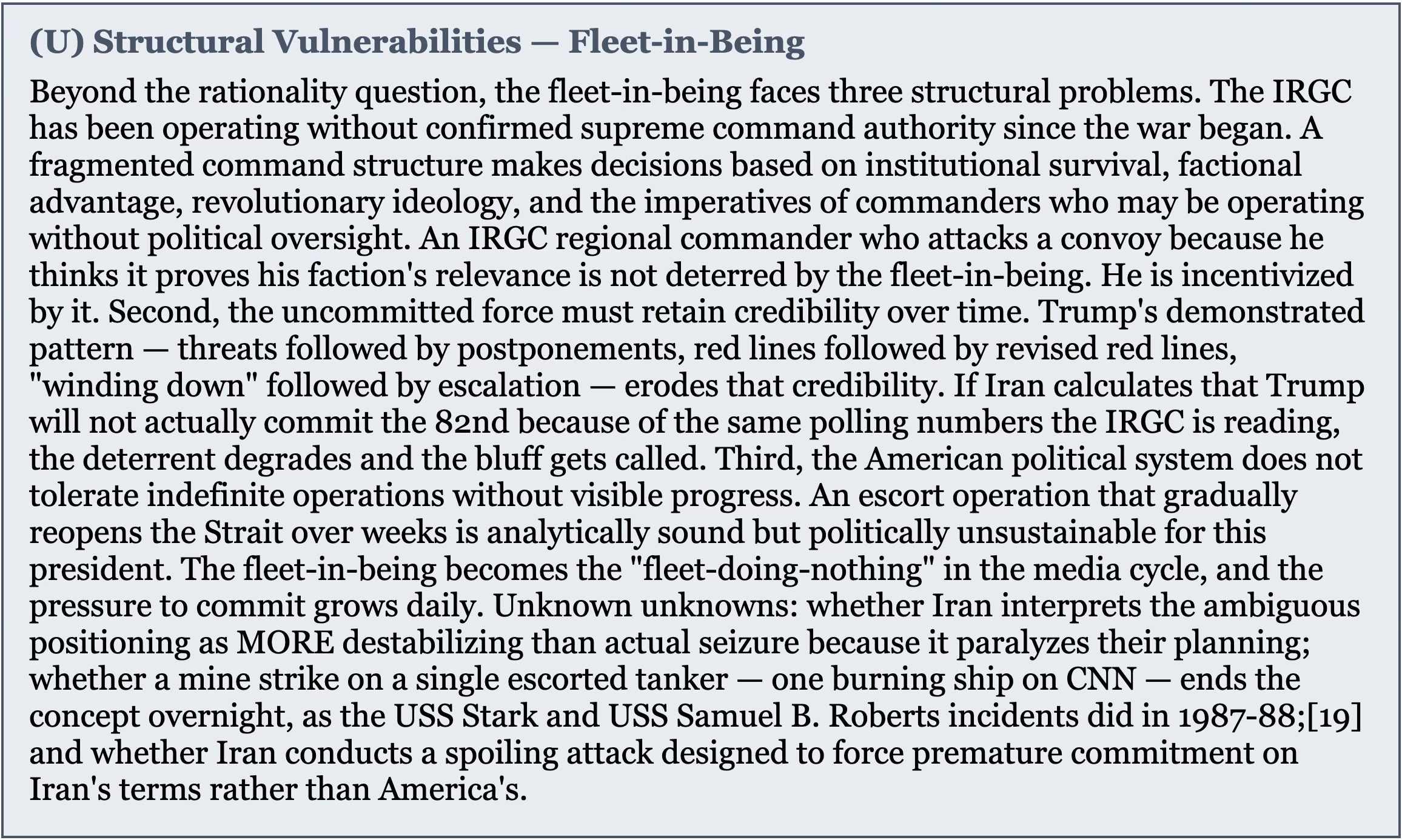
The question none of these options answers: where are the GCC militaries? Saudi Arabia spends seventy-five billion dollars annually on defense — the fifth-largest military budget on earth.[25] The UAE fields French-built Leclerc tanks, F-16 Block 60s, and arguably the most capable special operations force in the Arab world. These states pushed for this war. They are the primary beneficiaries of Hormuz reopening. And they are sitting on the sideline while American paratroopers prepare to land on Kharg. The Sunni-Shia dimension is real — Saudi and Emirati forces fighting on Iranian soil would trigger a sectarian framing that both Riyadh and Abu Dhabi desperately want to avoid. But mine countermeasures, convoy escorts, logistics sustainment, and basing support do not require Sunni boots on Shia soil — and the GCC is uniquely positioned to provide them.
The fact that the world’s fifth-largest military spender is allowing a country on the other side of the planet to do its fighting — in a conflict that threatens Gulf water supplies, oil revenue, and population centers — is a strategic absurdity that deserves more scrutiny than it is receiving.[25]
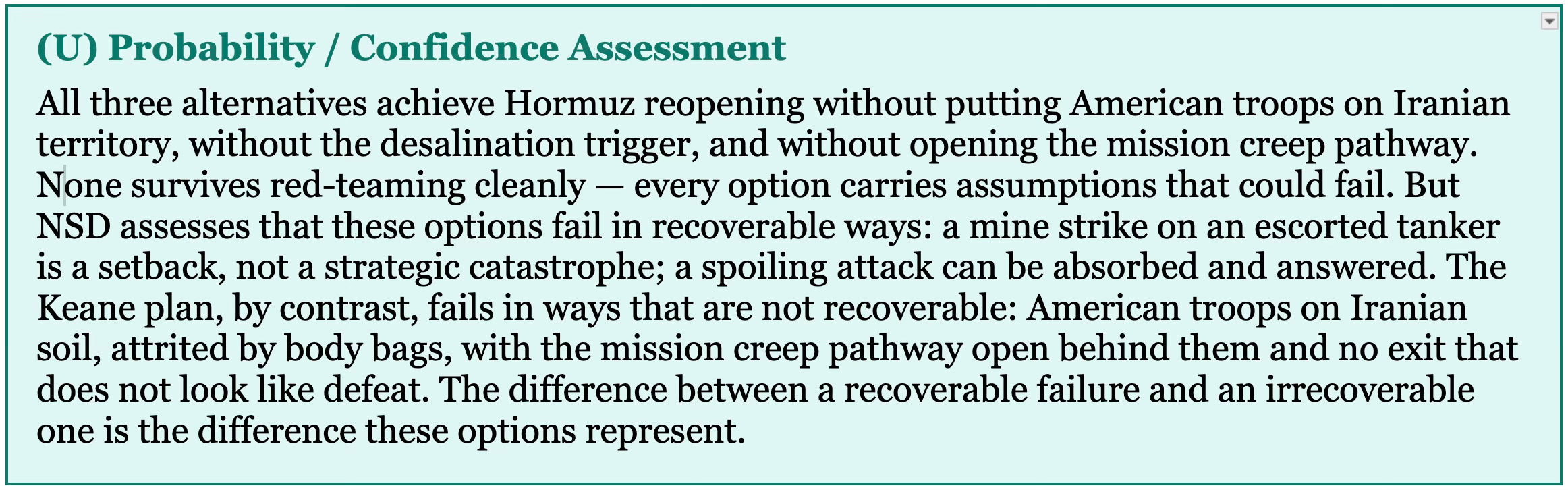
None of them will be chosen — because none of them produces an Inchon. None produces the flag-raising footage or the dramatic master stroke this president requires. And a president who told The Guardian in 1988 about “doing a number on Kharg Island” is not going to leave the 82nd Airborne sitting on ships when he can put them on the island he has been thinking about for thirty-eight years.
The gap between the militarily optimal option and the politically preferred option is where wars go wrong. It is where Inchon becomes the Yalu.

(U) SECTION VI — PHASE BY PHASE — WHERE COMMON SENSE DEMANDS HONESTY
Phase 1 — The Seizure. This works. The 82nd takes Kharg. The Marines take the Strait islands. American forces are on Iranian territory. Hormuz begins reopening. Trump gets his Inchon. The two-minute video montage briefing shows paratroopers on Kharg and Marines raising the flag on Abu Musa. It is a dramatic, telegenic, decisive military stroke. In the short term, this is a genuine operational success.
Phase 2 — The Hold. This is where the assessment pivots. Can the force on Kharg be well defended — by DDGs offshore, continuous air cover hunting launchers opposite the island, combat air patrols suppressing the drone threat? If IRGC fires are sufficiently degraded, the answer is yes, and the hold succeeds. Kharg becomes an American-controlled economic chokepoint that strangles Iran’s remaining revenue.
But if Iran retains enough concentrated firepower to sustain fires against an eight-square-mile island full of American paratroopers, the dynamic inverts. Iran does not need to retake Kharg. It needs to produce casualties. Images. Body bags. For a president with fifty-nine percent disapproval and only seven percent public support for boots on the ground, even modest casualties on Iranian soil become politically explosive. Iran’s strategic objective on Kharg is not military. It is to make holding the island politically unbearable. Whether they retain the capability to achieve that is the question that determines everything.
The Hormuz Strait islands present a different holding problem. They are smaller, closer to allied support in the UAE and Oman, and further from Bandar Abbas than Kharg.[9] But maritime resupply through the Strait requires the very clearance the operation is supposed to achieve. And the sub-surface threat — an estimated five to six thousand Iranian mines — is the vulnerability that air power cannot solve. Above the waterline, the US wins. Below it, the problem persists regardless of which islands are held.
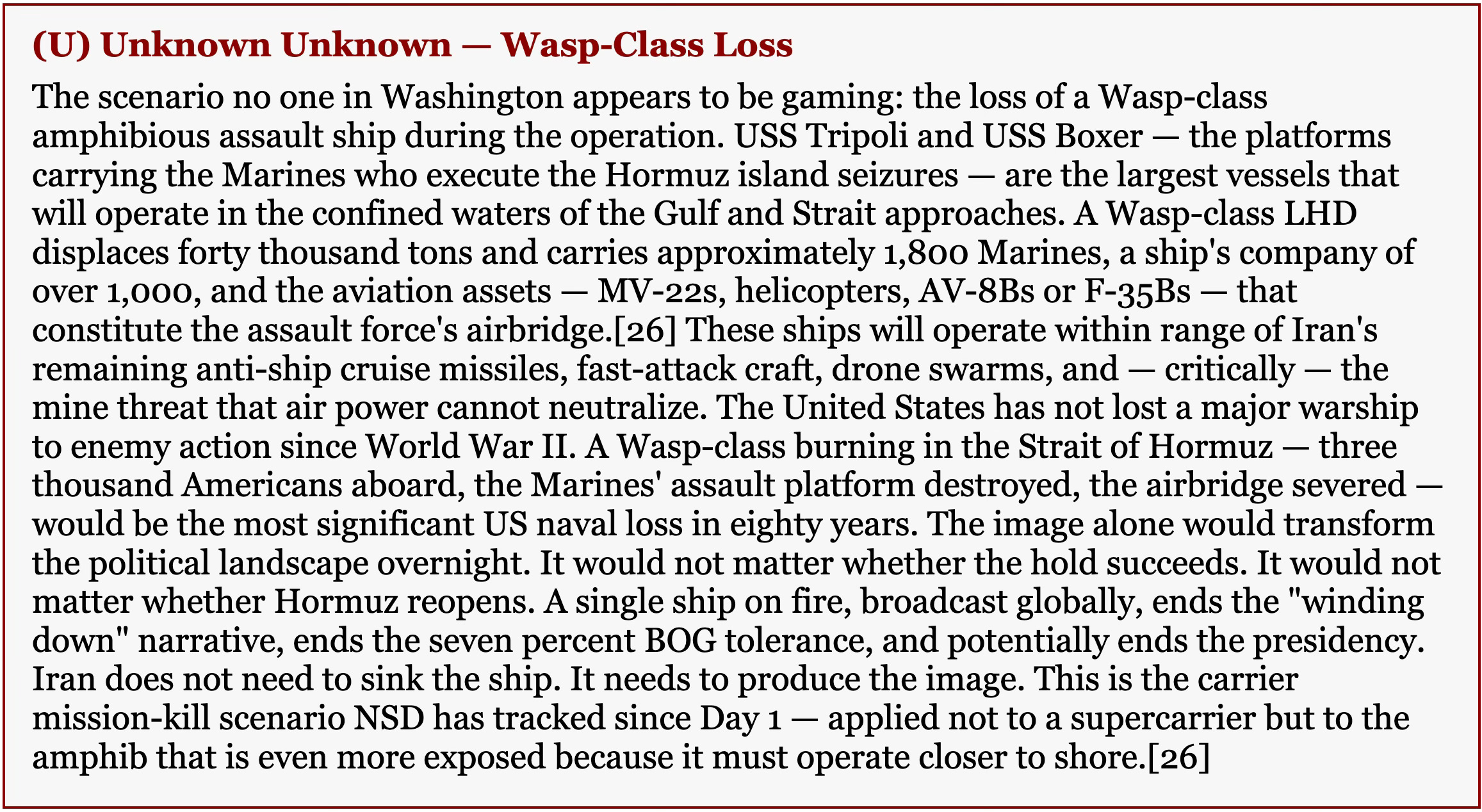
Keane’s stated objective is to keep the Strait open “as long as it takes.” That phrase is the unsolved variable. Short-term seizure is achievable. Medium-term sustainment is the unknown. Long-term is where it either succeeds as a new status quo — or becomes Khe Sanh on the water.
Phase 3 — The Temptation. This is where success becomes more dangerous than failure.
The islands are secured. Hormuz is reopening. The missile and drone threat is mostly silenced. But the IRGC is still in charge in Tehran. And now the voices that drove this war from the beginning — Graham, Netanyahu, Mohammed bin Salman, the Gulf states — say what they have been saying privately since February 28: finish the job. The regime is hated. The people will welcome liberation. You have broken their military spine. Go to Tehran.
This is the mission creep pathway. It is not hypothetical. It is the stated objective of the campaign’s most influential advocates. Graham is already invoking Iwo Jima. The administration’s own objectives include ensuring Iran “can never obtain a nuclear weapon” — an objective that cannot be permanently achieved without regime change or permanent occupation. Rubio’s “people are going to have to go and get it” is the language of the next escalation, not this one.
The pressure to go to Tehran after a successful island seizure will be enormous. Every regional ally will push for it. Every hawk in Congress will demand it. Every day the IRGC survives in power after losing Kharg and the Strait islands will be framed as unfinished business.
Phase 4 — Iran Is Not Iraq.
If they go, here is what they find.
Iran is 1.6 million square kilometers of mountain and desert. Three times the size of Iraq. The Zagros Mountains make the Sunni Triangle look like a parking lot. The population is ninety million — nearly four times Iraq’s twenty-five million in 2003. The IRGC is not a conventional military that surrenders when its barracks are bombed. It is a parallel state with its own economy, its own intelligence service, its own propaganda apparatus, and a resistance ideology hardened by forty-seven years of revolutionary identity. It will melt into the population with its weapons, its networks, and its cells. It will launch the insurgency it has been training for since 1979.[13]
And the choice of what comes next — who governs, what system replaces the Islamic Republic — will not be the Iranian people’s choice. It will be Trump’s choice. He will install his preference, as he did in Venezuela. Liberators will become occupiers. The occupation that was supposed to take months will take years. And the administration that could not end a four-week air campaign will find itself running a ground war in a country that has outlasted or absorbed every foreign power that has tried to hold it since Alexander the Great.[13]
Thucydides understood that the most dangerous moment for a great power is not when it fails, but when it succeeds and does not know when to stop.[14]
(U) SECTION VII — THE DESALINATION RED LINE
Before the mission creep pathway even opens, any island seizure risks crossing the conflict’s most extreme non-nuclear escalation threshold: systematic Iranian attacks on Gulf desalination infrastructure.
This threshold has already been breached in both directions. On March 7, Iran accused the United States of striking a freshwater desalination plant on Qeshm Island in the Strait of Hormuz, disrupting water supplies to thirty villages. On March 8, Bahrain accused Iran of retaliatory drone strikes on one of its desalination plants. Kuwait’s Doha West facility and the UAE’s Fujairah F1 power and water complex both sustained collateral damage. Parliamentary Speaker Qalibaf warned explicitly that “critical infrastructure, energy, and oil across the region will be irreversibly destroyed” if Iran’s power grid is attacked. UN water expert Kaveh Madani warned that desalination plants “across the region could be hit within the next few days.”[15]
Desalination plants in the six GCC countries have a combined seawater-desalination capacity of about 67 million cubic meters per day, roughly 45 percent of the global seawater-desalination total and close to 40 percent of the world’s actual desalinated water production.[16] Israel sits outside the GCC but is in the same structural category: seawater desalination now provides around 80 percent of Israel’s potable water, with five major Mediterranean plants supplying roughly 600 million cubic meters per year.[17] For Gulf states, desalination already fulfills well over half of total water demand in Qatar and Bahrain and significant shares in the UAE and Kuwait, while even Saudi Arabia — less dependent in percentage terms — produces more desalinated water than any other single country.[16] Iran, by contrast, derives an estimated 95 percent or more of its water use from surface reservoirs and increasingly overdrawn groundwater — largely for agriculture — with desalination providing on the order of 1–3 percent of national supply despite rapid GCC and Israeli build-out on the opposite shore.[18] Many regional analysts argue these plants are effectively a mutual red line whose shared vulnerability creates a measure of self-deterrence, but that logic weakens rapidly once a belligerent believes it has already lost its core economic lifeline.[16]
A deliberate campaign against Gulf desalination infrastructure would be, short of a nuclear weapon, the most extreme escalation available to Iran. And it is the logical response to an operation that seizes ninety percent of Iran’s oil export revenue and the coastal terrain that controls the Strait.[7-8] The question is not whether the US can take the islands. It is whether anyone in the administration has gamed what Iran does the morning after when it has nothing left to lose.
(U) SECTION VIII — THE QUESTION THAT SHOULD HAVE BEEN ASKED TWICE
Before February 28: what happens when Iran closes Hormuz? The answer was the most rehearsed scenario in geopolitics. It was predictable. It was predicted. NSD predicted it. And the administration either accepted it as a trade-off — which means they started a war knowing it would produce a global energy crisis — or failed to anticipate it, which is worse.
Before the first paratrooper lands on Kharg: what happens when the islands are secured and the IRGC is still in charge? If the answer is “we’ll figure it out when we get there,” that is exactly how Iraq started. If the answer is “we go to Tehran,” that is exactly how Iraq ended — except Iran is a categorically harder problem in every dimension.[13]
NSD proposed a plan in January 2024 that would have achieved the core military objective — degrading Iran’s maritime threat capability — without triggering the Hormuz closure, the energy crisis, the global economic disruption, or the twenty-seven-day war that has killed over three thousand Iranians including two hundred and fourteen children and thirteen Americans. What happened instead was the geopolitical equivalent of using a sledgehammer to kill a wasp and being surprised when the house caught fire. The next escalation — the simultaneous island assault — is a better-designed hammer. It will hit the nail. But the house is still on fire, and no one appears to be asking whether seizing the islands puts the fire out or spreads it to the neighbors.
(U) CONCLUSION
If you do not understand the war you start, and if you tell yourself lies about how it is going, you are sure to lose.
That is not defeatism. That is realistic geostrategic common sense. It is the lesson of Vietnam, Iraq, Afghanistan, and every war in which a great power confused tactical success with strategic victory and operational momentum with political wisdom.
The simultaneous island assault will succeed. NSD assesses this with reasonable confidence. Trump may get his Inchon. But MacArthur got his too — and could not stop there. Seventy-five years later, American troops are still in Korea.[6] The trap is not the operation. The trap is what success makes you believe you can do next.
*When analysts can see a foreseeable loss of options — a closing decision window, a deteriorating alliance, a looming escalation ladder — they incur a duty to be useful to the people who can still act.* — NSD Doctrine: Institutional Requirements for Anticipatory Intelligence
*The National Security Desk outlined a limited strike plan for Iran’s maritime threat capabilities in January 2024. NSD is against mission creep into forever wars and against starting wars that should have been limited strike operations. The full NSD analytical archive is available at substack.com/@milab.*
*Standing references:* *”How to Stop Iran” — NSD/MILab, January 2024. milab.substack.com/p/how-to-stop-iran* *”The ‘Leaked’ Document: Tehran’s War Plan for Regime Change in Washington” — NSD/MILab, 11 March 2026. milab.substack.com/p/leaked-document-tehrans-war-plan* *”A Hybrid World War” — NSD/MILab, 23 October 2023. milab.substack.com*
The National Security Desk offers these posts freely, but your support is necessary and appreciated. Please subscribe, paid if you’re able, or leave a tip.
Thank you

(U) REFERENCES
[1] The Korean War began in June 1950, and by August–September UN forces were confined to a defensive Pusan Perimeter in the southeast under sustained North Korean attack.
[2] The Inchon landing in September 1950 was an amphibious assault ordered by General Douglas MacArthur behind North Korean lines to relieve the Pusan Perimeter and recapture Seoul.
[3] Inchon’s tidal range, narrow channel, and sea walls made it one of the most hazardous major amphibious operations of the war, leading many planners to doubt its feasibility.
[4] The success of the Inchon operation enabled UN forces to break out of Pusan, retake Seoul, and reverse early North Korean gains within weeks.
[5] After Inchon, UN forces advanced toward the Yalu River, prompting large-scale Chinese intervention by late November 1950 and turning the conflict into a protracted, high-casualty war.
[6] The Korean War ended in an armistice signed in 1953, not a formal peace treaty, and US forces remain stationed in South Korea under long-term security arrangements.
[7] Kharg Island, about 30 km off Iran’s coast in the northern Gulf, is Iran’s main oil export hub, handling roughly 90 percent of its crude exports in recent years.
[8] Analysts describe Kharg as a critical vulnerability in Iran’s oil economy because major onshore pipelines converge there before crude is loaded onto tankers.
[9] Abu Musa, Greater Tunb, and Lesser Tunb sit near the Strait of Hormuz’s main shipping lanes and have long been disputed islands central to Gulf maritime security politics. The UAE claims sovereignty over all three, seized by Iran in 1971.
[10] Public reporting and think-tank analysis describe US pressure campaigns in Venezuela as focused on regime change by delegitimizing the incumbent leadership while leaving most state institutions formally intact.
[11] After the US killed IRGC-Quds Force commander Qasem Soleimani in January 2020, Iran launched ballistic missiles at US forces at Iraq’s Al Asad and Erbil bases, reportedly providing advance warning that helped prevent US fatalities in the initial strikes.
[12] That episode is widely interpreted as an example of calibrated, proportional retaliation in which both sides signaled capability while avoiding immediate escalation into wider war.
[13] Contemporary strategic literature on Iran stresses the country’s vast size, mountainous terrain, and revolutionary security institutions as major obstacles to foreign occupation or imposed regime change compared to Iraq in 2003. Iran has outlasted or absorbed foreign interventions from the Mongols through the Anglo-Soviet invasion of 1941 to the US-backed Shah regime.
[14] Strategic commentary often invokes Thucydides to illustrate how great powers can turn tactical success into strategic overreach by failing to recognize when to stop, a theme applied in modern analyses of US interventions.
[15] Regional reporting and UN-linked expert commentary in March 2026 highlight emerging tit-for-tat strikes and threats involving desalination plants on both sides of the Gulf.
[16] Studies of Gulf water security estimate that GCC states account for roughly 40 percent of the world’s desalinated water production and around 45 percent of global seawater-desalination capacity, with Qatar, Bahrain, the UAE, Kuwait, and Saudi Arabia all heavily reliant on desalination for municipal supply.
[17] Israeli water-policy analyses indicate that seawater desalination now provides around 80 percent of Israel’s potable water, with several large Mediterranean plants delivering on the order of 600 million cubic meters annually.
[18] Environmental and water-resource assessments describe Iran as relying overwhelmingly on surface reservoirs and overdrawn groundwater — over 90–95 percent of national use — with desalination contributing only 1–3 percent of total supply, predominantly for coastal urban and industrial users.
[19] US Navy escort and convoy operations through contested straits have historical precedent in Operation Earnest Will (1987-88), during which the US Navy escorted reflagged Kuwaiti tankers through the Persian Gulf during the Iran-Iraq War. The USS Stark (1987, hit by Iraqi Exocet missiles, 37 killed) and USS Samuel B. Roberts (1988, struck an Iranian mine) demonstrated how single incidents could reshape the political and operational calculus of an escort campaign. The current force convergence — Aegis destroyers, carrier air wings, Marine aviation — constitutes a significantly more capable escort package than was available in 1987.
[20] The United Nations Convention on the Law of the Sea (UNCLOS) Article 38 establishes the right of transit passage through straits used for international navigation, including the Strait of Hormuz. Forcing passage through an international waterway under military escort to restore transit rights is legally distinct from seizing sovereign territory.
[21] The fleet-in-being concept originated in 17th-century naval doctrine, where an uncommitted naval force compelled an adversary to allocate disproportionate resources to counter the potential threat. Applied to ground forces positioned near but not committed to island seizure, the principle operates identically: the adversary must defend against the possibility of seizure while the uncommitted force preserves all options.
[22] Strategic coercion theory distinguishes between compellence (using force to change an adversary’s behavior) and deterrence (threatening force to prevent behavior). A fleet-in-being posture combines both: the escort operations compel Iran to accept passage while the uncommitted ground force deters Iranian escalation against the escorts. Thomas Schelling’s framework in “Arms and Influence” (1966) describes this as the difference between the commitment that leaves something to chance and the commitment that closes off options.
[23] NSD’s red-team methodology identifies two cognitive biases as particularly dangerous in military planning: the fundamental attribution error (assuming the adversary thinks the way you do) and confirmation bias (weighting evidence that supports the preferred option while discounting evidence that challenges it). The “rational actor” assumption is a specific form of the fundamental attribution error: every state actor is rational within its own cultural, historical, and strategic frame — Iran has been making strategically coherent decisions within a Persian/Shia/revolutionary framework for forty-seven years. The analytical failure is not in assuming rationality but in assuming Western cost-benefit rationality is universal. See NSD/MILab, “What is a RED TEAM?” and “RED TEAM Methodology” — milab.substack.com.
[24] Iran’s mine warfare capability is extensive. The Iranian inventory includes contact mines, influence mines (acoustic and magnetic), and moored mines deployed from a variety of platforms including surface combatants, submarines, fast-attack craft, and civilian vessels. During the 1987-88 Tanker War, Iran used the commercial vessel Iran Ajr to lay mines covertly — a capability that has only expanded in the subsequent four decades. The progressive clearance assumption in the escort option is particularly vulnerable to this re-laying capability.
[25] Saudi Arabia’s defense budget of approximately $75 billion (SIPRI 2025) makes it the fifth-largest military spender globally. The UAE has invested heavily in advanced Western platforms including Leclerc main battle tanks, F-16E/F Block 60 fighters, and special operations capabilities. Both states, along with Qatar and Bahrain, have been identified in multiple reports as having urged Washington toward confrontation with Iran. The absence of significant GCC military contributions to the Hormuz reopening effort — beyond basing and overflight permissions — is noted by regional analysts as a structural asymmetry in the coalition burden. The Sunni-Shia dimension constrains direct GCC combat involvement on Iranian territory, but non-combat contributions (MCM, escort, logistics, sustainment) do not carry the same sectarian risk and remain conspicuously absent from the operational picture.
[26] Wasp-class Landing Helicopter Dock (LHD) vessels displace approximately 40,000 tons fully loaded, carry a Marine Expeditionary Unit of roughly 1,800 Marines plus a ship’s company of over 1,000, and embark a mixed aviation element of MV-22 Ospreys, CH-53 heavy-lift helicopters, AH-1Z attack helicopters, and (on some deployments) F-35B Lightning II short takeoff/vertical landing fighters. USS Tripoli (LHA-7, America-class, slightly larger) and USS Boxer (LHD-4, Wasp-class) are the two amphibious flagships converging on the Gulf as of March 26. The United States has not lost a major warship to enemy action since the sinking of USS Indianapolis in 1945. The confined waters of the northern Gulf and Strait of Hormuz place these vessels within range of anti-ship cruise missiles, fast-attack craft, drone swarms, and — most critically — the mine threat that air power cannot neutralize. The NSD SITREP worst-case scenario tracker has assessed a carrier or amphib mission-kill as LOW-MEDIUM probability and CATASTROPHIC consequence since Day 1 of the campaign.