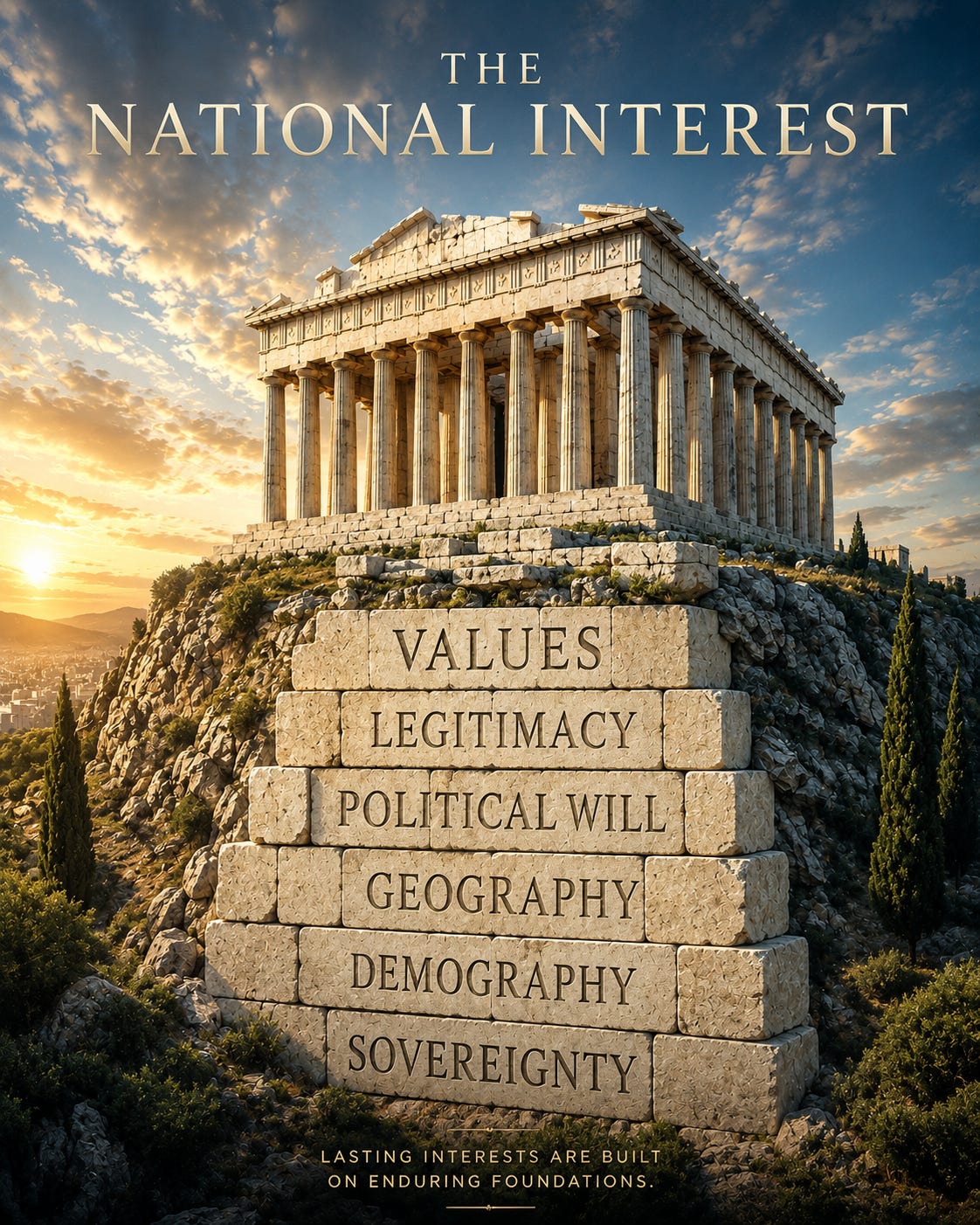
Washington DC 30 MAY 2026

(U) EXECUTIVE SUMMARY
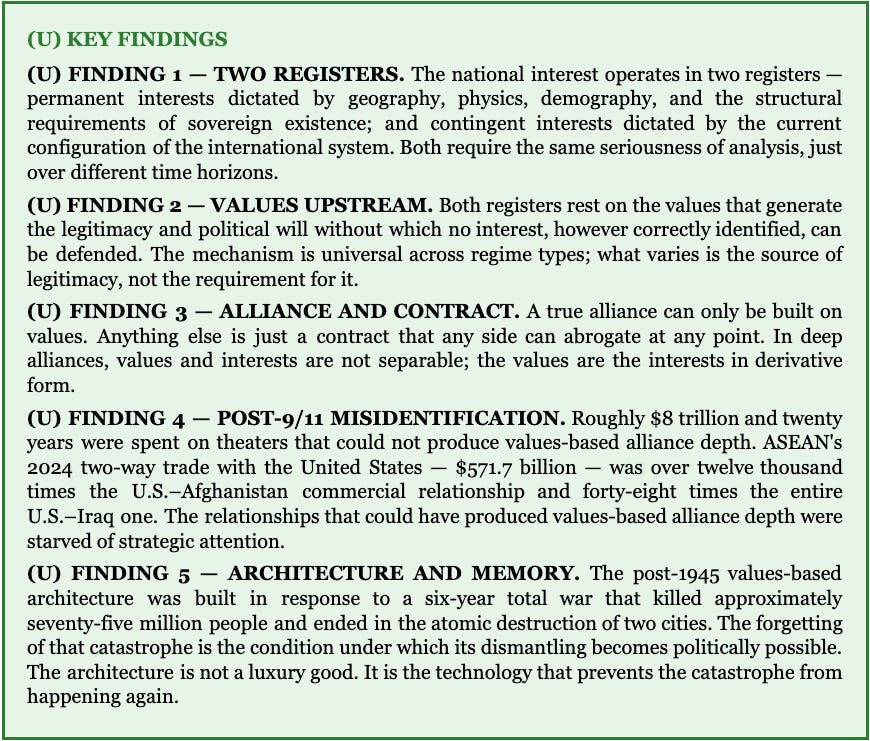
This paper presents a definitional framework for the national interest. It distinguishes permanent interests — dictated by geography, physics, demography, and the structural requirements of sovereign existence — from contingent interests, dictated by the current configuration of the international system. Both rest on the values that generate the legitimacy and the political will without which no interest, however correctly identified, can be defended; the mechanism is universal across regime types. The framework distinguishes alliance from contract: a true alliance can only be built on values, while anything else is a contract any side can abrogate at any point. In deep alliances, values and interests are not separable; the values are the interests in derivative form. The framework identifies three errors of strategic misidentification — promoting the contingent to the permanent, demoting the permanent to the contingent, and confusing tactics for interests altogether — and applies the framework to the post-9/11 misidentification of American interests, in which $8 trillion and twenty years were spent on theaters that could not produce values-based alliance depth while the relationships that could were starved of strategic attention. The paper closes with the historical case for the post-1945 values-based architecture: it was built in response to a civilizational catastrophe of six-year total war ending in atomic destruction, and the forgetting of that catastrophe is the condition under which its dismantling becomes possible.

(U) DEFINITION
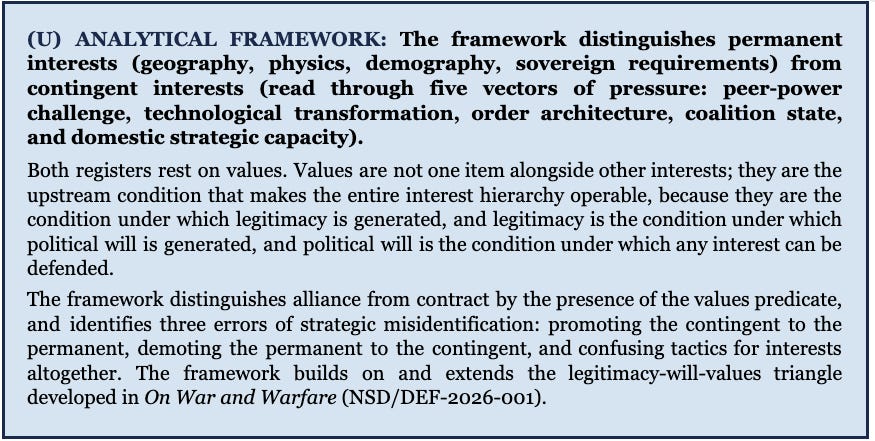
The national interest operates in two registers.
Permanent interests
Permanent interests are dictated by geography, physics, demography, and the structural requirements of sovereign existence. They do not change with administrations, electoral cycles, or fashion. They are upstream of politics.
Contingent interests
Contingent interests are dictated by the current configuration of the international system. They change as the configuration changes — as adversaries rise and fall, technologies transform, orders are built and dismantled, coalitions form and fray, and domestic strategic capacity expands or degrades. They are no less binding than permanent interests; they require the same seriousness of analysis, just over a different time horizon.
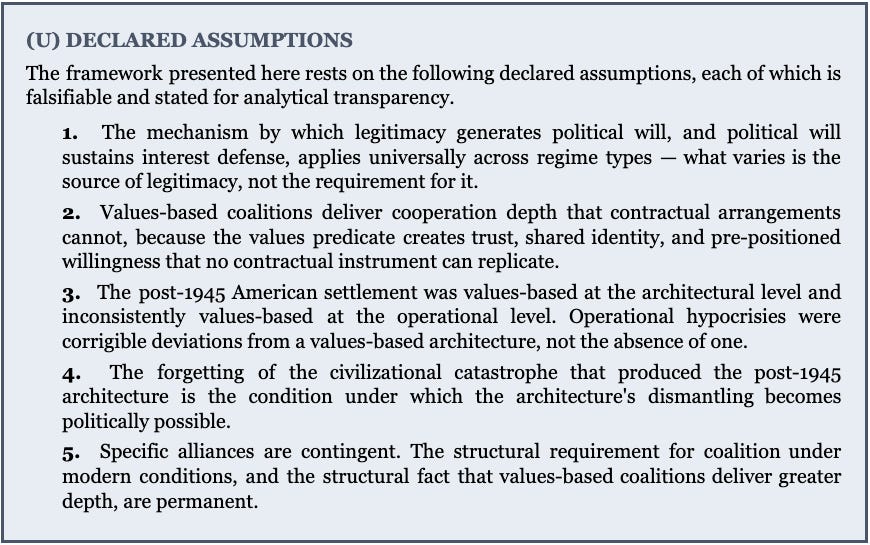
Both registers rest on the values that generate the legitimacy and political will without which no interest, however correctly identified, can be defended. The mechanism is universal across regime types; what varies is the source of legitimacy, not the requirement for it.[1]
Strategy is the active maintenance of a strategic environment in which the polity and the nations that share its values can live successfully, peacefully, and prosperously, by selecting contingent instruments disciplined by permanent interests.
The recurring failure of American strategy since 2001 has been the inversion of this discipline: contingent obsessions promoted to permanent status, permanent interests demoted to negotiable preferences, and tactical objectives mistaken for either.
(U) I. THE PERMANENT TIER
Permanent interests are those dictated by geography, physics, demography, and the structural requirements of sovereign existence. They are permanent because they are upstream of politics. Change the geography, the physics, or the demographic facts and the permanent interests change; until then, they don’t.
The permanent tier for any state includes:
Territorial integrity and defensible borders. A function of geography, not policy.
Secure access to the shared physical commons upon which the state depends. Sea lanes, air corridors, orbital regimes, undersea cable routes, the electromagnetic spectrum. These commons are not sovereign — they are shared by definition. Access to them is dictated by where the state sits on the map, what physics allows, and what coalition can be assembled to keep the commons open against those who would close them.
Intergenerational viability. The demographic and human-capital base sufficient to sustain the economy, the defense industrial base, and the civic institutions of the state across generations, by whatever combination of native birth rate and immigration the polity chooses.
Resource and energy sufficiency. The inputs without which the economy and the military cease to function. Food, water, energy, critical minerals, industrial base.
Freedom from coercion by hostile powers. The ability to make sovereign decisions without a foreign veto. This is a function of geography (how close are the threats?), physics (can they reach you?), and capability (can you deter them?). The coercer need not be a peer power; what matters is the asymmetry between the coercive capability brought to bear and the target’s capacity to resist. Smaller states can be coerced by larger neighbors; larger states can be coerced by adversaries with asymmetric capabilities — cyber, terrorism, economic, nuclear, informational. The interest is in the conditions that prevent coercion, not in the absolute scale of any specific threat.
The political form that defines the state. Every state has a constitutional or foundational order that defines what it is — the institutional structure, the source of legitimacy, the principle of organization. The permanent interest of any state includes the survival of that form, because a state that loses its defining political form ceases to be the state whose interests were at stake. The form precedes the interests, because the form constitutes what is having the interest. The American case (developed in Section III) is a uniquely demanding instance of this universal principle, but the principle itself applies to every regime.
The structural requirement for coalition under modern conditions, and the structural fact that values-based coalitions deliver cooperation depth that contractual arrangements cannot. Specific alliances are contingent. The structural requirement for coalition is not.
(U) II. THE CONTINGENT TIER
Contingent interests are generated by the current configuration of the international system. They are real interests, not lesser ones. The discipline is not to confuse them with permanent interests, and not to discount them because they are conditional.
The contingent tier is best read through five vectors of pressure on permanent interests in the current moment.
Peer-power challenge. Which states currently possess the capability and intent to threaten permanent interests, and what specific capabilities they bring. China-as-peer-competitor today; the Soviet Union 1947–1991; Imperial Germany 1898–1918.
Technological transformation. Which technologies are reshaping the means by which permanent interests can be served or attacked. AI, autonomous systems, hypersonics, space, biotech today; nuclear weapons in 1945; the railway in 1860.
Order architecture. The institutions, rules, and norms that currently structure the international system and either reinforce or constrain the pursuit of permanent interests. Order architecture is not necessarily singular. During the Cold War, two competing orders — the U.S.-led liberal order and the Soviet-led communist bloc — operated in tension, each with its own institutions, rules, and alignment principles. The contemporary international system shows signs of re-bifurcating along similar lines, divided this time not between communism and liberalism but between authoritarian and democratic governance models — with the contemporary United States, under transactionalist leadership, drifting from its anchoring role in the democratic bloc rather than continuing to lead it. A state’s contingent interest in a given order depends on which order it sits within, which orders it is contesting, and whether its alignment is itself in flux. Reference points: the post-1945 liberal order; the Cold War’s bifurcated architecture; the Concert of Europe (1815); Westphalia (1648).
Coalition state. The current condition of the alliance system and the level of trust, interoperability, and shared purpose available to be drawn upon. Specific alliances — NATO, AUKUS, Five Eyes, the U.S.–Japan and U.S.–ROK treaties, the Quad — sit here. Each is contingent. None is guaranteed.
Domestic strategic capacity. Whether the polity itself is currently capable of identifying its interests, formulating strategy, and executing it. This is the variable Trumpism has degraded most catastrophically.
Strategy operates on all five vectors simultaneously. A serious analysis names the current state of each.
(U) III. VALUES AS UPSTREAM FOUNDATION
Values are not one item alongside other interests in either tier. They are upstream of the entire framework, because they are the condition under which legitimacy is generated, and legitimacy is the condition under which political will is generated, and political will is the condition under which any interest, however correctly identified, can be defended.
The mechanism — drawn from NSD/DEF-2026-001, On War and Warfare — is direct.[2] Will is generated by three forms of legitimacy operating together: legitimacy of government, legitimacy of cause, and legitimacy of conduct. All three are values-dependent. A government attacking the constitutional order loses legitimacy. A cause inconsistent with the values held by the people loses legitimacy. A conduct lawless or cruel loses legitimacy. When any of the three fails, will erodes. When all three fail, will collapses, and no amount of capability can substitute for it.
This means values are not a moral preference standing alongside hard interests. Values are the upstream condition that makes the entire interest hierarchy operable. Without values, you have interests on paper but no political mechanism to mobilize the polity in their defense. Without will, no interest is served whatever its analytical importance.
The mechanism is universal across regime types. Authoritarian regimes that lose legitimacy lose will and fall, just as democracies do. What varies is the source of legitimacy — democratic consent, performance legitimacy, religious sanction, ideological sanction, dynastic inheritance — but the requirement is constant.
The American case is structurally distinctive. Because America is a nation constituted by an idea — equality, articulated through the Constitution — and not by ethnicity, religion, or shared territory, American national will is uniquely values-dependent in a way no other power’s is. A Russia stripped of its current values claims is still Russia. A France stripped of its current values claims is still France. The United States stripped of its values is not anything else — there is no fallback identity, no ancestral homeland, no ethnic core. The idea is the nation. This is what makes Trump’s transactionalism not merely a different style of foreign policy but an existential threat to the polity itself: he is removing the only thing that makes Americans American.
(U) IV. ALLIANCE AND CONTRACT
A true alliance can only be built on values. Anything else is just a contract that any side can abrogate at any point.
The distinction is structural, not stylistic. A contract delivers only the cooperation specified in its terms; what is not specified is not covered. An alliance generates cooperation beyond what was specified, because the values predicate creates trust, shared identity, and pre-positioned willingness that no contractual instrument can replicate. Where contracts deliver compliance, alliances deliver initiative, sustainment, resilience to political change at the leadership level on either side, tolerance for divergence on issues short of the values predicate, mutual respect, and the frankness that lets partners warn each other off bad decisions in language that would be diplomatically intolerable from any other source. The values predicate creates the safe space for honest critique; without the predicate, the same words become insult.
Specific alliances are contingent; the structural fact that alliances built on values deliver depth that contracts cannot is permanent. NATO, AUKUS, Five Eyes, the U.S.–Japan treaty, the U.S.–ROK treaty — each is a contingent solution to a permanent problem. These are widely recognized as more than treaties — institutional relationships of a different category, which is precisely why they have remained resilient under transactionalist pressure.
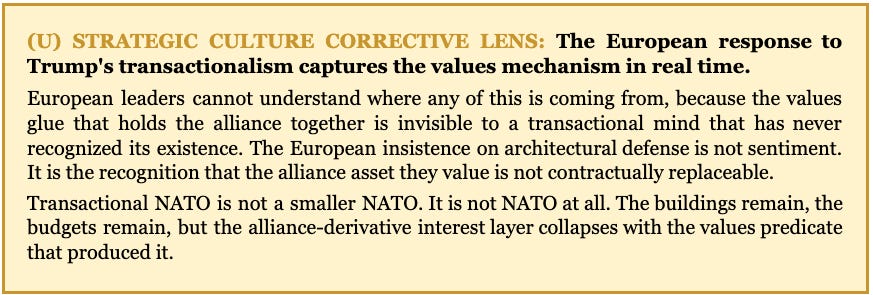
The empirical proof is observable in real time. Trump has spent nine years attempting to destroy NATO and has not succeeded, though the strain has been severe — he has pushed the alliance to the brink of its values tolerance, testing the predicate from multiple directions simultaneously. He has unilaterally exited the JCPOA, the Paris Agreement, the TPP, the INF Treaty, the Open Skies Treaty, WHO funding, and the UN Human Rights Council — all contracts, all abrogable by executive action. He has not been able to exit NATO, the U.S.–Japan Treaty, the U.S.–ROK Treaty, Five Eyes, or AUKUS — all alliances, all institutionally robust against unilateral abrogation, because each has values defenders inside and outside the executive branch who treat unilateral abrogation as a violation of the values predicate that constitutes the relationship. The European response captures the point: they cannot understand where any of this is coming from, because the values glue that holds the alliance together is invisible to a transactional mind that has never recognized its existence. The value of values can be measured by what survives an administration trying to destroy them.
(U) V. VALUES AND INTERESTS AT DEPTH
In a true alliance the values create the alliance, the alliance generates new shared interests that would not otherwise exist (combined deterrence, integrated supply chains, intelligence sharing, alliance-wide industrial base), and those new interests are values-derivative — they exist only because the values created the alliance that created the interests. Loss of the values dissolves the alliance and therefore the derivative interests.
Values-based alliances also naturally deepen of their own accord, because the same values that created them generate continuing incentives for deeper cooperation. Each successful joint operation, each crisis weathered together, each decision made in shared frame, builds the alliance further. Transactional alignments do the opposite: they shallow over time as each transaction must be separately negotiated and each partner monitors the other for advantage-taking. The Russia–China “partnership without limits” announced in February 2022 is the canonical contemporary case — a transactional alignment between two parties whose values are not shared, whose strategic interests increasingly conflict, particularly in Central Asia, and which historically have viewed each other as primary adversaries. The structural rhyme is the Molotov–Ribbentrop Pact of August 1939: a non-aggression agreement between regimes that despised each other, designed to buy time before the partition collapsed under the weight of irreconcilable interests. The pattern is the same. Without a values predicate, the alignment cannot survive the first significant shift in transactional logic, and both sides know throughout that the other is sharpening its knives.
This is why a transactional NATO is not a smaller NATO; it is not NATO at all. The buildings remain, the budgets remain, but the alliance-derivative interest layer collapses with the values predicate that produced it.
It is also why values-based alignments can deliver alliance-grade cooperation depth without formal treaty structure. Where values are shared and interests genuinely converge, the natural deepening of cooperation produces sustainment, resilience, and initiative even in the absence of a signed instrument. The treaty, where one exists, ratifies what the values have already built. Where the values are not present, no treaty can supply what is missing. This is the mechanism by which informal groupings — emergent coalitions of like-minded democracies, grand-strategic alignments built around shared procedural commitments — can produce strategic effect of a magnitude that surprises observers conditioned to look for treaty structure.
At depth, then, values and interests are not separable. The values are the interests in derivative form.
(U) VI. THE MISIDENTIFICATION TAXONOMY
Three predictable errors follow when non-strategists do the work of strategists.
Error one — promoting the contingent to the permanent. Treating a particular adversary, a particular war, or a particular ideological project as if it were a permanent interest. Counter-terrorism after 9/11 is the canonical case: a contingent instrument required to address a contingent threat got elevated to a permanent organizing principle of American grand strategy, and twenty years of strategic attention, $8 trillion, and an entire generation of military and intelligence capability were optimized against it. The geography did not change. The peer competitor did not go away. The permanent tier kept generating its bills, and nobody was paying them.
Error two — demoting the permanent to the contingent. Treating geography, demography, or alliance integrity as if they were negotiable preferences. The current administration’s NATO posture is the case in point — the structural requirement for values-based coalition under peer-threat conditions is permanent; treating it as a chip to be traded for a domestic political win is a category error of the first order, because the geography that makes Ramstein decisive does not stop being decisive when the administration changes its mind.
Error three — confusing tactics for interests altogether. Killing Osama bin Laden was a tactical objective. It was never a national interest. Removing Saddam Hussein was a tactical objective. It was never a national interest. The conflation of things we want to do with things we must protect is the hallmark of strategy written by people who have never been required to distinguish the two. The bin Laden raid was a successful tactical operation; the twenty-year war that produced it was a strategic catastrophe. Both statements are true simultaneously, and only the two-tier framework lets you say so without contradiction.
(U) VII. APPLICATION: IRAQ, AFGHANISTAN, AND THE INDO-PACIFIC
The framework lets the post-9/11 misidentification be stated with structural precision rather than rhetorical assertion, and the rounding error measured in the numbers.
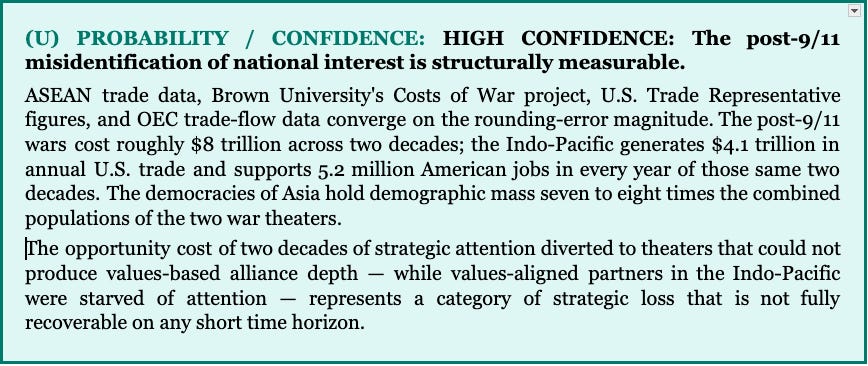
ASEAN’s 2024 two-way trade with the United States — $571.7 billion — was over twelve thousand times the U.S.–Afghanistan commercial relationship and forty-eight times the entire U.S.–Iraq one, before counting Japan, South Korea, Australia, or Taiwan. The post-9/11 wars cost roughly $8 trillion across two decades; the Indo-Pacific generates $4.1 trillion in annual U.S. trade and supports 5.2 million American jobs in every year of those same two decades. The democracies of Asia hold demographic mass seven to eight times the combined populations of the two war theaters. The geography that structures global maritime power runs through the ten gates of the Indo-Pacific, not the Hindu Kush or the Tigris.
The permanent U.S. interest in the Western Pacific — secure access to the commons, freedom from coercion, the structural requirement for values-based coalition with the democracies of the region, and the demographic and economic mass that drives American prosperity — was constant from 2001 to 2026. The contingent instruments that should have served that permanent interest — forward presence, alliance maintenance, industrial base, ISR coverage of the ten gates, integrated air and missile defense in the first island chain — were not built or were allowed to atrophy. The contingent obsession with counter-terrorism in two landlocked or near-landlocked theaters consumed the resources that the permanent interest required. The tactical objective of killing one man was achieved. The permanent interest was not served.
The values dimension sharpens the indictment. Afghanistan and Iraq could not produce values-based alliance depth, because the values that would have made deep alliance possible were not shared and could not be quickly built. The populations actively resisted the values being projected. We were occupiers, not partners, from the day each war began. The relationships that could have produced values-based alliance depth — Japan, South Korea, Australia, Taiwan, the Philippines — were starved of strategic attention. The opportunity cost was therefore not only dollars and gates. It was the alliance depth that could have been built with values partners and was instead spent on relationships that structurally could not become values-based partnerships at all.
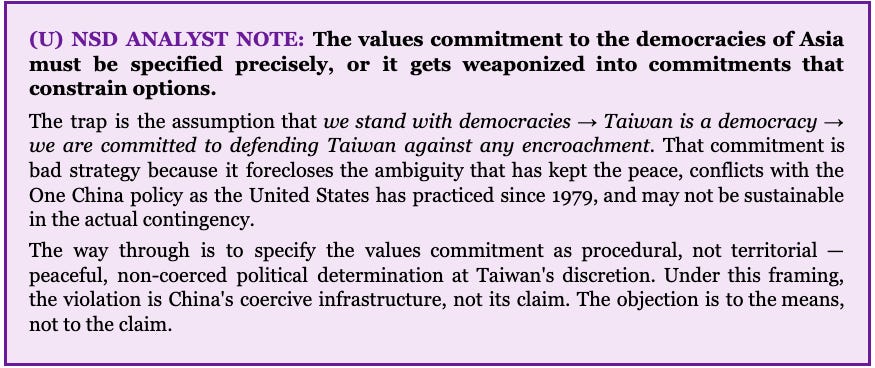
The framework also disciplines the Taiwan question. The values commitment to the democracies of Asia is procedural, not territorial — peaceful, non-coerced political determination at Taiwan’s discretion, which is consistent with the One China policy as the United States has practiced it since 1979 and with the principle that no resolution imposed by force is legitimate. China’s kill-chain architecture in the first island chain is not a claim to Taiwan; it is the construction of a coercive infrastructure that violates the values that bind Asian democracies together. The objection is to the means, not to the claim.
The mismatch is not a policy error. It is strategic malpractice.
(U) VIII. THE POST-1945 ARCHITECTURE AND THE CURRENT RUPTURE
The framework also clarifies what was achieved between 1945 and the current rupture, and what is being lost now. The argument matters because the temptation to treat the values-based architecture as a luxury good — a moralistic preference that can be discarded when convenient — depends on a forgetting of why it was built.
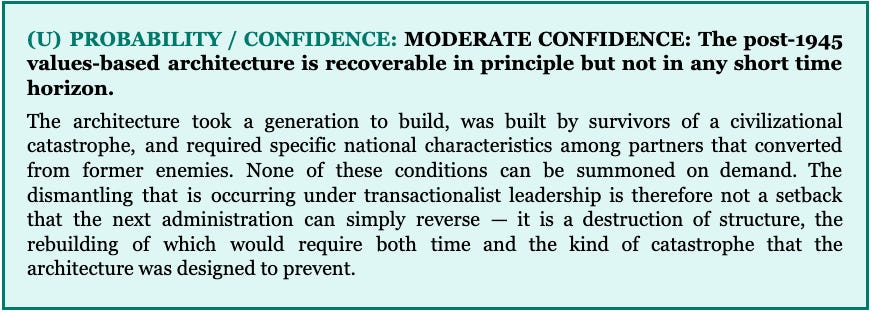
The values-based international order was not built because all parties already shared values. It was built because of a six-year total war that killed approximately seventy-five million people and ended in the atomic destruction of two cities. It was built because the generation that survived had seen, with their own eyes, what great-power competition produces when it runs without architectural constraints: industrial-scale slaughter, the deliberate murder of civilians as policy, the Holocaust, the firebombing of cities, the systematic collapse of every restraint that civilizations had taken centuries to develop. Bretton Woods, NATO, the United Nations, the Universal Declaration of Human Rights, the rules-based trading order, the alliance preference for democracies — these were not preferences. They were the survivor’s response to civilizational catastrophe, designed by people who knew exactly what would happen if the architecture failed because they had just watched it fail.
The architecture’s existence then made possible something unprecedented in the history of great-power politics: the conversion of former enemies into values partners. Japan and Germany were not values partners in 1940. Japan was militarist, imperial, and racist; Germany was the Nazi state. The conversion of both into deep values partners required total defeat, occupation aimed at societal reconstruction rather than resource extraction, sustained institution-building, generational time, and — critically — particular national characteristics that made the conversion possible. In Japan’s case, a deep tradition of emulating advanced foreign models, established during the Meiji Restoration, was redirected toward American constitutional democracy. In Germany’s case, a pre-Nazi democratic heritage was rebuilt over the wreckage of the regime that had overrun it. Without the architecture and these specific national conditions, the conversion would have been impossible.
This is the answer to the objection that “the Asian democracies didn’t share our values either.” That is true of Japan in 1940 — emphatically true. It is not true of Japan today, because the architecture and the catastrophe that produced it converted Japan into a values partner over half a century. The values relationship with Japan, South Korea, the Philippines, and Taiwan is the achievement of the post-1945 architecture, not its precondition. The architecture is what builds values partners. Without it, the values relationships do not get built. The argument is therefore not that Iraq and Afghanistan should have been converted on the Japan model — the conditions for that conversion (total war and reconstruction commitment, particular national characteristics, generational time) were not present, and the United States never committed the resources required. The argument is that the architecture itself, which makes such conversions possible at all, is what is now being dismantled.
At the operational level, Cold War American foreign policy was often values-violating: the Iran coup, the Guatemala coup, support for Pinochet, the Vietnam War, instrumental relationships with authoritarian anti-communists across three continents. Kissinger diagnosed this as the cross-wiring of an immature great power that had not resolved the tension between idealism and realism. The synthesis that holds: the post-1945 American settlement was values-based in its architecture and inconsistently values-based in its operations. The operational hypocrisies were deviations from a values-based architecture, not the absence of one. The deviations were corrigible, and many were corrected over time, often through the same domestic political processes the architecture itself enabled.
Trumpism is qualitatively different. It is not cross-wiring. It is the abandonment of the architecture itself in favor of personalist transactional impulse — what NSD has elsewhere termed transactomacy.[3] Cross-wiring kept the architecture and produced operational deviations that could be corrected against the standard it provided. Transactomacy removes the architecture, and therefore removes the standard against which deviations could be identified and corrected.
The forgetting is the disease. We built the values-based order because we had just seen, in industrial-scale and atomic terms, what its absence produced. The generation that built it understood the cost of doing without it because they had paid that cost. We have lost that memory. The dismantling of the architecture is possible only because the lesson that produced the architecture has been forgotten. And the lesson, restated plainly: when great-power competition runs without architectural constraints, it produces catastrophes at scales that bankrupt civilizations. We are not exempt. The architecture is not a luxury good. It is the technology that prevents the catastrophe from happening again.
(U) IX. ANALYTICAL JUDGMENT
This framework is not offered as theory for its own sake. It is offered because the recurring failure of American strategy since 2001 — the inversion of the discipline that distinguishes permanent from contingent interests, the elevation of tactical objectives to the status of national interests, the abandonment of the values architecture that converts capability into power — was not a series of judgment errors by individual administrations. It was the predictable output of a polity that had lost the framework needed to distinguish what it was protecting from how it was protecting it.
The framework exists to make that distinction operable. Permanent interests are not negotiable. Contingent interests are real but instrumental. Values are upstream of both. Alliance is built on values; everything else is a contract. The mismatch between what was protected and how is measurable in trillions of dollars, decades of attention, and the alliance depth that could have been built with values partners and was instead spent on theaters that could never produce it.
The architecture that converts these distinctions into strategy was built in response to a civilizational catastrophe and is now being dismantled by people who do not remember the catastrophe and do not understand the architecture. The dismantling is possible only because the memory has been lost. The framework, restated, is the memory. The work of strategists is to keep the memory alive — and to refuse to be displaced by people who pretend they can do this work without it.
(U) X. LINEAGE
This framework builds on and extends:
• Carl von Clausewitz (On War, 1832) — war as the continuation of politics by other means; the political objective as the apex of strategy; the paradoxical trinity of government, military, and people.
• Lord Palmerston (House of Commons, 1 March 1848) — the canonical statement of national interest as eternal and perpetual, contrasted with the contingency of allies and enemies. The framework refines Palmerston’s distinction by identifying the two-tier structure within “interests” themselves and by adding values as the upstream condition of any interest defense.
• George F. Kennan (Long Telegram, 1946; “X” article, 1947) — the original formulation of containment as values-based architecture rather than transactional balance; the strategic case for patient, structural commitment over reactive, kinetic response.
• Henry Kissinger (Diplomacy, 1994; World Order, 2014) — the diagnosis of American foreign policy as cross-wired between idealism and realism; the structural account of why mature great-power statecraft requires both architectural commitment and operational discretion.
• NSD/DEF-2026-001 — On War and Warfare: Definitions and Consequences (1 April 2026) — the legitimacy-will-values triangle that operates as the upstream foundation of the framework presented here. The current paper extends that framework from war to the broader question of what generates and sustains the interests for which wars are fought.
• NSD/CW2-2026-006 — No Ideology: That’s Not Trump’s Weakness. That’s His Weapon. (13 April 2026) — the transactomacy framework that names what replaces values-based architecture when the architecture is dismantled by an administration incapable of either ideology or strategy.

(U) REFERENCES
[1] The mechanism is observable across regime types and across time. The Shah of Iran fell when his legitimacy collapsed. Mubarak fell when his legitimacy collapsed. Assad fell when his legitimacy collapsed. In the cases of the Soviet Union and Ceaușescu, ideological legitimacy collapsed specifically — the legitimating story the regime told about itself ceased to be believed by the people whose belief was required to sustain it, and the will to defend the regime evaporated with the legitimacy that had generated it. In each case, capability remained substantial up to the moment of collapse. What had been lost was not material capacity but the upstream condition that made capacity politically usable. The mechanism is the same in democracies; what differs is the source of legitimacy, not the requirement for it.
[2] National Security Desk, On War and Warfare: Definitions and Consequences, NSD/DEF-2026-001, 1 April 2026. Sections II and III. The legitimacy-will-values triangle developed there is the operational substrate of the framework presented here.
[3] National Security Desk, No Ideology: That’s Not Trump’s Weakness. That’s His Weapon., NSD/CW2-2026-006, 13 April 2026. Section VII — Level 4: Transactomacy — The International Structural Effect. Transactomacy is the operating system that replaces alliance-based diplomacy with a supply-driven transactional regime in which sovereign relationships are converted into personalist equity for the operative regime. It is not realism. Realism requires a coherent worldview. Transactomacy is the absence of one.
The National Security Desk offers these posts freely, but your support is necessary and appreciated. Please subscribe, paid if you’re able, or leave a tip.
Thank you