THE PREDICTABLE PEARL HARBOR
America’s Drone Vulnerability and the Strategic Catastrophe Everyone Can See Coming



WASHINGTON DC 21MAR2026

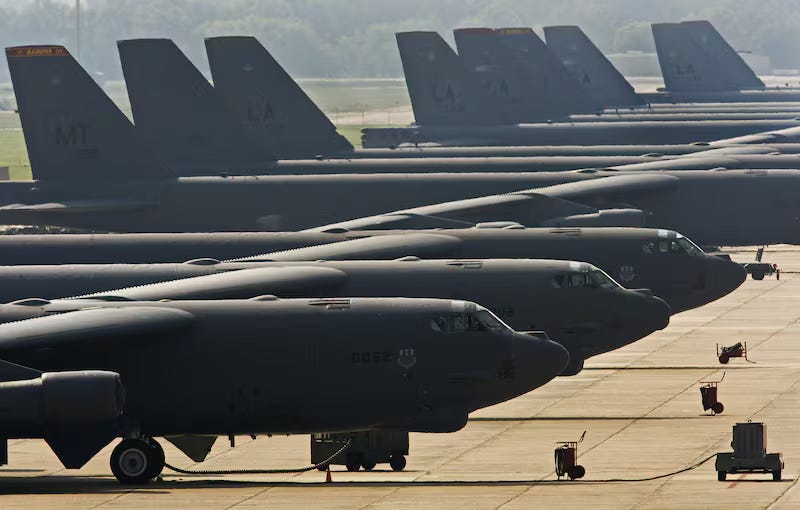
This is Barksdale Air Force Base — not a regional guard station. It is the headquarters of Air Force Global Strike Command, which commands every strategic bomber and every intercontinental ballistic missile in the United States arsenal. It is one of only two Continental United States bases housing B-52H nuclear bombers. It was, at the time of these incursions, actively launching bombing sorties against Iran as part of Operation Epic Fury. And for a week, unknown actors flew custom-built, jam-resistant drones over its flight line with impunity, forcing repeated shutdowns of flight operations at one of the most active strategic bomber bases in the world during a shooting war.
Barksdale also stores nuclear weapons. A drone cannot detonate a nuclear warhead — the physics of implosion-type devices require precisely sequenced detonation of shaped charges that no external impact can replicate, and modern permissive action links provide additional layers of use-denial. But the American public does not know that. What the public knows is that drones flew over a nuclear base for a week and nobody stopped them. The perceptual damage — the strategic communication gift to adversaries, the erosion of deterrent credibility, the domestic panic potential — is not bounded by the technical limitations of what a drone can physically do to a warhead. It is bounded by what people believe a drone can do. And what people believe, in the absence of authoritative reassurance that has not been provided, is that the nuclear arsenal of the United States was probed and found undefended.
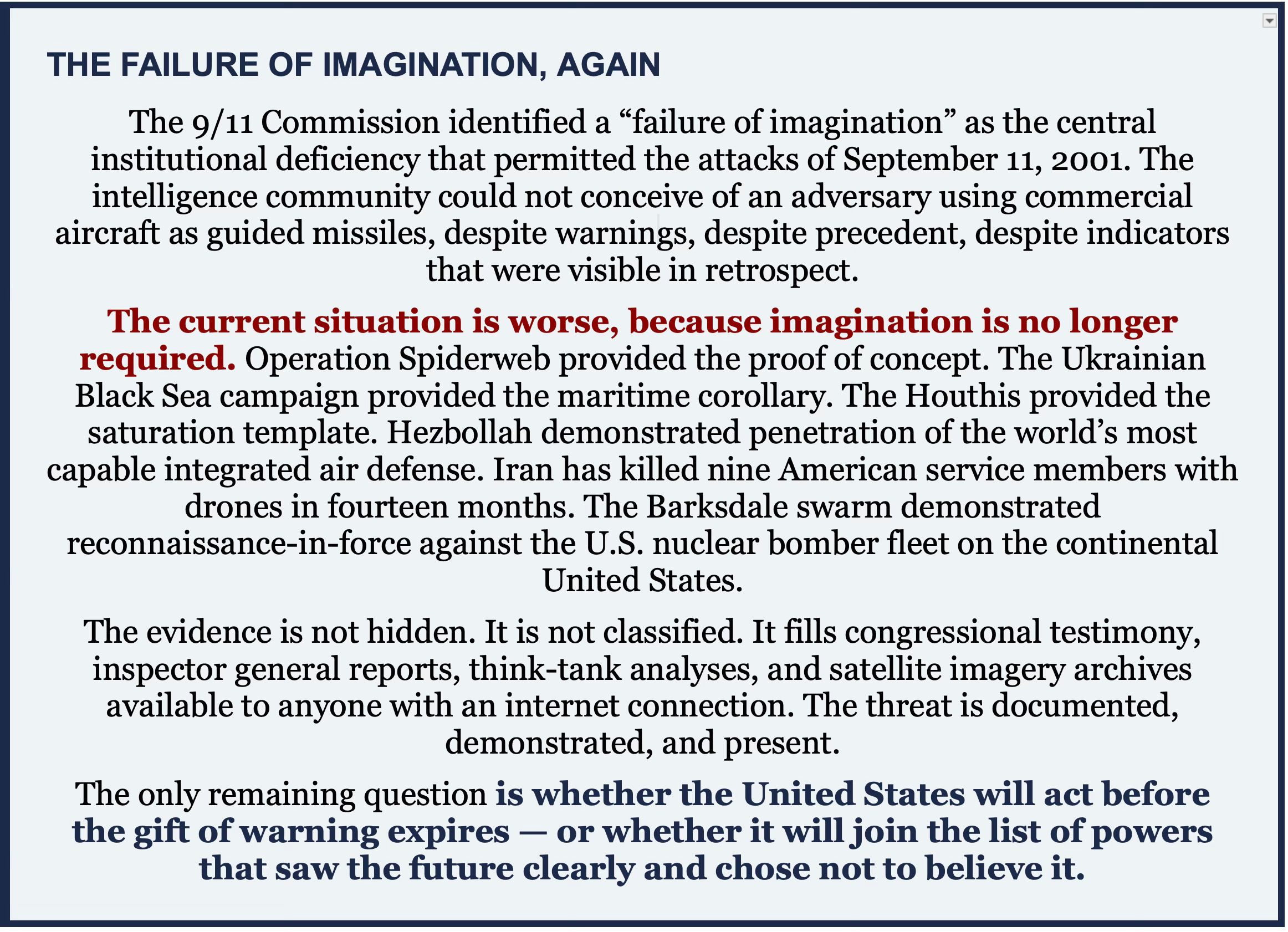
The historical parallels are not subtle and they should not need to be drawn. Pearl Harbor succeeded because the fleet was concentrated, unprotected, and assumed to be beyond the range of attack. September 11 succeeded because the intelligence community suffered what the 9/11 Commission called a “failure of imagination” — the inability to conceive that an adversary would use commercial aircraft as guided missiles, despite warnings, despite precedent, despite indicators that were visible in retrospect. In both cases, the United States was fat, content, and certain that the threat was somewhere else. In both cases, it was starting or provoking a confrontation with an adversary it had fundamentally underestimated — not in conventional military power, but in asymmetric ingenuity, operational patience, and willingness to strike where the defenses were not.
The United States has initiated a war with Iran — a regime that has spent four decades perfecting asymmetric warfare, that fields the most combat-experienced drone force on the planet, that has demonstrated the intent and capability to kill American officials on American soil, and that operates through proxy networks specifically designed to deliver strikes without attribution. The IRGC does not think like CENTCOM. It thinks like the SBU operatives who opened a freight office in Chelyabinsk and parked trucks full of drones next to Russian bomber bases. It thinks like the Houthi militia that sank commercial shipping with weapons costing less than a used car. And the most obvious door — the physical defense of the bases that house the nuclear deterrent — remains open. Not ajar. Open. The flight line at Barksdale has no hardened shelters, no terminal air defense, no demonstrated capacity to defeat the drones that have already been flying over it. This is not a failure of imagination. The imagination has been provided, in high definition, by Ukraine, by the Houthis, by Hezbollah, and by the unknown operators who spent a week mapping Barksdale’s defenses. This is a failure of action — and every day it continues, the cost of correction grows while the window for correction shrinks.


(U) 1. EXECUTIVE SUMMARY
The National Security Desk publishes anticipatory intelligence — assessments before confirmation, grounded in the analytical tradition that the most consequential intelligence failures are failures of action, not failures of information. The information in this report is all open-source. The warnings have been issued, repeatedly, by Congress, by the DoD Inspector General, by think tanks, and by the operational precedent set when Ukraine destroyed one-third of Russia’s strategic bomber fleet in a single night with $234,000 worth of commercially derived drones. What has not happened is action. That is the subject of this report.
In the week of March 9–15, 2026, custom-built, jamming-resistant drones flew in waves over Barksdale Air Force Base — one of two CONUS nuclear bomber bases, headquarters of Air Force Global Strike Command, actively conducting combat operations against Iran. Simultaneously, unidentified drones overflew Fort McNair in Washington, D.C., where the Secretary of State and the Secretary of Defense — the fourth and sixth in the presidential line of succession — are currently housed on a waterfront peninsula with no documented counter-drone protection. Neither the Barksdale operator nor the Fort McNair operator has been identified.
NORTHCOM Commander Gen. Gregory Guillot testified to Congress that there were 350 unauthorized drone detections across 100 U.S. military installations in 2024 alone. The DoD Inspector General found in January 2026 that a large percentage of those installations — including nuclear bomber bases and the shipyards that build nuclear submarines — lack operational approval to use counter-drone capabilities even where equipment exists. The Air Force posted its first industry solicitations for counter-drone technology on March 6, 2026 — three days before the Barksdale swarm began. The Battle Lab that will eventually produce a Standard Operating Procedure for base defense will not complete its first SOP until the end of 2026. The B-52s will not wait.
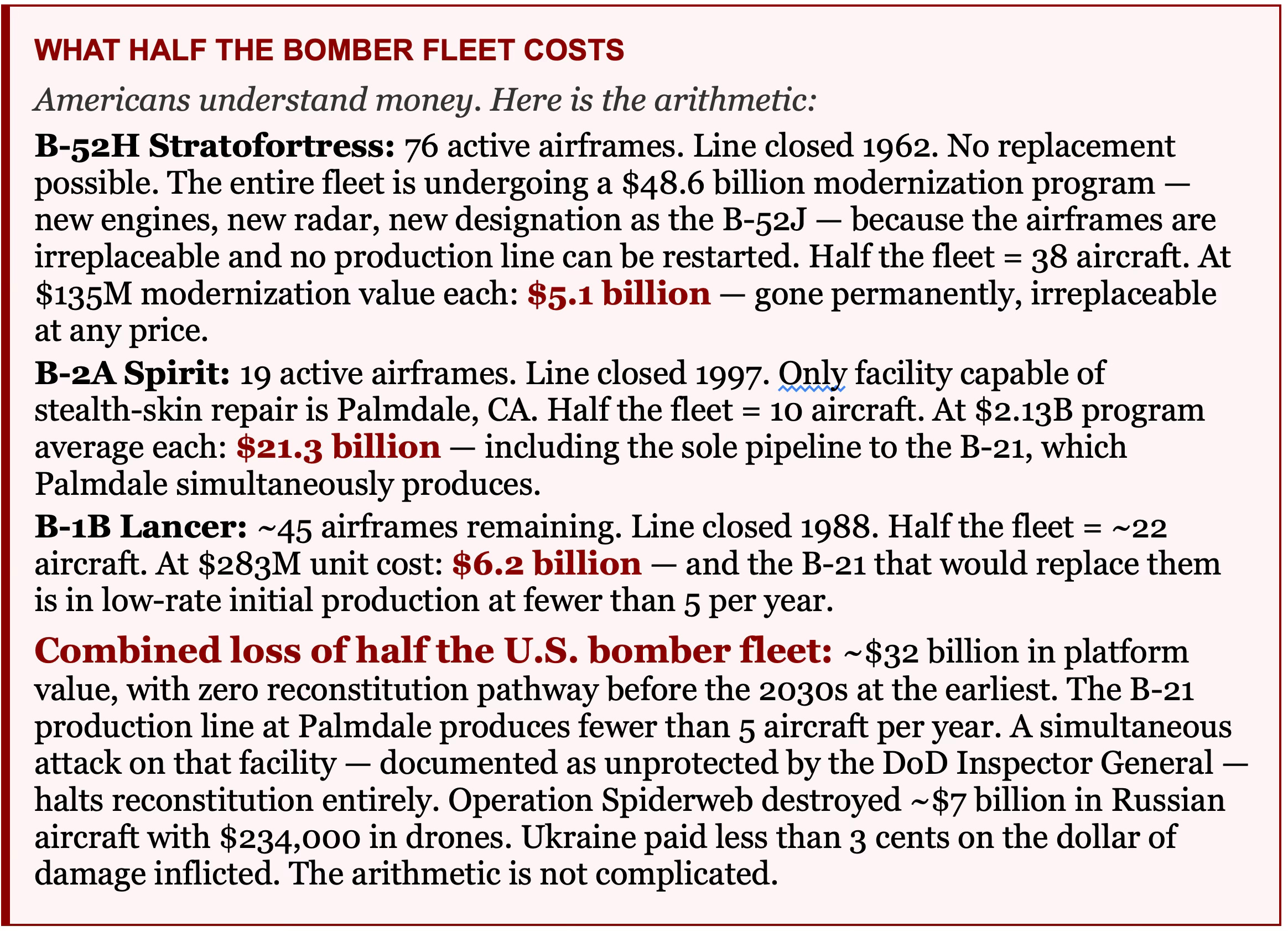
Every production line for every aircraft in the U.S. strategic bomber fleet is closed. The B-52 was last built in 1962. The B-2 in 1997. The B-1B in 1988. The B-21 is in low-rate production at fewer than 5 per year. America cannot replace what it loses.
This report synthesizes the full OSINT record: the Barksdale and Fort McNair incidents, every documented drone penetration at U.S. strategic installations, the Spiderweb operational model and its direct applicability to CONUS bases, the production yard chokepoints that represent the most catastrophic and least-discussed vulnerability, and the adversary calculus that makes Iran — enabled by Russian tactical intelligence and Chinese material support — the most likely actor to attempt what Ukraine demonstrated is possible. The Ukraine precedent is Section 4. Americans prefer consequences to history. The consequences are in Sections 2 and 5.
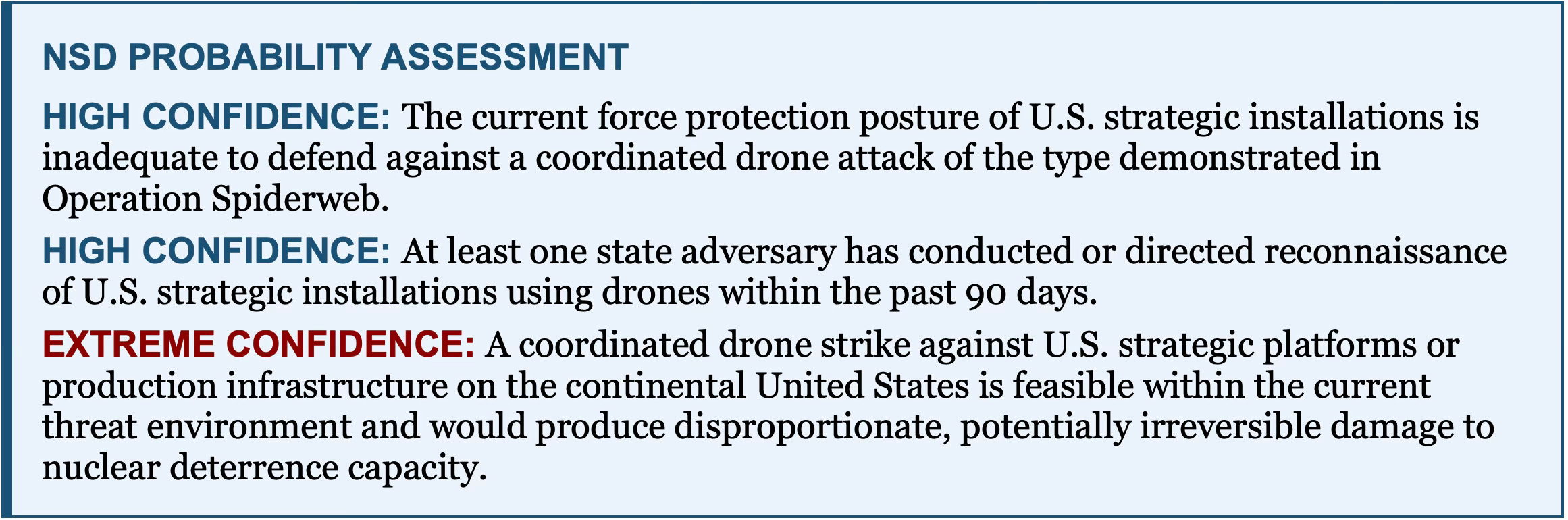
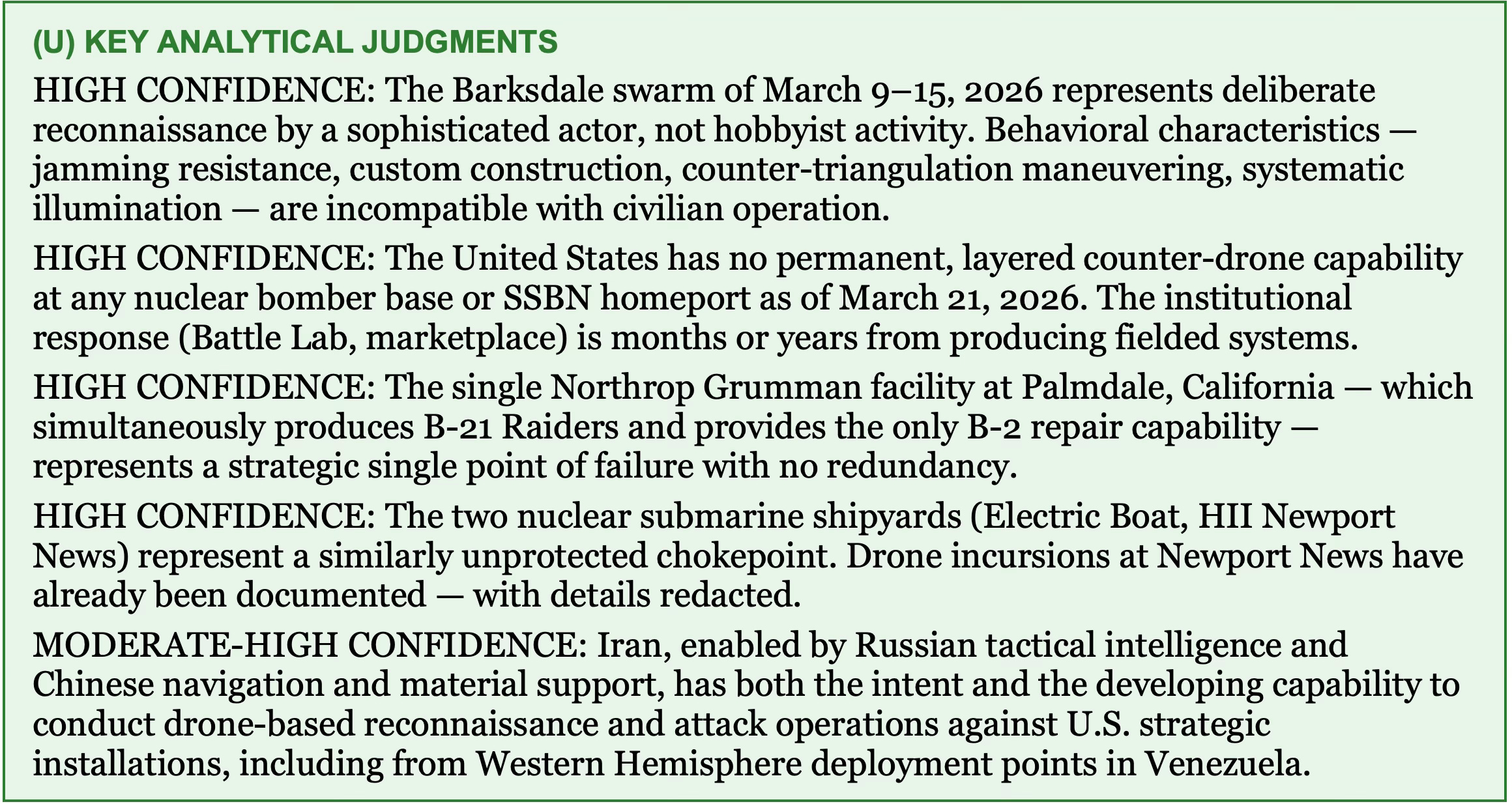
But the vulnerability does not end on the flight line. This report argues that the more consequential risk is to the industrial infrastructure underpinning the nuclear triad — the two shipyards that build and maintain nuclear submarines, the single Northrop Grumman facility in Palmdale, California that both produces B-21 Raiders and is the only site capable of repairing B-2 Spirit composite stealth damage, and the power and fuel systems these installations depend on. A drone attack that destroys a B-52 is catastrophic. A drone attack that halts Columbia-class submarine construction or destroys the B-21 production line is existential.
(U) 2. THE IMMEDIATE CRISIS: BARKSDALE AND FORT MCNAIR
(U) 2.1 BARKSDALE AFB — THE NUCLEAR BOMBER SWARM (MARCH 9–15, 2026)
The Air Force characterized the first night — March 9 — as a single incident requiring a shelter-in-place order. A confidential internal briefing document dated March 15, 2026, reviewed by ABC News, revealed what the week actually contained:
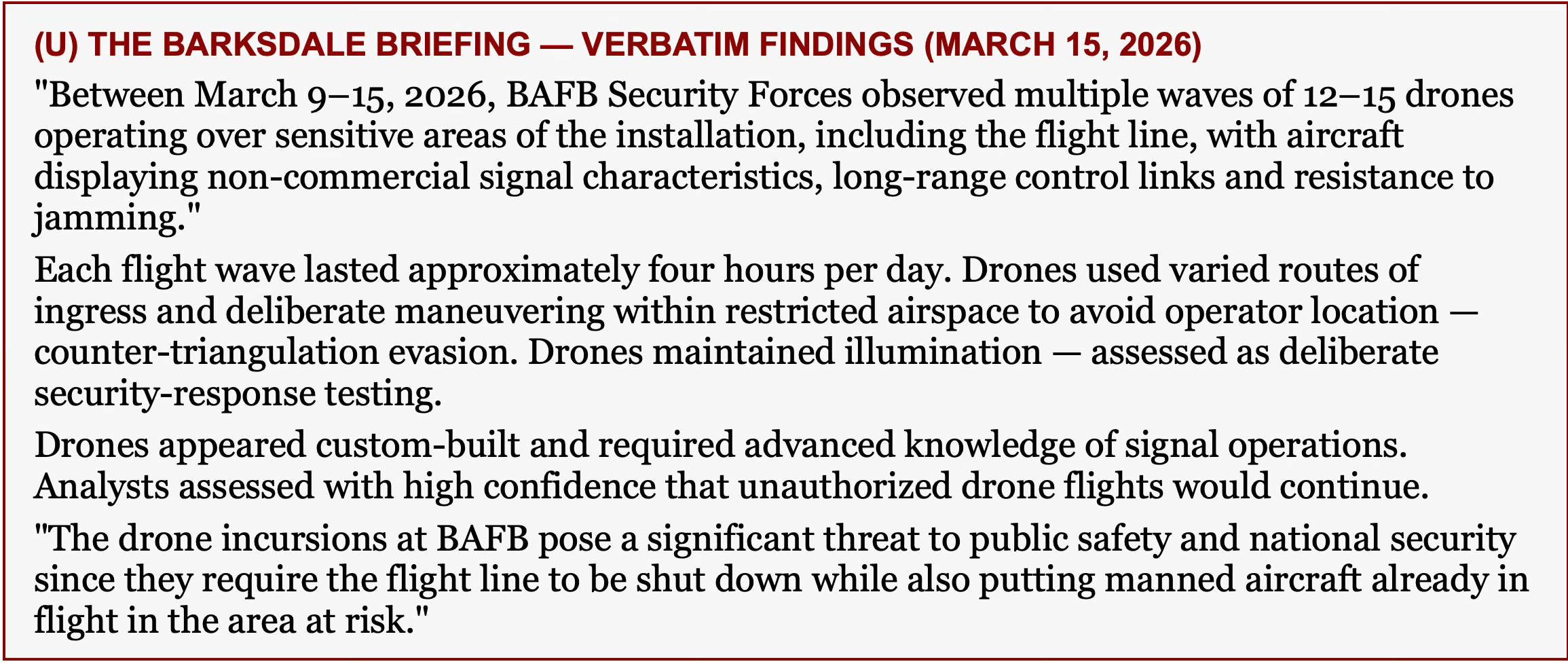
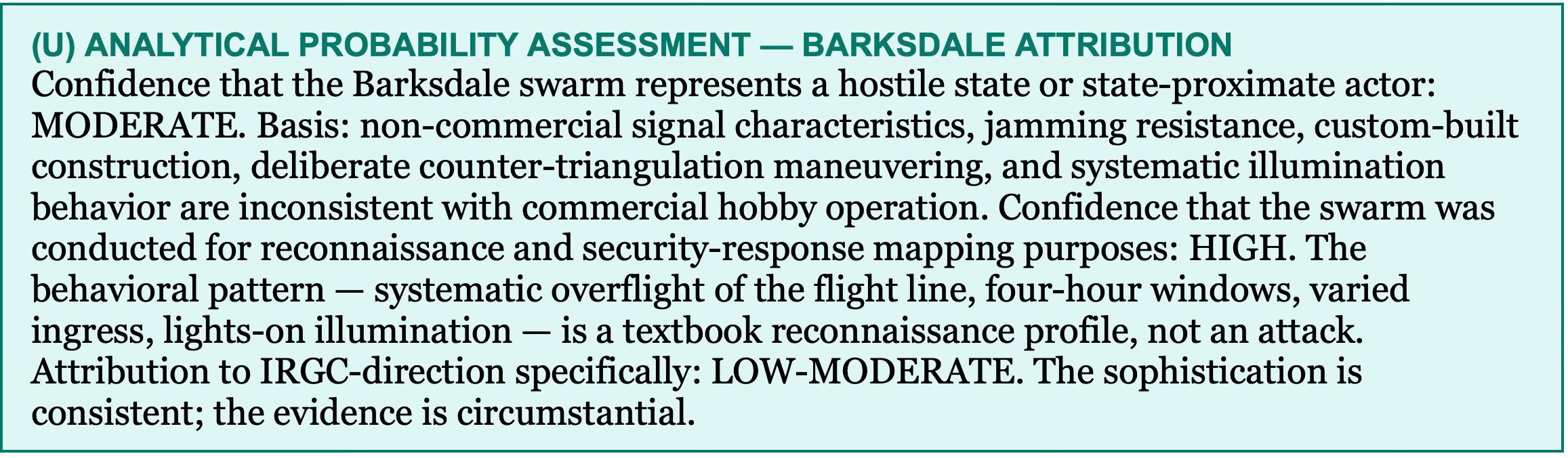
The characteristics of the Barksdale drones — custom-built, jamming-resistant, non-commercial signal characteristics, varied ingress routes, deliberate maneuvering over the flight line, illuminated for response-testing purposes — are not the signature of a hobbyist. They are the signature of a reconnaissance operation conducted by an actor with sophisticated electronic warfare knowledge and advance intelligence on Barksdale’s layout.
Mick Mulroy, former Deputy Assistant Secretary of Defense for the Middle East: “Certainly, it seemed to be more than just your average drone enthusiast who just pushed it too far. It looked like this was deliberate and intentional to see just how they would react. Seeing this probe on a base inside the United States is very troubling.”
As of March 21, 2026, the FBI and Louisiana State Police are investigating. No arrests have been made. No drones have been recovered. No attribution has been established. The B-52Hs at Barksdale are still parked on an open flight line with no permanent counter-drone protection.


(U) 2.2 FORT MCNAIR, WASHINGTON, D.C. — SUCCESSION OFFICIALS UNDER SURVEILLANCE (MARCH 2026)
Fort Lesley J. McNair sits on a narrow peninsula at the confluence of the Potomac and Anacostia Rivers in Washington, D.C. It houses the National Defense University. Since October 2025, it has housed something far more consequential: both Secretary of State Marco Rubio and Secretary of Defense Pete Hegseth live on Generals’ Row, a line of historic quarters directly overlooking the Washington Channel — the fourth and sixth officials in the presidential line of succession, living doors apart on a waterfront installation with no standoff distance from navigable water.
On a single night within the past ten days of March 19, 2026, multiple unidentified drones were detected over Fort McNair. The sightings prompted a White House meeting and discussions about relocating Rubio and Hegseth. As of March 21, 2026, neither has moved.
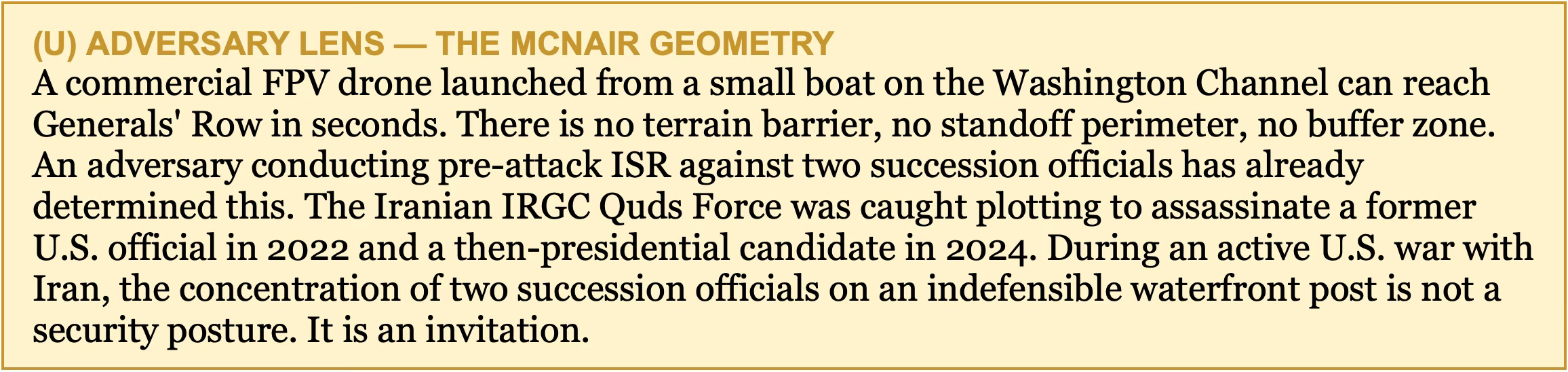
The military’s official statement — “currently there is no credible threat to Fort McNair” — deserves close reading. It says nothing about the intent, capability, or origin of the drones. The drones were detected. They were unidentified. No one knows who operated them. That is not the absence of a credible threat. That is a failure of attribution dressed as reassurance.
The broader force protection picture as of March 21, 2026: all U.S. military installations have been at FPCON Bravo since Operation Epic Fury commenced on February 28. MacDill AFB — home of CENTCOM and SOCOM — is at FPCON Charlie after a suspicious package containing possible energetic materials was found at its visitors’ center. Joint Base McGuire-Dix-Lakehurst is at FPCON Charlie. The FBI has issued warnings about potential Iranian drone attacks from offshore vessels near California. The State Department has directed all diplomatic posts worldwide to conduct immediate security reviews.
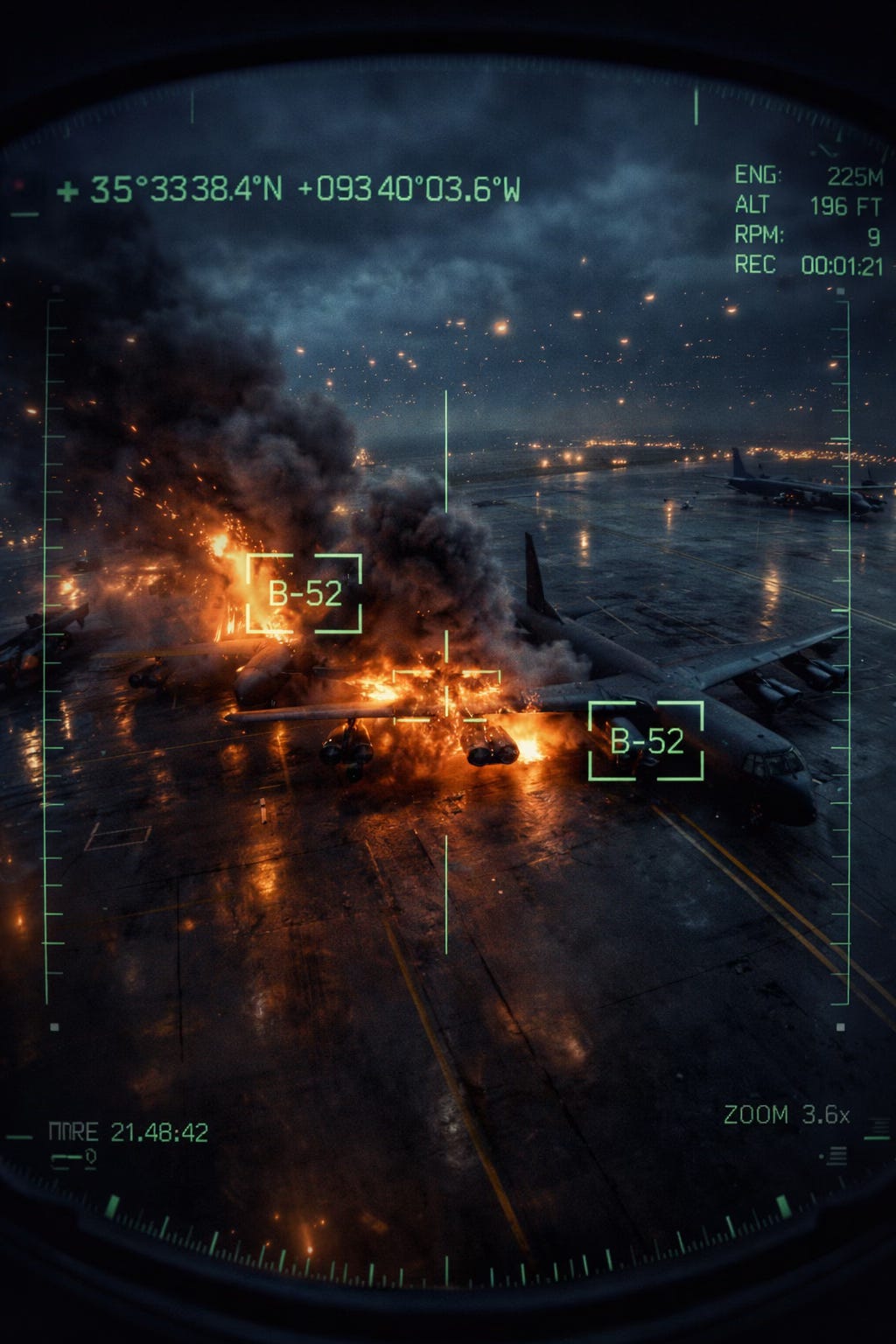
Visualization can help people grasp the problem - real news story from this week, plus a visualization of a mass Pearl Harbor drone attack
(U) 3. THE VULNERABILITY MAP: A NATION WIDE OPEN
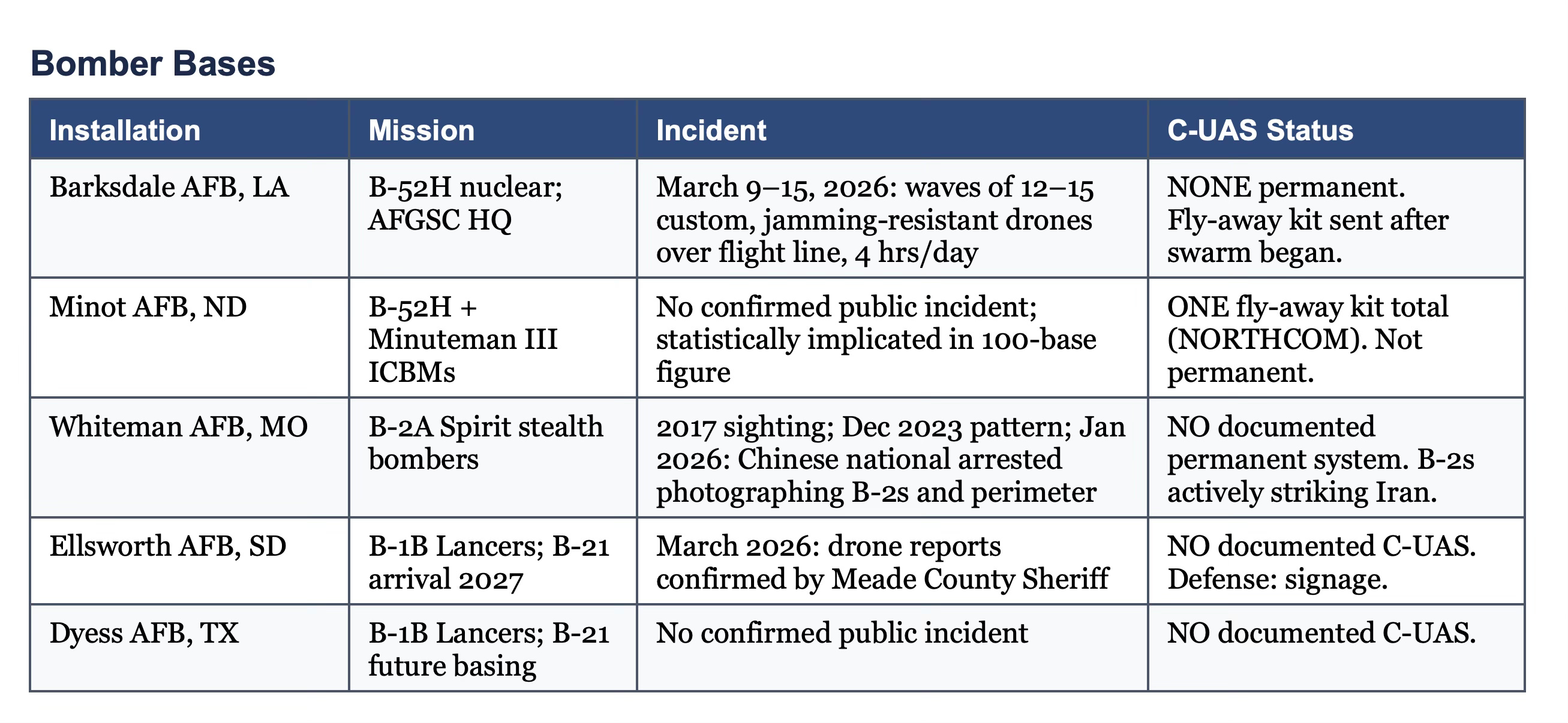
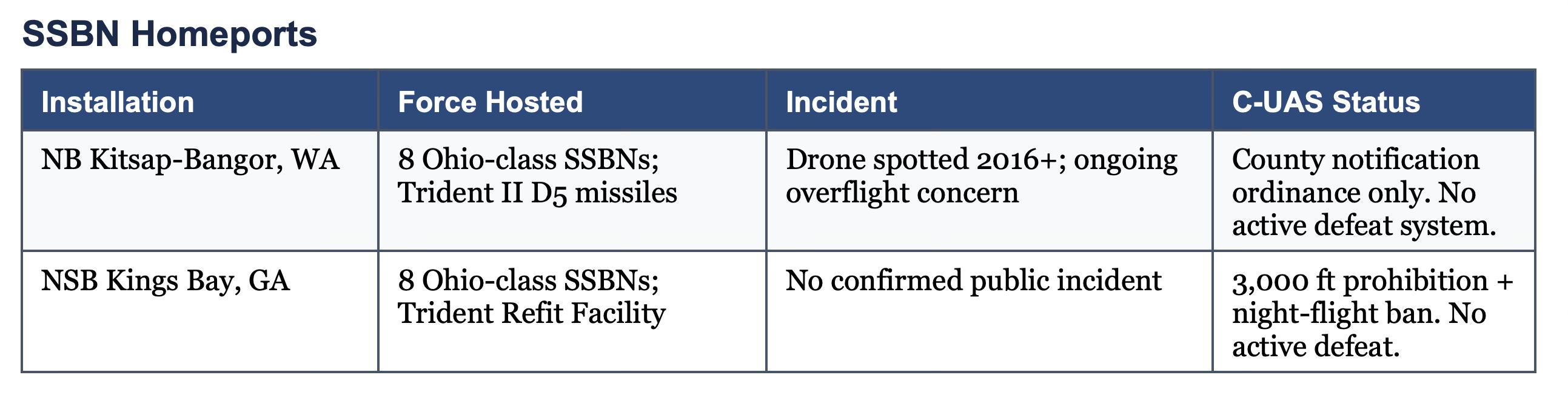
Gen. Guillot’s testimony of 350 unauthorized drone detections across 100 installations in 2024 establishes the baseline. What that figure obscures is the pattern: the most sensitive nodes of the U.S. nuclear enterprise — bomber bases, SSBN homeports, strategic shipyards, and the facilities that house the officials who authorize nuclear release — have all experienced drone penetrations or elevated threat conditions. The following catalog, derived exclusively from OSINT, organizes the vulnerability by category.
Naval Installations and Shipyards
Naval Station Norfolk — the world’s largest naval base — experienced weeks of drone overflights in 2024 per the DoD IG, with details redacted. The DoD IG also documented drone incursions at Newport News Shipbuilding — the HII facility that co-produces Virginia-class submarines and performs major SSBN overhauls — with all details fully redacted. The Langley 17-night drone swarm of December 2023, discussed below, included drones on trajectories toward Norfolk.
Joint Base Langley-Eustis — The 17-Night Swarm (December 2023)
The December 2023 Langley swarm remains the most operationally significant domestic drone penetration in the public record. Incursions began December 6 and continued for 17 consecutive nights — then stopped as suddenly as they began. Reports indicated 20–30 drone sightings per night, consistently appearing 30–45 minutes after sunset.
Retired four-star Gen. Mark Kelly, the highest-ranking officer to personally witness the swarm, described sizes ranging from commercial quadcopters to models comparable to a bass boat or a small car. Speed: approximately 100 mph. Altitude: 3,000–4,000 feet. One witness filmed over 40 drones simultaneously moving in a column from the James River toward Langley.
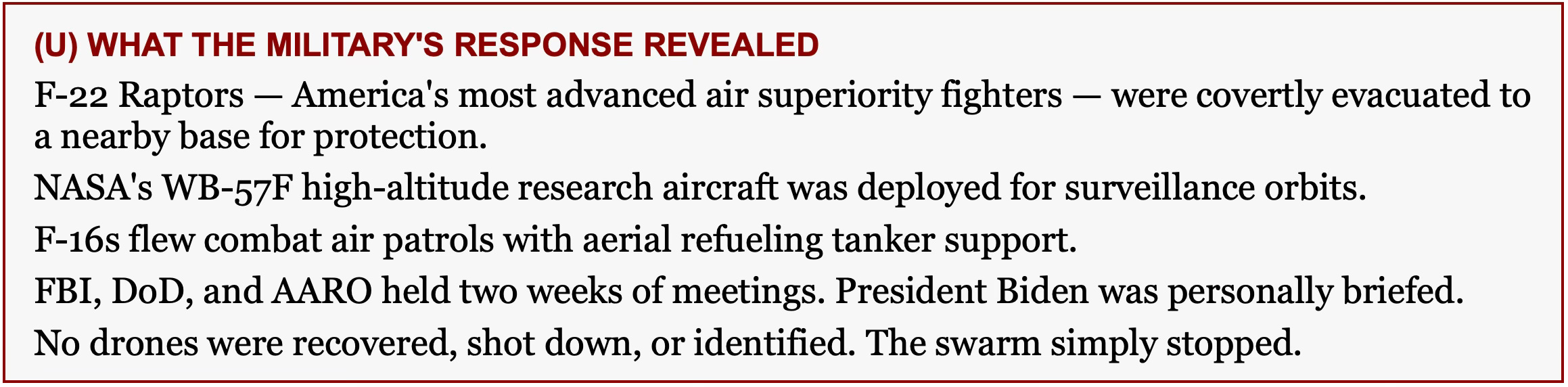
Gen. John van Herck, former NORTHCOM Commander, to 60 Minutes: “They could drop ordnance on [F-22s]. Drop bombs on them. They could crash into them to disable them.” Asked if Langley could detect a drone swarm at low altitude today: “Probably not, with your standard FAA or surveillance radars.”
A Chinese national, Fengyun Shi, was subsequently caught flying a drone near Newport News Shipbuilding with nighttime photographs of naval vessels under construction — specifically including nuclear submarines and aircraft carriers. He pleaded guilty and received a six-month sentence. Investigators could not link him to the Langley swarms. That the two events — an unidentified 17-night swarm at the headquarters of Air Combat Command, and a Chinese intelligence operative photographing nuclear vessels at the adjacent shipyard — did not produce a merged investigation or a unified public threat assessment tells you something about the institutional compartmentalization that enables the adversary.
Alliance Bases: RAF Fairford and the European Flank
RAF Fairford, Gloucestershire, is the primary U.S. heavy bomber forward operating location in Europe and the sole B-2 maintenance facility outside CONUS. As of March 20, 2026, at least 11 U.S. strategic bombers — 8 B-1Bs and 3 B-52Hs — are staged there for Operation Epic Fury, with B-52s observed carrying AGM-158 JASSM cruise missiles on external pylons.
Drone incidents at UK defense sites doubled from 126 in 2024 to 266 in 2025. The UK government has stated it “cannot rule out hostile state actors.” Under current UK law, military personnel cannot shoot down drones without police intervention. A new Armed Forces Bill has been introduced but not enacted.
In June 2024, pro-Palestinian activists physically breached RAF Fairford and damaged aircraft — demonstrating that kinetic vulnerability to non-state actors is not theoretical. For a state-sponsored operation with Iranian precision drones, the security gap is categorically more severe.
Morón Air Base in Spain — the secondary European staging point for B-52 operations — is unavailable. When Operation Epic Fury commenced, Spain flatly refused base use. Defense Minister Robles: “No assistance of any kind, absolutely none.” Alliance solidarity is conditional and under active strain.
The Nevada Nuclear Security Site and Mar-a-Lago Pattern
In October 2023, five drones flew over the Nevada Nuclear Security Site — where nuclear weapons experiments are conducted — over three days. The source was never identified. If drones probe nuclear test facilities with impunity, the assumption that nuclear weapons storage areas at operational bases are inviolate is unsupported.
Mar-a-Lago has been the subject of 40+ NORAD intercepts since January 2025, a permanent 1 nautical mile temporary flight restriction, multiple F-16 scrambles with flares, and three violations in two hours on March 1, 2025. The pattern of drone activity near presidential properties is persistent and escalating.
Brief examples of Ukrainian drone attacks
(U) 4. THE UKRAINE PRECEDENT: OPERATION SPIDERWEB AND WHAT IT PROVED
NSD leads with consequences, not history. The history is here because it is the most damning available evidence: Ukraine destroyed one-third of Russia’s strategic bomber fleet in a single night, nine months ago, with $234,000 worth of commercially derived drones — and the United States has not meaningfully hardened a single bomber base in response. Operation Spiderweb was not a surprise. It was the culmination of a three-year escalating campaign against Russian bomber bases. Every attack was watched by American military professionals. The institutional response, nine months later, is a Battle Lab in its infancy and an Amazon-style procurement marketplace.
The operational concept was elegant and devastating. Ukraine’s Security Service embedded its strike capability inside Russia months in advance. Operatives established a freight business in Chelyabinsk Oblast — 2,000 kilometers from Ukraine — in October 2024. Prefabricated wooden cabins, indistinguishable from commercial cargo, were mounted on flatbed trucks. Inside each cabin: approximately 36 Ukrainian-made FPV quadcopters, code-named Osa (Wasp). Ukrainian intelligence agents worked next door to an FSB regional headquarters. Hired Russian truck drivers — unwitting — transported the cabins near five air bases spanning from the Arctic to eastern Siberia. On command, rooftop panels opened remotely, and 117 drones emerged.
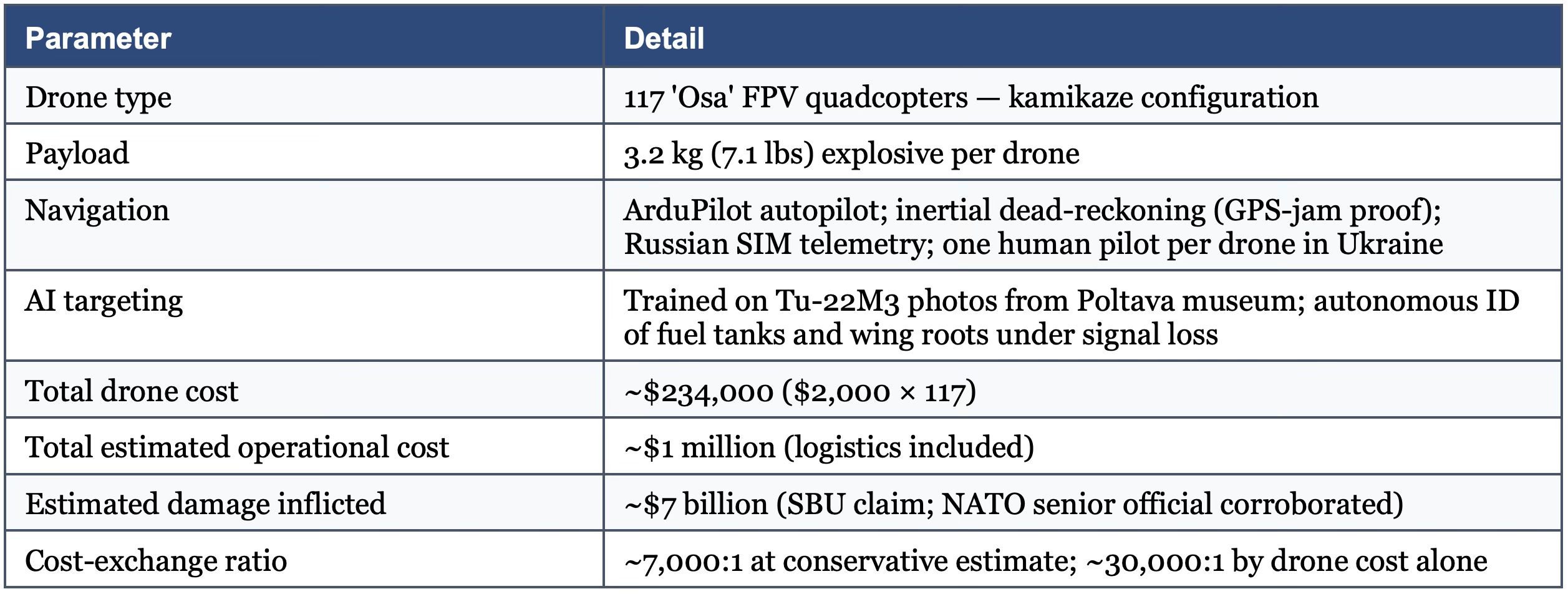
The Norwegian Defence Research Establishment called it “the most successful and devastating attack ever carried out against Russian bomber bases.” What followed is instructive.
What Russia Did in Response
Within days: mass bomber relocation. Tu-160s moved to Anadyr (400 miles from Alaska), Yelizovo (Kamchatka), and Borisoglebskoye (Tatarstan). Tu-22M3s and Tu-95MSs relocated from Murmansk to Tatarstan, Amur, Saratov, and Mozdok.
Within weeks: construction began on hardened aircraft shelters at 14 airfields. Satellite imagery confirmed 10 earth-covered reinforced bunkers at Khalino Airfield alone, plus additional concrete shelters at Saki in Crimea. Pantsir-S1, Tor-M2, and electronic warfare systems were deployed to bomber bases.
Within months: the Russian VKS restructured strike operations, deploying Tu-160s in place of Tu-95s for cruise missile launches, adapting to the reduced fleet.
Russia — under active bombardment, with a fighting war in Ukraine — responded faster and more comprehensively to the drone threat to its bomber fleet than the United States has responded to the same threat in the nine months since Spiderweb. The institutional failure in counter-drone posture is documented in full in Section 7.



(U) 4.3 THE DEMOCRATIZATION OF THE SWARM
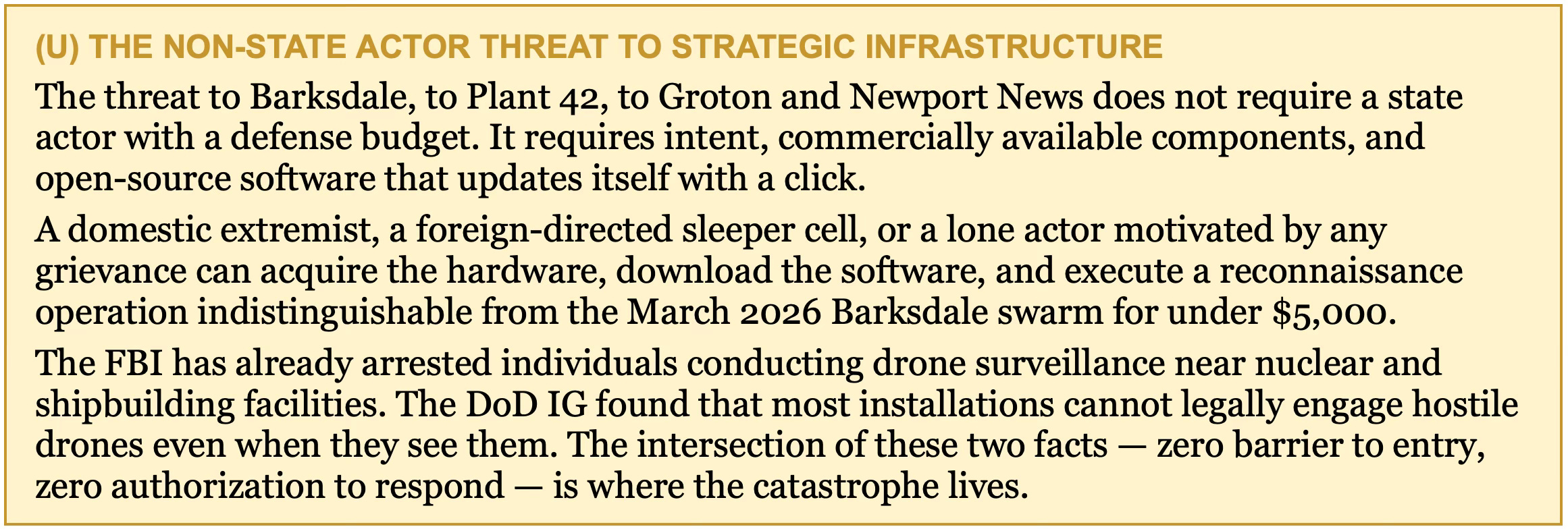
The instinct is to assume that coordinated drone swarm operations remain the preserve of state militaries with dedicated R&D budgets. That assumption is now dangerously obsolete. In 2018, the National Academies of Sciences, Engineering, and Medicine assessed that by 2025, the technologies necessary to deploy collaborative swarms of hundreds of drones would be “widely available.”¹⁰¹ That prediction has materialized. The Combating Terrorism Center at West Point concluded in March 2025 that “the barrier to entry for lethal drone technology is remarkably low and continues to fall,” with the convergence of cheaper commercial drones, GPS-guided autonomous flight, and do-it-yourself payload capabilities amplifying “the asymmetric effects of these systems.”¹⁰⁷
The open-source autopilot ecosystem that makes this possible is not a fringe hobbyist community. ArduPilot and PX4 — both free, both exhaustively documented — together power more than a quarter of all new commercial drone projects in a market worth $2.33 billion.¹⁰⁰ Formation flight, waypoint coordination, and inter-drone communication are standard features, not experimental capabilities. ArduPilot alone has over 18,700 forks on GitHub and more than 700,000 lines of battle-tested code. The flight controller hardware to run it costs under $35. A flyable GPS-equipped drone can be assembled from commercial components for $100–$250 per unit. A swarm of ten, with ground control, runs to a few thousand dollars — less than the cost of a single Javelin missile.

The five-phase evolution documented in Ukraine — from commercial drones for surveillance in early 2022, through modified munition-droppers, to AI-integrated coordinated swarm attacks by 2024 — compressed what should have been a decade of military innovation into thirty months.¹⁰⁸ As one analyst summarized: “What required a dedicated team of engineers in early 2022 can now be accomplished by a reasonably skilled individual following online tutorials.”
(U) 5. BEYOND THE FLIGHT LINE: THE PRODUCTION YARD CRISIS
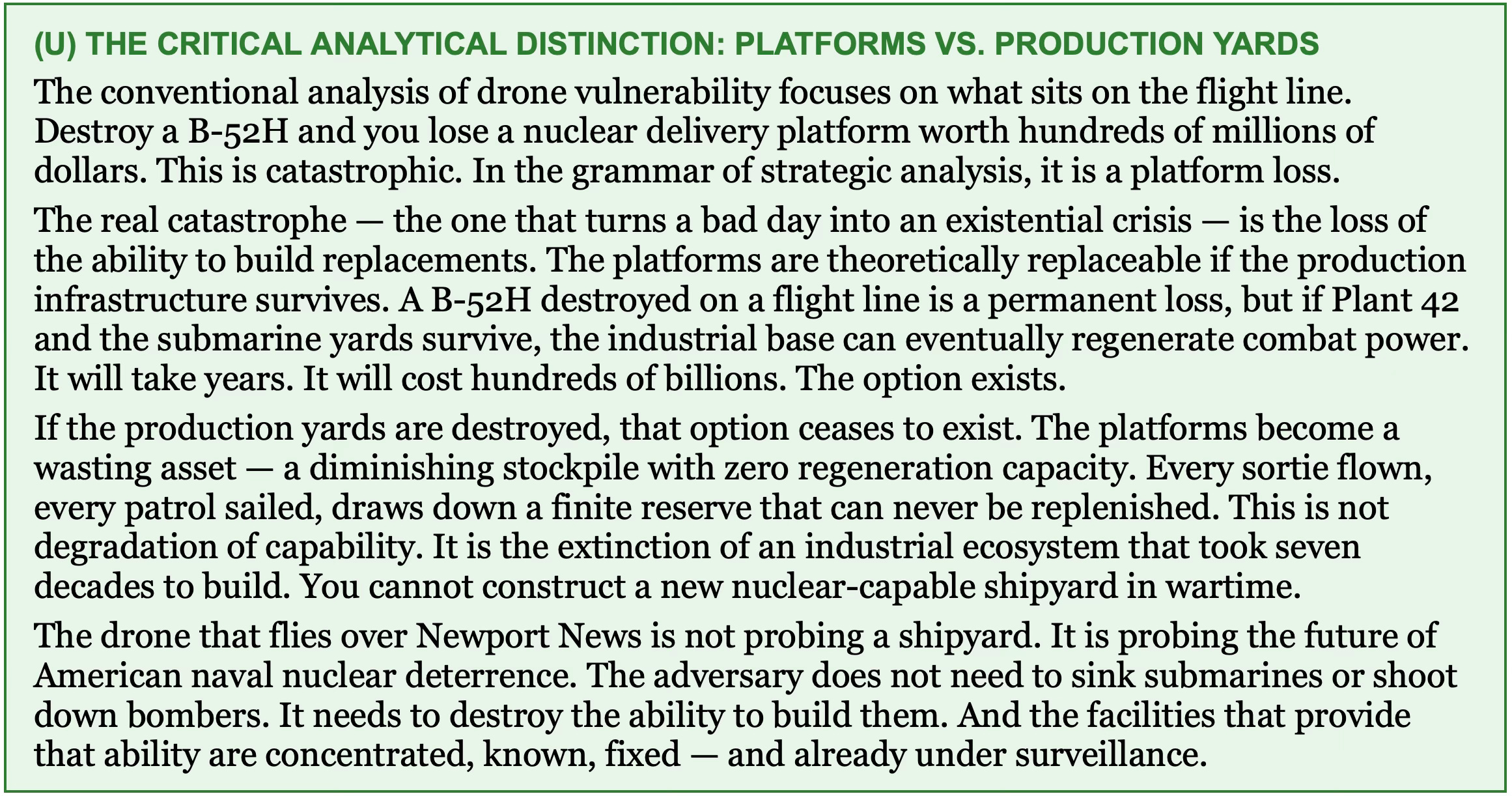
The strategic risk from drone attacks on U.S. bomber bases is severe. The strategic risk from drone attacks on the industrial infrastructure that produces and maintains the assets on those bases is existential. This is the dimension the institutional response has most completely failed to address — and the one that the OSINT record most clearly illuminates.
(U) 5.1 THE PALMDALE CHOKEPOINT: ONE FACILITY, TWO PROGRAMS, ZERO REDUNDANCY
Northrop Grumman’s Air Force Plant 42 in Palmdale, California, performs two functions that are irreplaceable and mutually exclusive: it is the sole production facility for the B-21 Raider, America’s next-generation stealth bomber, and it is the only location capable of repairing damage to the B-2 Spirit’s composite stealth structure.
The B-2 repair benchmark makes the point concretely. When the Spirit of Georgia suffered a landing gear collapse in 2021 — localized, mechanical damage — repair required Northrop Grumman’s specialized Palmdale facility, the design of entirely new repair concepts across four phases, specialized composite manufacturing, and airworthiness certification from scratch. The process took 50 months and cost $23.7 million for damage confined to the landing gear.
A drone strike inflicting damage to a B-2’s stealth skin or avionics — the kind of targeted strike the Spiderweb drones were programmed to execute, using AI to identify fuel tanks and wing roots — would be more severe by orders of magnitude. Repair timelines would extend to five years or more, if feasible at all. The B-2’s stealth coating is not sheet metal. It is a precisely engineered composite system with classified tolerances. A contaminated or structurally compromised stealth surface cannot simply be patched.
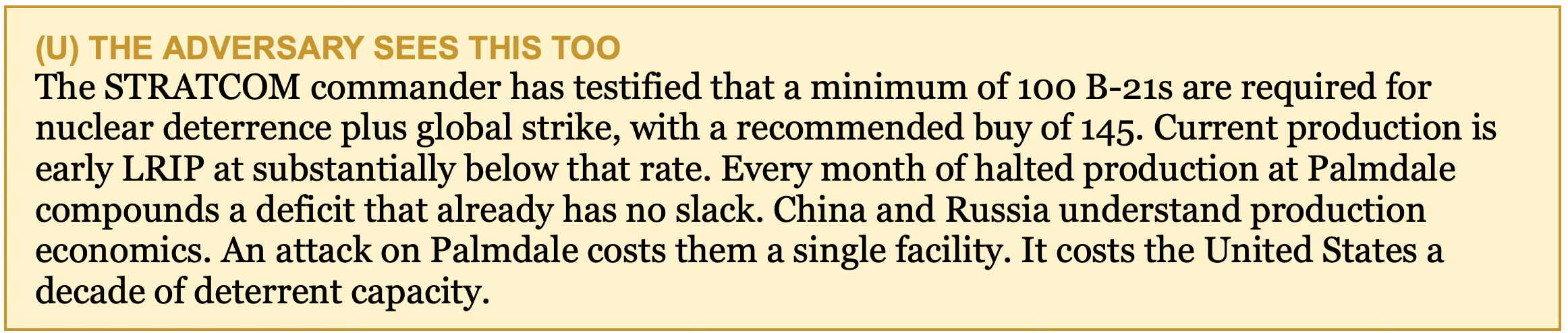
A successful drone attack on the Palmdale facility simultaneously halts B-21 production and eliminates the only pathway to restoring damaged B-2s. At a moment when the Air Force is expanding B-21 production by 25 percent under a $4.5 billion agreement and considering a second production line precisely because demand exceeds single-facility capacity, the concentration of both programs at one location is a vulnerability that no operational security review can ignore.
This is not a future risk. Breaking Defense reported as early as 2022 that Plant 42 was already experiencing “increased incidents of probing” — before Spiderweb, before the Iran war, before the Barksdale reconnaissance swarm. The DoD Inspector General’s January 2026 report found that when investigators asked whether Plant 42 was even a “covered facility” under the statute authorizing counter-drone action — the Air Force said yes; DoD officials could not confirm. Plant 42’s counter-drone legal status is, as of this writing, bureaucratically indeterminate. The most consequential single building in the American defense industrial base does not have confirmed legal authority for counter-drone engagement.
(U) 5.2 THE NUCLEAR SUBMARINE TWO-YARD CHOKEPOINT
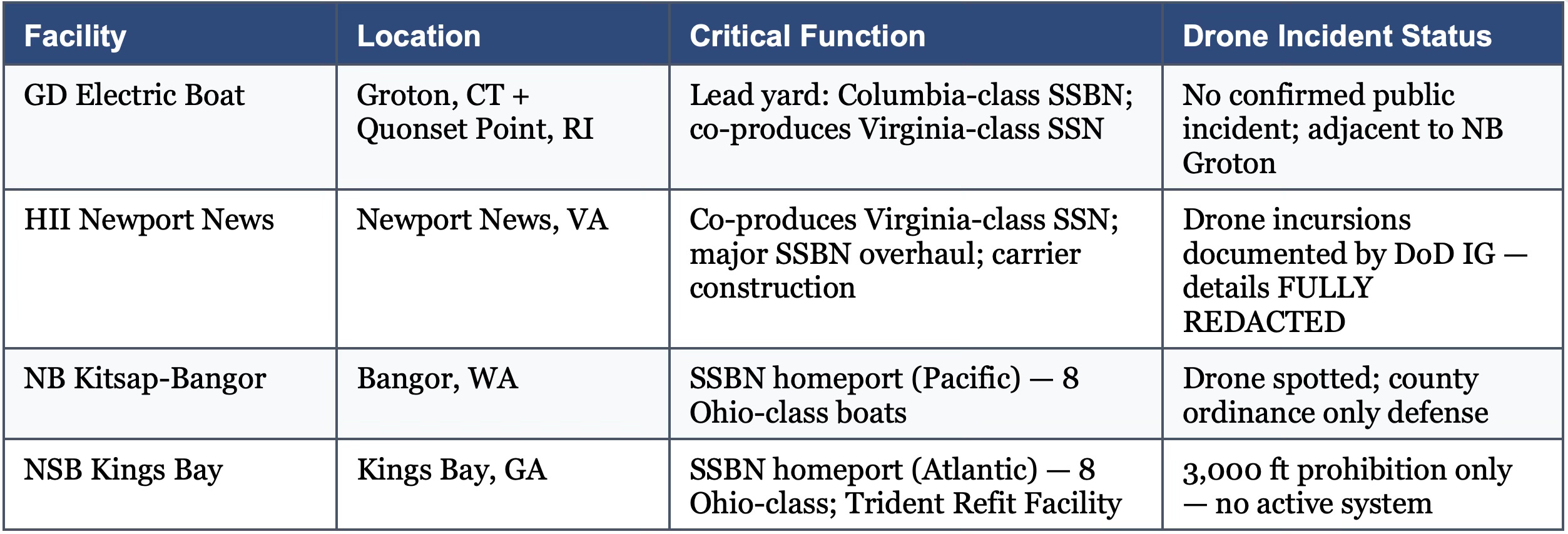
Exactly two shipyards can build or maintain nuclear submarines in the United States: General Dynamics Electric Boat in Groton, Connecticut, and HII Newport News in Newport News, Virginia. Both are known, fixed, unprotected facilities. The Langley 17-night swarm of December 2023 included drones on trajectories toward Norfolk, adjacent to Newport News — simultaneously with a Chinese national photographing nuclear vessels there. The DoD IG confirmed drone incursions at the Newport News Supervisor of Shipbuilding with all details fully redacted.
The consequences of incapacitating either yard are not hypothetical — they are calculable from current production data. Virginia-class SSN production already runs at 1.2 boats per year against a required rate of 2 per year — 60 percent of target, producing a deficit of 19 submarines against the stated requirement of 66. Columbia-class SSBN construction is on a timeline where the first deterrent patrol must be achieved by 2031 to avoid, in USSTRATCOM’s own language, “an unacceptable capability gap.” The existing maintenance backlog stands at 1,500 submarine-days — the equivalent of four fewer submarines available per year. Any disruption to either yard makes these deficits permanent.
(U) 5.3 POWER GRIDS, FUEL FARMS, AND THE INFRASTRUCTURE LAYER
Military bases depend on commercial power grids operated by civilian utilities. High-voltage transformers — the critical link between the transmission grid and base distribution — are custom-manufactured with lead times of 12 to 24 months. There is no strategic reserve. A drone carrying 3 to 5 kilograms of explosive — the standard payload of the FPV quadcopters that flew over Barksdale — could destroy a transformer that takes a year to replace, denying power to flight operations, weapons storage environmental controls, communications, and radar simultaneously.
Every bomber base maintains bulk fuel storage visible on commercial satellite imagery. Operation Spiderweb’s drones were specifically programmed using AI to identify and target fuel tanks and wing roots — because destroying fuel creates secondary fires that spread to adjacent aircraft, compounding damage from each individual strike. At Belaya, satellite imagery showed burn scars consistent with fuel-fed fires spreading across the parking apron.
The ammunition storage dimension adds a further layer. B-52Hs at Barksdale carry AGM-86B Air-Launched Cruise Missiles (nuclear-armed), AGM-158 JASSMs (conventional), and various other ordnance. Weapons loading areas — identifiable on commercial satellite imagery — represent high-value targets where a drone hit could trigger secondary detonation of conventional munitions, producing blast damage far exceeding what the initial drone payload could achieve alone.
Full length media report of Ukraine drone attacks
(U) 6. THE ADVERSARY CALCULUS: IRAN, RUSSIA, AND CHINA
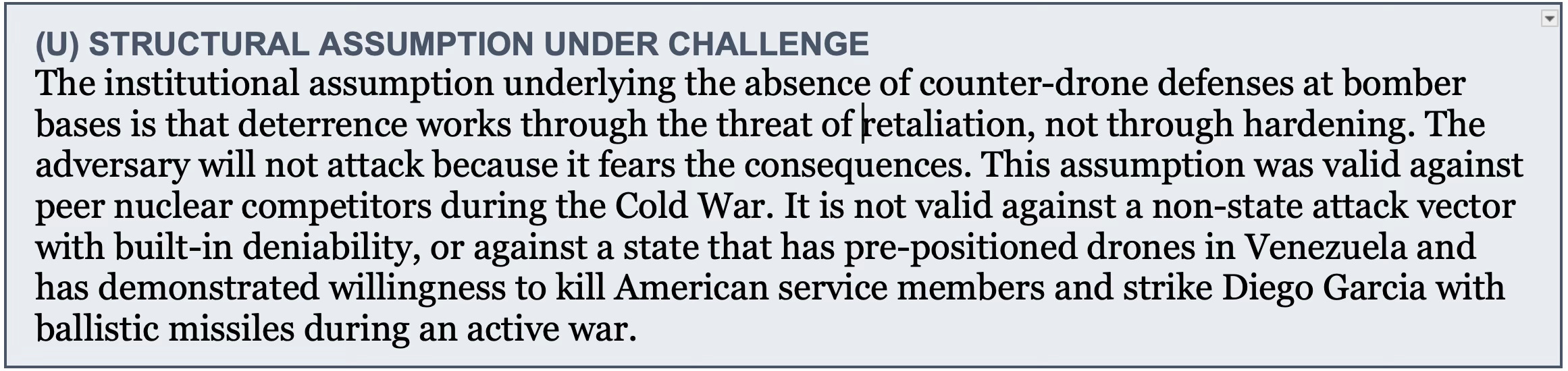
The drone threat to U.S. strategic installations is not an emerging or theoretical capability. Ukraine demonstrated its viability in June 2025. The IRGC has been the world’s most operationally active offensive drone force for over a decade — it has sunk commercial vessels, penetrated Israeli air defenses twice, killed American service members at Tower 22 and Shuaiba Port, and struck Diego Garcia with intermediate-range ballistic missiles on the day this report is compiled. The question is not whether Iran has the intent. The question is whether it has pre-positioned the capability in the Western Hemisphere — and the Venezuela evidence suggests it has.
Russian Tactical Intelligence Sharing
CNN reported, citing a Western intelligence source, that Russia is providing specific advice to Iran on drone tactics derived from the Ukraine battlefield, including: multi-drone coordinated assaults, frequent flight-path alteration for air defense evasion, swarm operations, and electronic warfare integration. Zelenskyy confirmed: “Russia has begun to assist the Iranian regime with drones. This will undoubtedly extend to missiles.”
The strategic logic for Russia is straightforward: every U.S. munition consumed against Iran is unavailable for Ukraine. Enabling Iran to conduct strategic-level drone operations against U.S. bases imposes massive costs with no Russian fingerprints. The triad stress-testing provides real-time data on U.S. air defense performance.
Chinese Enabling Support
The U.S.-China Economic and Security Review Commission reported in March 2026 that China’s support for Iran’s military programs has become “less restrained.” This includes: offensive drones provided directly to Iran; BeiDou satellite navigation access (military-grade precision); YLC-8B anti-stealth radars capable of detecting B-2 aircraft; nearly 1,000 tons of sodium perchlorate rocket fuel precursor shipped in early 2025; and approximately $31.2 billion annually in Iranian oil purchases that fund the entire drone and missile program.
Venezuela: The Western Hemisphere Node
Photographic evidence confirmed between December 2025 and January 2026 that Mohajer-6 combat UAVs — Iran’s most capable armed medium-altitude long-endurance drone, with a 2,400-kilometer operational radius — are operationally deployed at El Libertador Air Base in Maracay, Venezuela. This is the first confirmed presence of strike-capable Iranian drones in the Western Hemisphere. Puerto Rico is 1,100 kilometers from Maracay. The Panama Canal is 1,500 kilometers. Southern Florida is within theoretical range of the Shahed-136 clone Venezuela has designated the Zamora V-1.
The FBI has issued Joint Terrorism Task Force alerts warning of a potential Iranian drone attack from a vessel off the U.S. coast, specifically targeting California. The geometry is consistent with the Venezuela deployment: offshore vessel positioning eliminates ground-to-ground range constraints and generates minimal warning time for CONUS air defenses.
(U) 7. COUNTER-DRONE POSTURE: NEGLIGENCE ON THE RECORD
The United States Air Force did not begin formally developing counter-drone tactics, techniques, and procedures until January 2026 — seven months after Spiderweb. Its first industry solicitations were posted March 6, 2026 — three days before the Barksdale swarm. The institution is asking industry to help it figure out what it needs while hostile actors probe its nuclear bomber base. This section documents the gap in detail.
The DoD Inspector General Finding (January 2026)
Report No. DODIG-2026-045, published January 20, 2026, is the definitive government assessment of the counter-drone posture:
DoD has issued more than 20 policies governing counter-drone systems — they are contradictory, unclear, and “failed to offer clear guidance.”
A large percentage of installations do not have operational approval to use counter-drone capabilities — even where equipment exists.
Luke AFB — where 75 percent of the world’s F-35 pilots are trained — is not designated a covered facility. Commanders cannot legally use counter-drone systems.
Air Force Plant 42, Palmdale — which produces B-21s — cannot be confirmed as covered by DoD officials, despite the Air Force claiming otherwise.
RAND/JCO wargames across six exercises involving approximately 500 bases found a “hodgepodge of varying policies.” In a March 2025 exercise, participants stated “I think this is so-and-so’s role” — the other party responded “no, it’s not ours.”
The Supervisor of Shipbuilding at Newport News — which builds carriers and nuclear submarines — experienced drone incursions; details are fully redacted.
JB Charleston: The Revealing Exception
The fact that Joint Base Charleston — a C-17 cargo hub — received funded counter-drone systems (Medusa Next Gen + Ninja, $5 million from TRANSCOM/OSD) while Barksdale, Kings Bay, and Kitsap-Bangor have no equivalent reveals the systemic prioritization failure. A cargo aircraft hub received protection that the nuclear bomber fleet and SSBN homeports did not. The DoD’s revealed preferences, in the budget record, do not match its stated deterrence priorities.
The Ukraine and Israel Comparison
Ukraine — under active bombardment, with a fraction of the U.S. defense budget — has more effective base defense against drone attacks than America’s most critical nuclear installations. Ukraine intercepts 1,500+ drones per week using layered electromagnetic, kinetic, net-based, and AI-enabled systems. Israel’s Iron Dome provides integrated urban and base coverage. The United States, at its nuclear bomber bases, has shelter-in-place orders and phone calls to the FAA.
(U) 8. CONGRESSIONAL WARNINGS: YEARS OF ALARM, NO ACTION
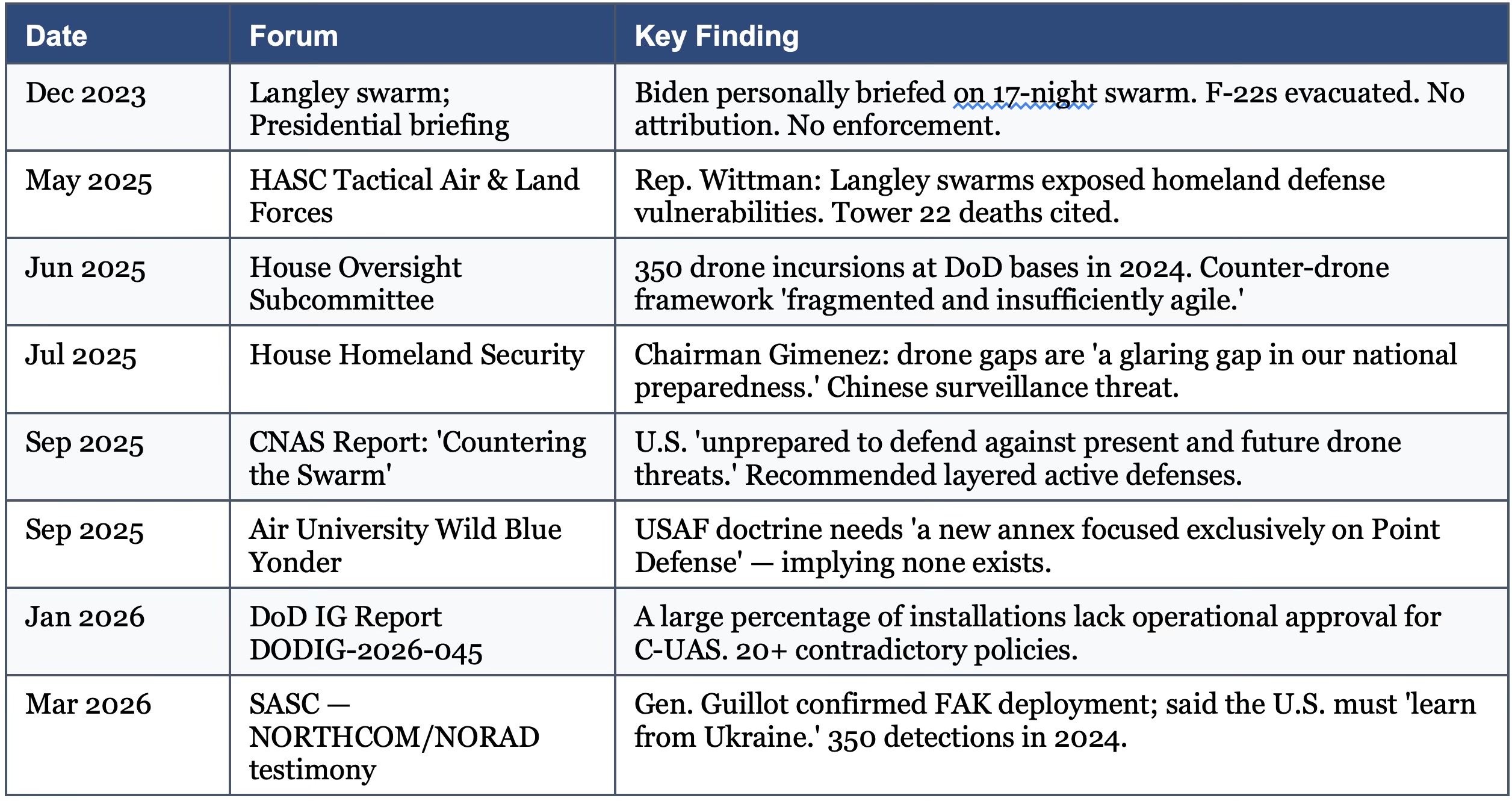
The drone threat to U.S. military installations has been the subject of sustained Congressional attention since 2023. Every major finding has been ignored in terms of fielded defenses. The following timeline establishes the record.
(U) 9. THE MARITIME PRECEDENT: WHAT THE BLACK SEA TELLS US ABOUT THE SSBN THREAT
A country without a navy destroyed one-third of Russia’s Black Sea Fleet. Ukraine, operating with no surface combatants, sank or disabled approximately 20 vessels — including the 12,000-ton flagship cruiser Moskva, multiple Kilo-class submarines, and seven large landing ships — using unmanned surface vessels costing $250,000 each against targets worth tens or hundreds of millions of dollars. On December 14–15, 2025, Ukraine’s “Sub Sea Baby” underwater drone sank a Kilo-class submarine — the first submarine sunk by an unmanned underwater vehicle in the history of naval warfare.
The IRGC has been monitoring this campaign as closely as any military force on earth. Iran has already transferred anti-ship missiles and fast attack craft to Venezuela, creating layered asymmetric maritime capability in the Caribbean. It has operated USV-type capabilities through Houthi proxy forces in the Red Sea, sinking the MV Tutor in the first confirmed commercial vessel kill by combined drone and USV attack.
NB Kitsap-Bangor houses 8 Ohio-class SSBNs — the most survivable leg of the nuclear triad when at sea. The vulnerability is not the submarines at sea. The vulnerability is the submarines in port, the crews and maintenance personnel on base, the refit facilities at Kings Bay, and the two shipyards that must deliver the Columbia-class replacement. A drone or USV attack on Kitsap-Bangor’s waterfront facilities would not need to sink a submarine to achieve strategic effect. It would need only to delay a boat’s departure, damage a refit facility, or kill key technical personnel — compounding a maintenance backlog already equivalent to four submarines per year.
(U) 10. NSD ASSESSMENT AND RECOMMENDATIONS
Immediate Actions Required
1. Emergency C-UAS deployment to Barksdale and Whiteman AFBs: Not fly-away kits — permanent, layered systems combining RF detection, AI-enabled tracking, electronic defeat, and kinetic hard-kill for targets that defeat jamming. The PDBL model is appropriate for development, not for protecting active nuclear bomber bases during a shooting war.
2. Relocate Secretaries Rubio and Hegseth from Fort McNair: Fort Myer offers inland position, elevation, multiple controlled-access gates, and no waterfront exposure. The current arrangement is a succession-official concentration vulnerability on an indefensible peninsula. This should be resolved immediately, not reviewed.
3. Emergency perimeter assessment at Palmdale AF Plant 42: The DoD IG cannot confirm Palmdale’s covered-facility status. This must be resolved within days, not months. Counter-drone systems protecting the sole B-21 production line and sole B-2 repair facility should be treated as equivalent in priority to protecting the aircraft themselves.
4. Immediate investment in hardened aircraft shelters at Barksdale and Minot: Russia built shelters at 14 airfields within weeks of Spiderweb. The United States has 22 hardened shelters across all installations — fewer than three times as many as NATO’s Upper Heyford had in the Cold War. B-52Hs are irreplaceable. Open parking aprons are indefensible.
5. Legal clarification on counter-drone engagement authority: The DODIG-2026-045 finding that most installations lack operational approval to use C-UAS — even where equipment exists — must be resolved by emergency directive, not further policy layering. Commanders defending nuclear assets must not face criminal prosecution risk for engaging hostile drones over their flight lines.
6. Congressional action on expired DHS/DOJ C-UAS authority: The authority under 6 U.S.C. § 124n expired September 30, 2025. H.R. 8610 has not been enacted. The Secret Service’s legal basis for drone mitigation at presidential properties is uncertain. This is a statutory gap that requires closure before an incident forces the question.
7. Classified assessment of Newport News Shipbuilding drone incursions: The DoD IG documented incursions at Newport News with all details redacted. NSD recommends urgent Congressional inquiry into what was observed, what the attribution assessment concluded, and what protective measures have been implemented.
(U) SOURCE CONFIDENCE, ANALYTICAL STANDARDS & ENDNOTES
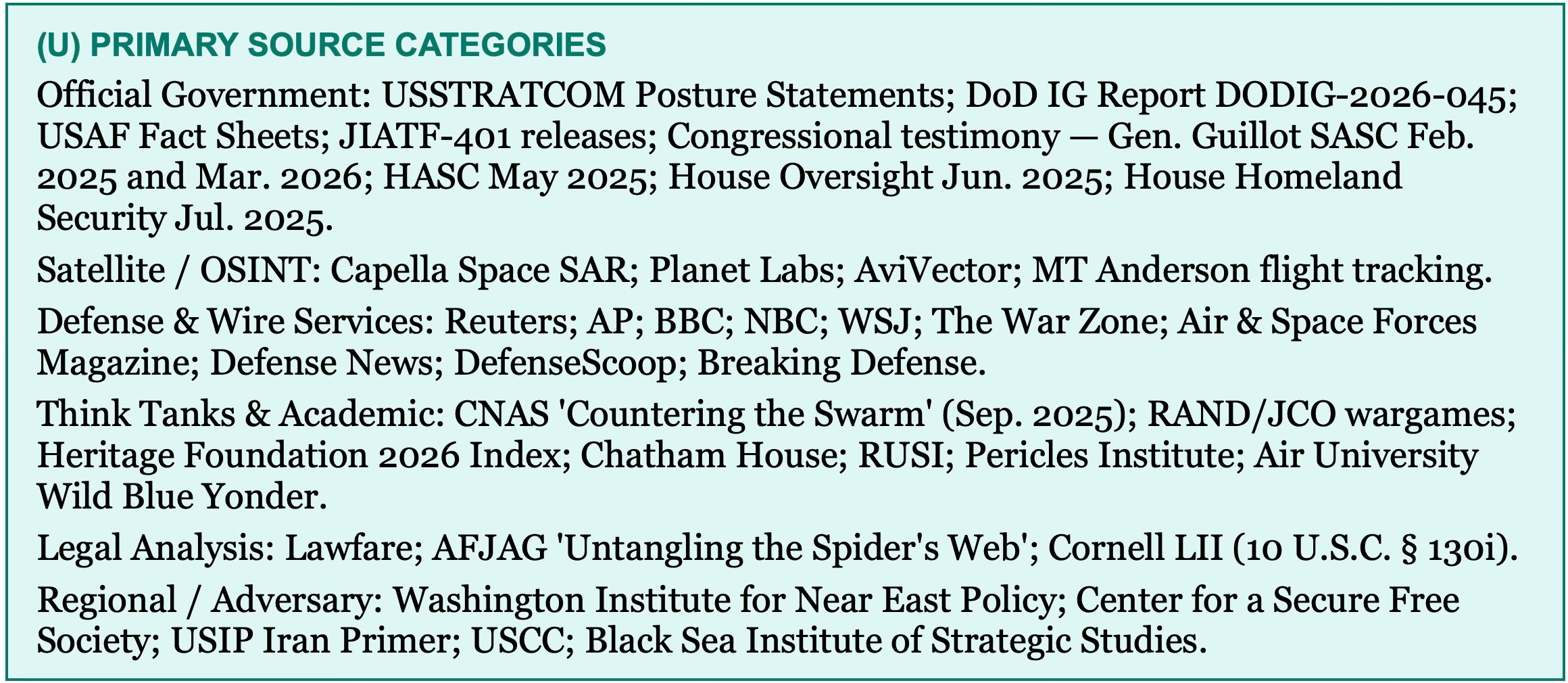
This report was prepared to ICD-203 analytic standards and relies exclusively on open-source intelligence. All 108 citations are independently verifiable by any reader. No classified information was used. Ukrainian government and intelligence claims are identified as such and triangulated against independent OSINT. Confidence levels assigned in the text reflect the evidentiary weight and source diversity supporting each judgment
Back in 2019 Hollywood got it - the Pentagon in 2026 - not so much
The National Security Desk offers these posts freely, but your support is necessary and appreciated. Please subscribe, paid if you’re able, or leave a tip.
Thank you

(U) 108 ENDNOTES — ALL OPEN SOURCE, ALL INDEPENDENTLY VERIFIABLE
1. Wikipedia — Operation Spiderweb https://en.wikipedia.org/wiki/Operation_Spiderweb
2. Reuters, June 1, 2025 — Ukraine drone attack on Russian aircraft https://www.reuters.com/business/aerospace-defense/ukraine-stages-major-attack-russian-aircraft-with-drones-security-official-says-2025-06-01/
3. Militarnyi, June 4, 2025 — Satellite imagery confirms 13 aircraft destroyed at Belaya and Olenya https://militarnyi.com/en/news/operation-spider-s-web-satellite-imagery-confirms-destruction-of-13-aircraft-at-belaya-and-olenya-air-bases/
4. USNI Proceedings, September 2025 — Black Sea Fleet assessment https://www.usni.org/magazines/proceedings
5. Air & Space Forces Magazine, October 2025 — ‘Air Base Defense Is Our Duty. It’s Been Ignored Too Long.’ https://www.airandspaceforces.com/air-base-defense-is-our-duty-its-been-ignored-too-long/
6. CNN Exclusive, March 11, 2026 — Russia sharing drone tactics with Iran https://www.cnn.com/2026/03/11/middleeast/russia-iran-advice-drone-tactics-intl
7. JNS / USCC Fact Sheet, March 18, 2026 — China deepening ties with Iran https://www.jns.org/china-deepening-ties-with-iran-providing-drones-to-tehran-per-report-to-congress
8. Center for a Secure Free Society, January 2026 — Iran military footprint in Venezuela https://www.securefreesociety.org/research/neutralizing-iran-military-footprint-in-venezuela/
9. The War Zone, March 13, 2026 — Drone attacks on U.S. from the sea https://www.twz.com/news-features/drone-attacks-on-u-s-from-the-sea-are-a-known-possibility
10. ABC News, March 20, 2026 — Multiple waves of unauthorized drones at Barksdale (confidential briefing) https://abcnews.com/International/multiple-waves-unauthorized-drones-spotted-strategic-us-air/story?id=131245527
11. Fox News, March 20, 2026 — Unauthorized drones over Barksdale; Mulroy quote https://www.foxnews.com/us/unauthorized-drones-detected-over-u-s-air-force-base-housing-nuclear-capable-b-52-bombers-military
12. The War Zone, March 15, 2024 — Mysterious drones swarmed Langley AFB for weeks https://www.twz.com/air/mysterious-drones-swarmed-langley-afb-for-weeks
13. Wall Street Journal, October 12, 2024 — Drones over military installations; F-22 evacuation detail https://www.wsj.com/politics/national-security/drones-military-pentagon-defense-331871f4
14. 60 Minutes / CBS News, March 16, 2025 — Van Herck on drone swarm detection capacity https://www.cbsnews.com/news/60-minutes-drone-sightings-military-bases/
15. Washington Post, March 18, 2026 — Drones spotted over Fort McNair; Rubio and Hegseth https://www.washingtonpost.com/national-security/2026/03/18/fort-mcnair-drones-rubio-hegseth/
16. FOX 5 DC, March 19, 2026 — Fort McNair drone sightings https://www.fox5dc.com/news/drones-dc-base-rubio-hegseth-security
17. NY Post, March 19, 2026 — Drones over Fort McNair https://nypost.com/2026/03/19/us-news/us-detects-drones-over-fort-mcnair-base-where-marco-rubio-pete-hegseth-live-report/
18. WJLA / ABC 7 News DC, March 19, 2026 — Torres quote; significant security concern https://wjla.com/news/local/unidentified-drones-fly-over-fort-mcnair-expert-calls-it-security-concern
19. Stars and Stripes, March 18, 2026 — MacDill AFB shelter-in-place https://www.stripes.com/branches/air_force/2026-03-18/macdill-afb-shelter-in-place-march-18-21107645.html
20. Washington Post, March 18, 2026 — MacDill AFB suspicious device https://www.washingtonpost.com/national/2026/03/18/macdill-air-force-base-threats-suspicious-device/10c59aee-2312-11f1-954a-6300919c9854_story.html
21. DefenseScoop, March 19, 2026 — Drone incursion at strategic U.S. military base https://defensescoop.com/2026/03/19/drone-incursion-strategic-us-military-base/
22. Gen. Guillot SASC Testimony, February 13, 2025 — 350 detections at 100 installations in 2024 https://defensescoop.com/2026/03/19/drone-incursion-strategic-us-military-base/
23. DoD IG Report DODIG-2026-045, January 21, 2026 — Management Advisory: Immediate Attention Required https://www.dodig.mil/Reports/Audits-and-Evaluations/Article/4383710/management-advisory-immediate-attention-required-to-protect-dod-covered-assets/
24. Defense News, January 28, 2026 — Bureaucratic confusion; Newport News redactions https://www.defensenews.com/unmanned/2026/01/28/bureaucratic-confusion-leaves-dod-sites-exposed-to-drones-dod-ig-says/
25. Defense News, July 25, 2025 — RAND/JCO wargames on drone attacks at U.S. bases https://www.defensenews.com/unmanned/2025/07/25/these-wargames-explored-drone-attacks-on-us-military-bases/
26. Nautilus Institute, January 2026 — After New START: B-52 and $48.6B modernization program https://nautilus.org/napsnet/napsnet-policy-forum/after-new-start-the-b-52-strategic-bomber-and-the-collapse-of-treaty-constraints/
27. Military Watch Magazine, February 2026 — USAF ready for 65% nuclear bomber expansion https://militarywatchmagazine.com/article/usaf-ready-65pct-expansion-nuclear-bomber
28. AFGSC, December 2025 — How the Air Force revived a damaged B-2; 50-month repair at Palmdale https://www.afgsc.af.mil/News/Article-Display/Article/4347120/how-the-air-force-overcame-the-odds-to-revive-a-damaged-b-2/
29. Air & Space Forces Magazine, March 18, 2026 — Pentagon considering second B-21 production line https://www.airandspaceforces.com/pentagon-considering-second-b-21-production-line/
30. Army Recognition, February 2026 — B-21 production increased 25% under $4.5B agreement https://www.armyrecognition.com/news/aerospace-news/2026/u-s-increases-b-21-raider-production-by-25-with-4-5b-to-counter-china-russia-and-iran
31. Small Wars Journal, September 2025 — Cheap drones, priceless targets; Stinger funding removed by OSD https://smallwarsjournal.com/2025/09/09/cheap-drones-priceless-targets-fortifying-americas-bomber-fleet/
32. The War Zone, January 2025 — 22 U.S. hardened shelters vs. China’s 400+; NATO Upper Heyford had 72 alone https://www.twz.com/air/lack-of-hardened-aircraft-shelters-leaves-u-s-airbases-vulnerable-to-china-new-report-warns/
33. Heritage Foundation, March 2026 — 2026 Index of U.S. Military Strength; nuclear rated ‘very mixed’ https://www.heritage.org/sites/default/files/2026-03/2026_IndexOfUSMilitaryStrength_ASSESSMENT_POWER_NUCLEAR.pdf
34. USSTRATCOM 2025 Posture Statement — Columbia-class 2031 first patrol deadline; capability gap warning https://www.stratcom.mil/Portals/8/Documents/2025%20USSTRATCOM%20Congressional%20Posture%20Statement.pdf
35. First Breakfast, May 2025 — Repairing the U.S. Navy’s repair system; 1,500 submarine-day backlog

36. National Security Journal, December 2025 — Virginia-class falling apart; 47 SSNs vs. 66 required https://nationalsecurityjournal.org/the-navys-virginia-class-submarine-program-is-falling-apart/
37. LB.ua, June 2, 2025 — SBU claims; $234K drones vs. $7B damage; 7,000:1 cost-exchange https://en.lb.ua/news/2025/06/02/36048_malyuk_karlssons_ukraines.html
38. NBC News, June 7, 2025 — Spiderweb; Withington/RUSI and Alberque quotes on irreplaceability https://www.nbcnews.com/world/ukraine/ukraine-spiderweb-drone-attack-russia-kyiv-moscow-osint-satellite-rcna211381
39. Moscow Times, June 12, 2025 — Russia relocates bombers; Bronk/RUSI on Anadyr dispersal logic https://www.themoscowtimes.com/2025/06/12/russia-relocates-strategic-bombers-after-ukraines-spiders-web-drone-attack-a89427
40. Moscow Times, July 14, 2025 — Russia constructs bunkers at 14 airfields within weeks https://www.themoscowtimes.com/2025/07/14/russia-builds-protective-bunkers-at-airbases-after-ukraines-spiders-web-drone-strikes-a89800
41. Al Jazeera, June 18, 2025 — Spiderweb forces dispersal; Pantsir/Tor-M2 deployed to bomber bases https://www.aljazeera.com/news/2025/6/18/ukraines-spiderweb-drone-assault-forces-russia-to-shelter-move-aircraft
42. Chatham House, July 17, 2025 — Spiderweb: game-changer for NATO; Norway FFI assessment https://www.chathamhouse.org/2025/06/ukraines-operation-spiders-web-game-changer-modern-drone-warfare-nato-should-pay-attention
43. Breaking Defense, June 9, 2025 — Spiderweb wake-up call; U.S. counter-drone efforts inadequate https://breakingdefense.com/2025/06/spiders-web-warning-the-us-must-prioritize-drone-defense-to-avoid-russias-fate/
44. CNAS, September 2025 — ‘Countering the Swarm’: U.S. unprepared for drone threats https://www.cnas.org/publications/reports/countering-the-swarm
45. 10 U.S.C. § 130i (Cornell Law) — C-UAS authority; covered facilities https://www.law.cornell.edu/uscode/text/10/130i
46. Lawfare — Are domestic drone shoot-downs lawful? Section 130i Dec. 31, 2026 termination https://www.lawfaremedia.org/article/are-domestic-drone-shoot-downs-lawful
47. NPR, February 27, 2026 — Military laser shoots down CBP drone; El Paso airspace closure https://www.npr.org/2026/02/27/g-s1-111794/lawmakers-say-us-military-used-laser-to-take-down-border-protection-drone
48. Forbes, February 27, 2026 — FAA shuts down airspace after Texas laser incident https://www.forbes.com/sites/siladityaray/2026/02/27/faa-shuts-down-airspace-after-us-military-laser-shoots-down-cbp-drone-over-texas/
49. DoD C-UAS Policy Fact Sheet, February 2026 — Hegseth policy; ‘not overly prescriptive’ https://media.defense.gov/2026/Feb/10/2003873921/-1/-1/1/FACT-SHEET-C-UAS-POLICY-IN-THE-US-HOMELAND.PDF
109. Combating Terrorism Center at West Point, March 28, 2025 — ‘The Rising Threat of Non-State Actor Commercial Drone Use’; barrier to entry remarkably low and continues to fall https://ctc.westpoint.edu/the-rising-threat-of-non-state-actor-commercial-drone-use-emerging-capabilities-and-threats/
110. About Objects — ‘The Democratization of Destruction: How Drone Warfare Changed Everything,’ April 24, 2025; five-phase Ukraine evolution compressed a decade into 30 months https://www.aboutobjects.com/2025/04/24/the-democratization-of-destruction-how-drone-warfare-changed-everything/
111. SwarmGPT — ETH Zurich, arXiv:2412.08428, October 2025; LLMs generate coordinated swarm behaviors from plain-language; validated with 200 simulated and 20 physical drones https://arxiv.org/html/2412.08428v2
112. ArduPilot and PX4 open-source autopilot ecosystem — A-Bots, May 2025; powers 25%+ of new commercial drone projects in $2.33B market; 18,700+ GitHub forks; $35 flight controller hardware https://a-bots.com/blog/PX4-vs-ArduPilot
113. National Academies of Sciences, Engineering, and Medicine, 2018 — cited in CTC West Point (2025): by 2025 collaborative swarms of hundreds of drones would be ‘widely available’ — prediction confirmed https://ctc.westpoint.edu/the-rising-threat-of-non-state-actor-commercial-drone-use-emerging-capabilities-and-threats/
50. AFJAG Corps — ‘Untangling the Spider’s Web’; Posse Comitatus fence-line constraint https://www.afjag.af.mil/Post/Article-Display/Article/4388812/untangling-the-spiders-web/
51. Commercial UAV News — C-UAS ROE gap; 6 U.S.C. § 124n expired Sep. 30, 2025; H.R. 8610 not enacted https://www.commercialuavnews.com/drone-defense-at-home-closing-the-cuas-rules-of-engagement-roe-gap
52. HSToday — IRGC: proxy deniability architecture; shared strategic framework https://www.hstoday.us/subject-matter-areas/counterterrorism/irans-islamic-revolutionary-guard-corps-state-how-the-regimes-security-apparatus-drives-external-threats/
53. The War Zone, March 9, 2026 — B-52s and B-1Bs at RAF Fairford; JASSM pylons observed https://www.twz.com/news-features/b-52s-arrive-at-u-k-base-as-air-campaign-over-iran-grinds-on
54. BBC News, February 2, 2026 — UK drone incidents doubled 126 to 266; hostile state actors not ruled out https://www.bbc.com/news/articles/c23rxr1lz8do
55. Reuters, March 2, 2026 — Spain refuses base use for Iran operations; Robles: ‘no assistance of any kind’ https://www.reuters.com/world/middle-east/us-aircraft-leave-spain-after-government-says-bases-cannot-be-used-iran-attacks-2026-03-02/
56. CNN, March 11, 2026 — Russia providing specific drone tactics to Iran from Ukraine battlefield https://www.cnn.com/2026/03/11/middleeast/russia-iran-advice-drone-tactics-intl
57. Moscow Times / CNN, March 11, 2026 — Russia helping Iran with advanced drone tactics https://www.themoscowtimes.com/2026/03/11/russia-helping-iran-with-advanced-drone-tactics-cnn-a92201
58. JNS / USCC, March 18, 2026 — China: BeiDou access, sodium perchlorate, offensive drones to Iran https://www.jns.org/china-deepening-ties-with-iran-providing-drones-to-tehran-per-report-to-congress
59. Center for a Secure Free Society, January 2026 — Mohajer-6 operational at El Libertador, Venezuela https://www.securefreesociety.org/research/neutralizing-iran-military-footprint-in-venezuela/
60. Atlas Institute, March 2025 — Houthi Red Sea campaign; 190 attacks; Suez transits halved https://atlasinstitute.org/the-red-sea-shipping-crisis-2024-2025-houthi-attacks-and-global-trade-disruption/
61. Wikipedia — 2024 Hezbollah drone strike on Binyamina; Iron Dome penetration https://en.wikipedia.org/wiki/2024_Hezbollah_drone_strike_on_Binyamina
62. Anadolu Agency, March 8, 2026 — Hezbollah: 20 drone attacks, Rafael complex, Iron Dome radars https://www.aa.com.tr/en/middle-east/hezbollah-launches-20-rockets-drone-attacks-against-israeli-sites/3854589
63. Washington Examiner, March 3, 2026 — Six Americans killed at Shuaiba Port, Kuwait; Patriot/THAAD present https://www.washingtonexaminer.com/policy/defense/4478100/counter-drone-defense-spotlighted-american-casualties-iran/
64. BBC News, March 21, 2026 — Iranian IRBM strike on Diego Garcia; SM-3 intercept https://www.bbc.co.uk/news/live/ce84073mr06t
65. Washington Institute, December 2024 — Houthi shipping patterns; Iranian USV threat to Indian Ocean https://www.washingtoninstitute.org/policy-analysis/houthi-shipping-attacks-patterns-and-expectations-2025
66. DOJ — United States v. Asif Merchant; Iranian assassination plot against Trump https://www.justice.gov/opa/pr/man-charged-iranian-backed-plot-assassinate-former-president
67. FBI Congressional testimony, December 2025 — Iran continues to plot attacks against former officials https://www.fbi.gov/news/testimony/threats-to-the-homeland-2025
68. Fox News — FBI advisory: Iran explored offshore drone launch platforms near California https://www.foxnews.com/us/fbi-advisory-iran-drone-platforms-california
69. Fox News — Federal warning: intercepted Iranian communications; potential sleeper-cell trigger https://www.foxnews.com/politics/federal-warning-iranian-communications-sleeper-assets
70. ABC News / RBC-Ukraine, March 2, 2026 — All U.S. military bases at FPCON Bravo since Epic Fury https://abcnews.go.com/Politics/us-military-bases-fpcon-bravo-operation-epic-fury/story
71. WUSF, March 18, 2026 — MacDill elevated to FPCON Charlie https://www.wusf.org/military/2026-03-18/macdill-fpcon-charlie-suspicious-package
72. Forbes, February 23, 2026 — Pentagon C-UAS marketplace at IOC; 1,600+ items on CHS catalog https://www.forbes.com/sites/zitaballingerfletcher/2026/02/23/pentagon-to-launch-online-amazon-style-marketplace-for-drones/
73. Air & Space Forces Magazine, March 10, 2026 — ACC Point Defense Battle Lab; first SOP end-2026 https://www.airandspaceforces.com/acc-battle-lab-counter-drone-defense-plans/
74. Grand Forks AFB — Point Defense Battle Lab official page https://www.grandforks.af.mil/Point-Defense-Battle-Lab/
75. JB Charleston C-UAS funding, June 2025 — Medusa Next Gen + Ninja ($5M); only nuclear-mission-unrelated base protected https://www.fairchild.af.mil/News/Article-Display/Article/4207507/joint-base-charleston-strengthens-partnerships-to-counter-drone-threats/
76. Newsweek, April 2024 — Every Russian Black Sea ship sunk or damaged; full list https://www.newsweek.com/every-russian-black-sea-ship-sunk-damaged-ukraine-full-list-1884448
77. National Interest — One-third of Russia’s Black Sea Fleet sunk or crippled https://nationalinterest.org/blog/buzz/one-third-russias-black-sea-fleet-has-been-sunk-or-crippled-210343/
78. Wikipedia — Sinking of the Moskva; Neptune AShM; flagship lost https://en.wikipedia.org/wiki/Sinking_of_the_Moskva
79. 19FortyFive, December 2025 — Kolpino sunk by Sub Sea Baby UUV; first sub killed by underwater drone in history https://www.19fortyfive.com/2025/12/impossible-to-fix-russias-kilo-class-black-hole-submarines-are-an-endangered-species/
80. USIP Iran Primer, February 2024 — Iran’s drone roster: Shahed-136/238, Mohajer-6/10, Karrar, Kaman-22 https://iranprimer.usip.org/blog/2024/feb/02/roster-iran%E2%80%99s-drones
81. PBS NewsHour, March 11, 2026 — Ukrainian troops share lessons from fighting Shahed drones https://www.pbs.org/newshour/show/ukrainian-troops-share-lessons-learned-from-fighting-irans-shahed-drones
82. Army Technology, March 2026 — Shahed-136: 90kg warhead variant; EW integration; 4,000km claimed range https://www.army-technology.com/projects/shahed-136-kamikaze-uav-iran/
83. Daily Sabah, March 15, 2026 — Russia and China’s quiet strategic advantage from U.S.-Iran war https://www.dailysabah.com/opinion/op-ed/quiet-advantage-what-russia-and-china-may-gain-from-us-iran-war
84. FEDweek, June 30, 2025 — Congressional concerns: drone surveillance at DoD and federal facilities https://www.fedweek.com/federal-managers-daily-report/concerns-raised-about-drone-surveillance-at-dod-bases-other-federal-facilities/
85. New York Times, October 30, 2025 — Hegseth and Rubio move onto Fort McNair; Generals’ Row detail https://www.nytimes.com/2025/10/30/us/politics/hegseth-rubio-fort-mcnair.html
86. The Atlantic, October 30, 2025 — Trump officials moving onto military bases; pattern analysis https://www.theatlantic.com/politics/archive/2025/10/trump-officials-military-bases/680000/
87. Military Times, February 12, 2025 — Army spent $137,000 on Hegseth’s Fort McNair residence https://www.militarytimes.com/news/pentagon-congress/2025/02/12/army-spent-137000-on-hegseths-fort-mcnair-residence/
88. Daily Beast, March 11, 2026 — AG Pam Bondi moves to Fort McNair citing cartel and Epstein threats https://www.thedailybeast.com/ag-pam-bondi-moves-fort-mcnair-citing-cartel-epstein-threats/
89. Fox News, March 19, 2026 — Pentagon declines Fort McNair confirmation; relocation under White House discussion https://www.foxnews.com/politics/pentagon-fort-mcnair-drones-hegseth-rubio
90. Wall Street Journal / Nevada Nuclear Security Site, October 12, 2024 — Five drone overflights; source never identified https://www.wsj.com/politics/national-security/drones-military-pentagon-defense-331871f4
91. Breaking Defense, 2022 — Air Force Plant 42 (Palmdale) experiencing ‘increased incidents of probing’ pre-Spiderweb https://breakingdefense.com/2025/06/spiders-web-warning-the-us-must-prioritize-drone-defense-to-avoid-russias-fate/
92. Pericles Institute — ‘The United States was given a great gift through Operation Spiderweb: we discovered a critical vulnerability without suffering a brutal loss.’ https://www.chathamhouse.org/2025/06/ukraines-operation-spiders-web-game-changer-modern-drone-warfare-nato-should-pay-attention
93. Business Insider / Breaking Defense — U.S. Army drone course director on Spiderweb: ‘THE one event I teach to students’ https://breakingdefense.com/2025/06/spiders-web-warning-the-us-must-prioritize-drone-defense-to-avoid-russias-fate/
94. State Department worldwide security review directive, March 2026 https://www.washingtonpost.com/national-security/2026/03/state-department-security-reviews/
95. Kyiv Post, June 4, 2025 — Spiderweb logistics: Chelyabinsk freight cover, truck acquisition, wooden cabin concealment https://www.kyivpost.com/post/53935
96. Axios, June 2, 2025 — Spiderweb surprise attack; SBU operational command detail https://www.axios.com/2025/06/02/ukraine-spider-web-surprise-attack
97. United24 Media — Satellite images confirm Russia building aircraft bunkers at 14 air bases post-Spiderweb https://united24media.com/latest-news/satellite-images-reveal-russia-building-aircraft-bunkers-at-14-air-bases-8963
98. HASC Tactical Air & Land Forces, May 1, 2025 — Rep. Wittman: Langley swarms exposed homeland defense gaps; Tower 22 cited https://www.fedweek.com/federal-managers-daily-report/concerns-raised-about-drone-surveillance-at-dod-bases-other-federal-facilities/
99. Air University Wild Blue Yonder, September 2025 — USAF needs new doctrine annex focused exclusively on Point Defense https://www.airandspaceforces.com/acc-battle-lab-counter-drone-defense-plans/
100. White House meeting convened on Fort McNair drone response, March 19, 2026 https://www.fox5dc.com/news/fort-mcnair-drone-sightings-white-house-meeting
101. U.S. News, March 18, 2026 — MacDill shelter-in-place after security threat https://www.usnews.com/news/national-news/articles/2026-03-18/macdill-air-force-base-shelter-in-place
102. BBC News, October 2024 — UK-Mauritius Chagos agreement; Diego Garcia long-term basing uncertainty https://www.bbc.com/news/articles/c98ynejg4l5o
103. Defence Industry Europe, March 9, 2026 — B-1Bs and B-52s concentrated at RAF Fairford for Epic Fury strikes https://defence-industry.eu/united-states-concentrates-b-1b-and-b-52-bombers-at-raf-fairford-to-expand-operation-epic-fury-strikes-on-iran/
104. WTOP / J.J. Green, March 18, 2026 — Fort McNair drones confirmed independently by source close to matter https://wtop.com/national-security/2026/03/drones-detected-over-fort-mcnair/
105. USSTRATCOM / Admiral Correll, March 2026 — Recommended B-21 minimum buy of 145 aircraft https://www.stratcom.mil/Portals/8/Documents/2025%20USSTRATCOM%20Congressional%20Posture%20Statement.pdf
106. House Homeland Security Subcommittee, July 15, 2025 — Chairman Gimenez: drone gaps ‘a glaring gap in our national preparedness’ https://www.fedweek.com/federal-managers-daily-report/concerns-raised-about-drone-surveillance-at-dod-bases-other-federal-facilities/
107. NATO NCIA, 2024 — Black Blade C-UAS exercise; Skylock, MyDefence, DroneShield evaluated https://www.ncia.nato.int/about-us/newsroom/nato-tests-new-counter-drone-technologies-in-portugal.html
108. DOJ/DHS/FAA/DoD joint federal warning, March 20, 2026 — ‘Severe consequences’ for illegal drone flights near military installations https://media.defense.gov/2026/Feb/10/2003873921/-1/-1/1/FACT-SHEET-C-UAS-POLICY-IN-THE-US-HOMELAND.PDF