

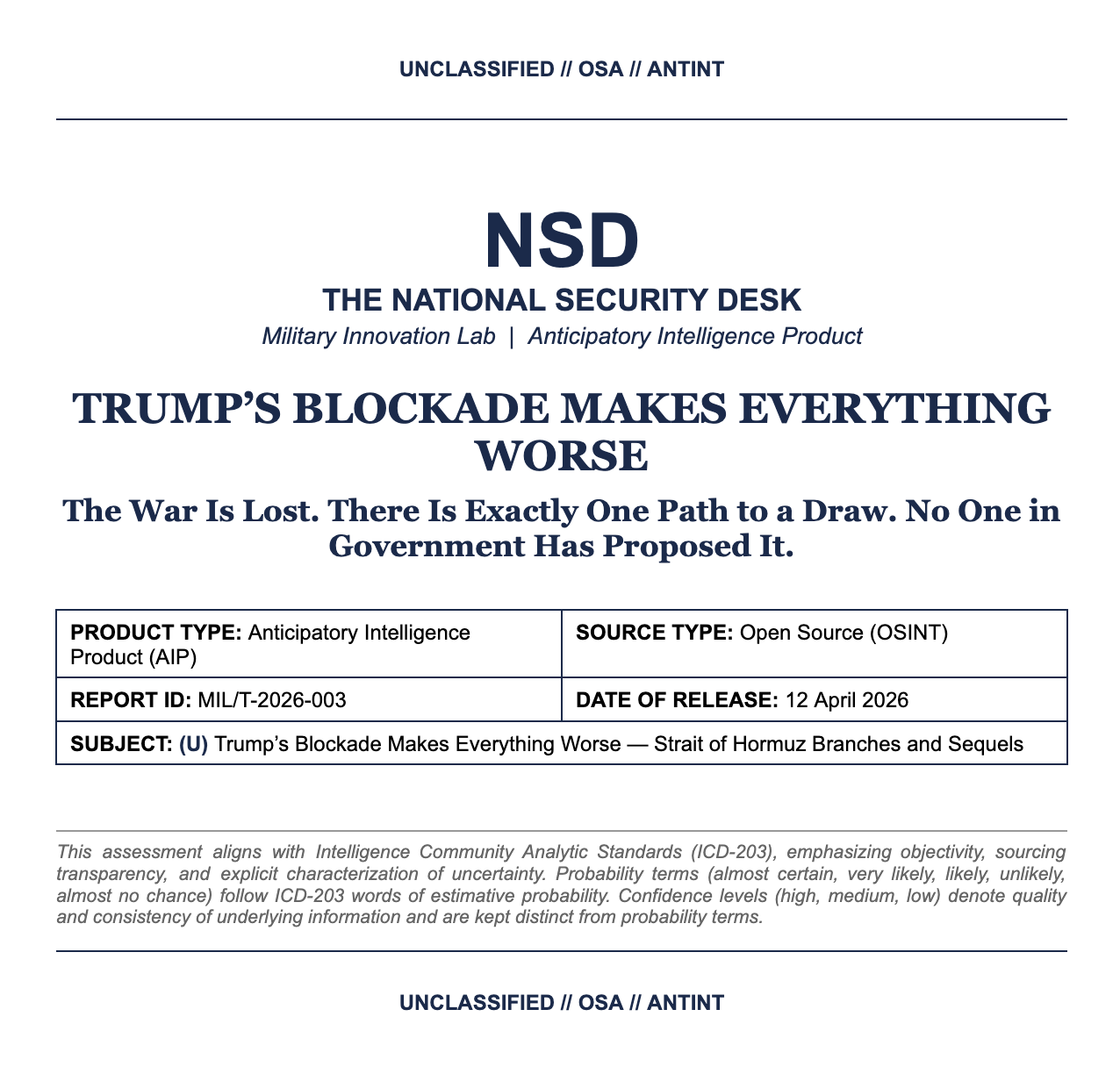
TRUMP’S BLOCKADE MAKES EVERYTHING WORSE
The War Is Lost. There Is Exactly One Path to a Draw. No One in Government Has Proposed It.


WASHINGTON DC 12APL2026
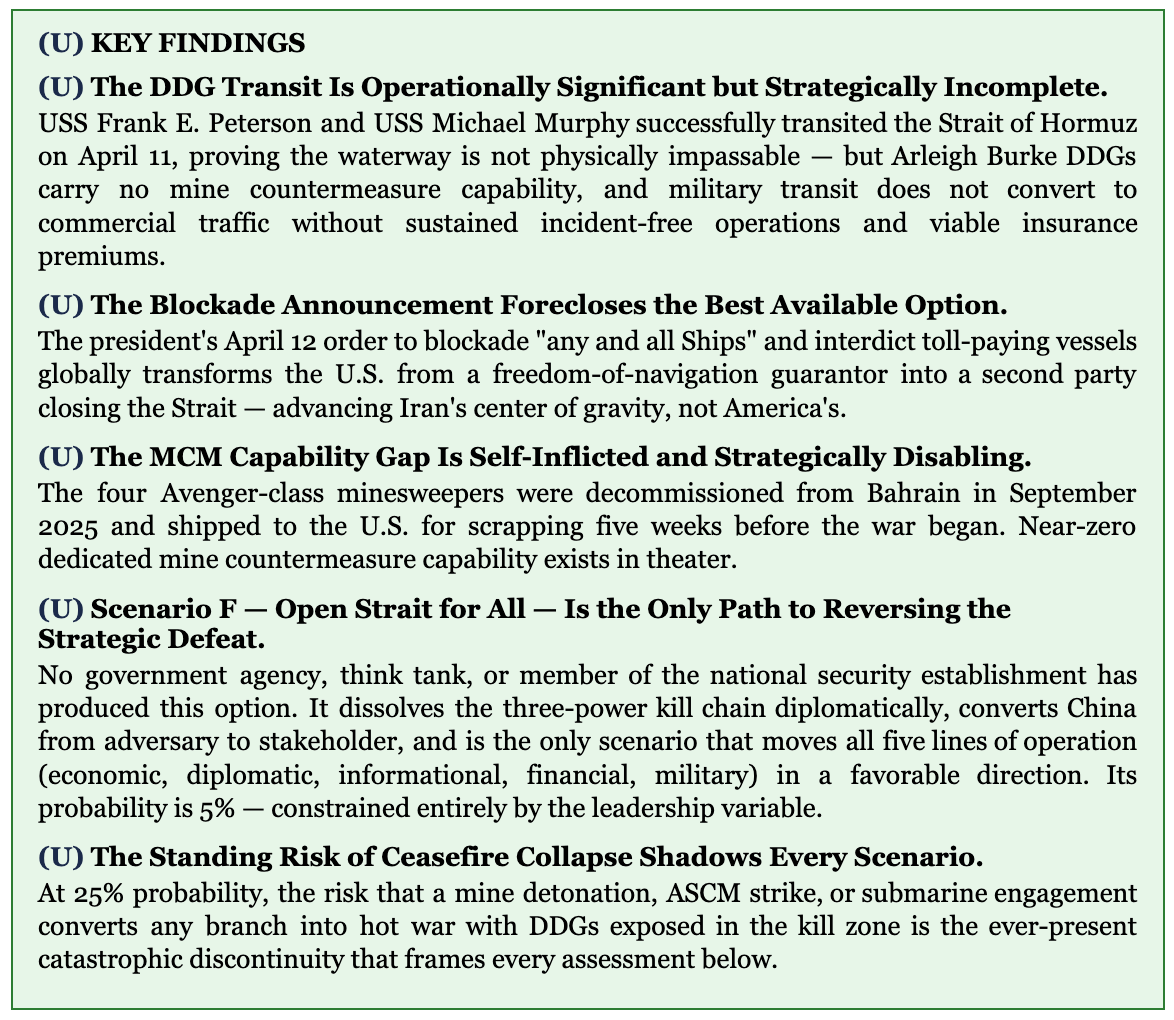
(U) ABSTRACT
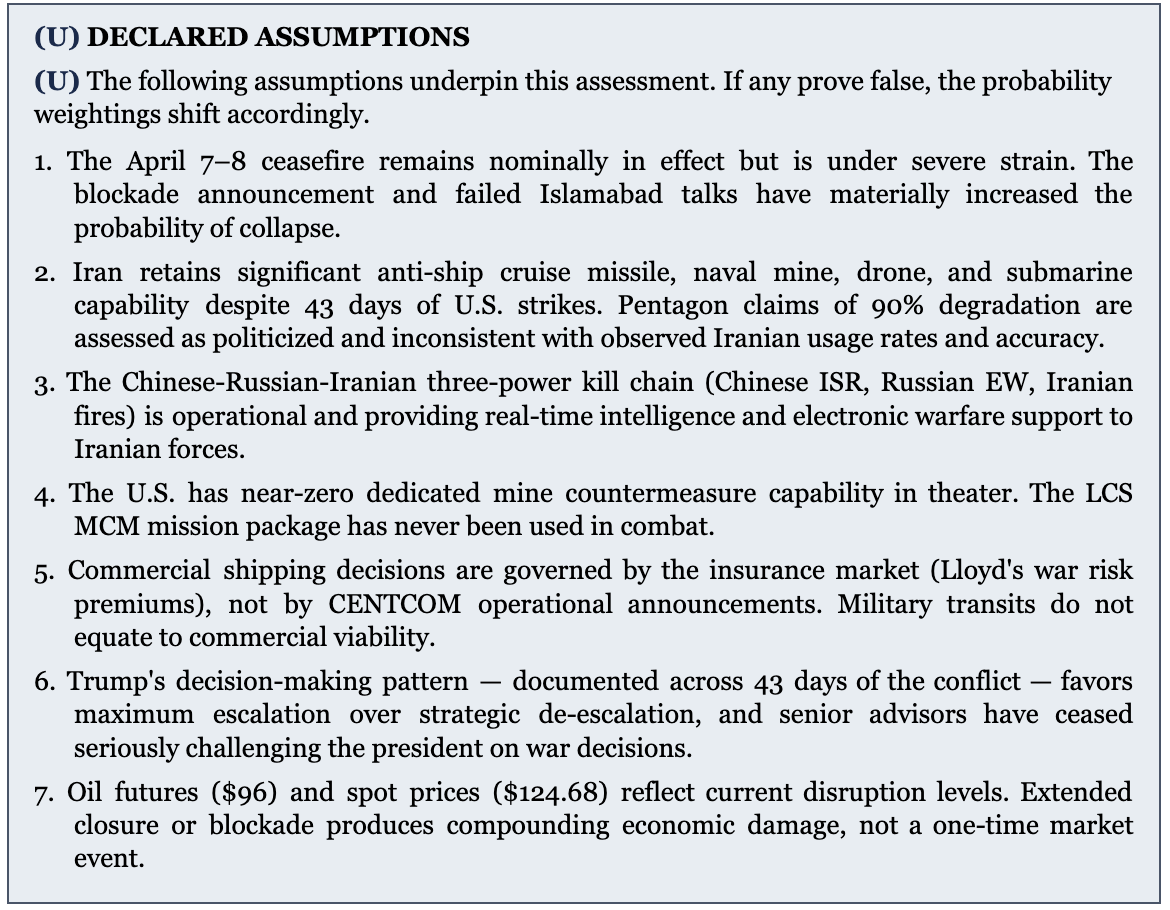
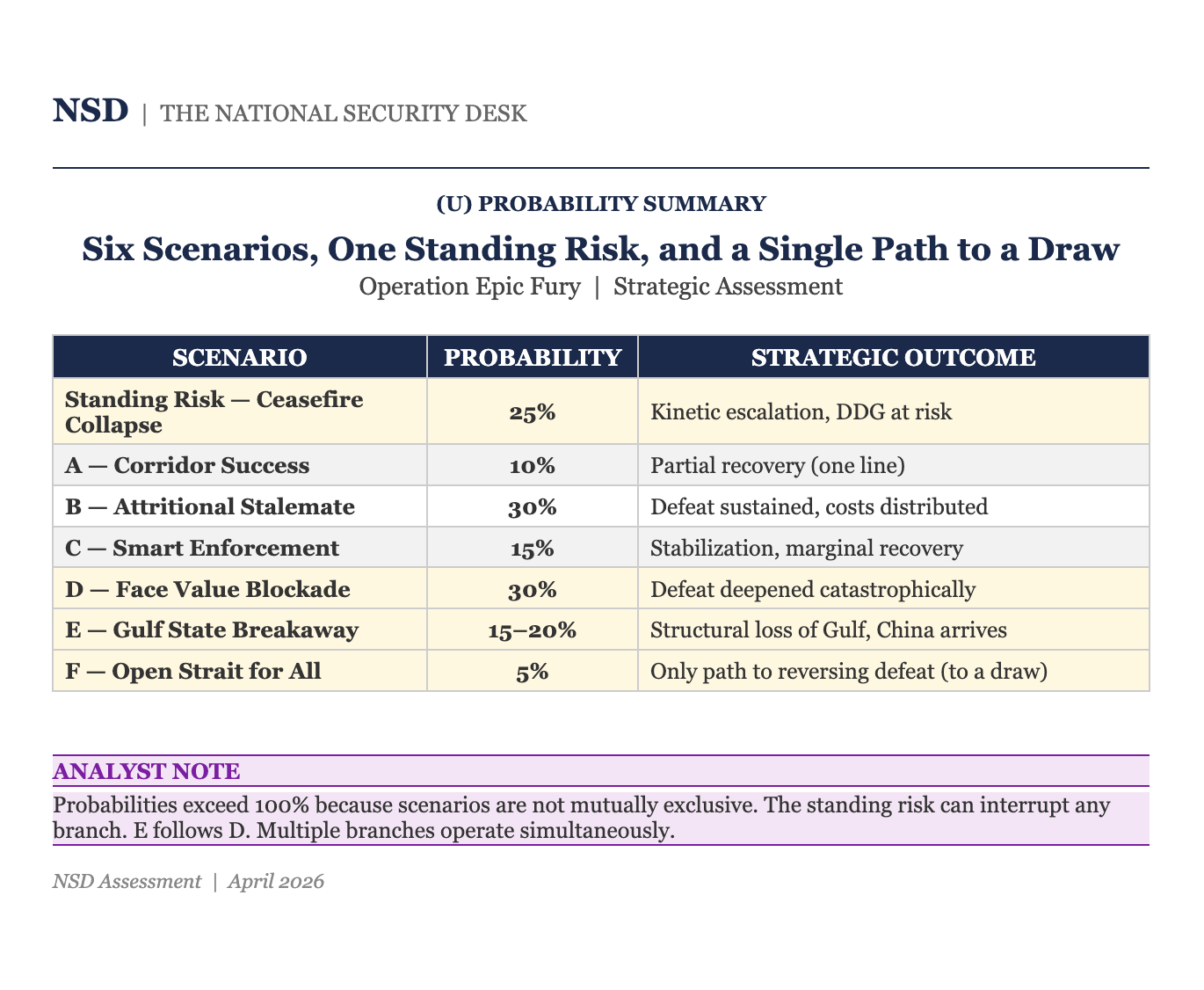
The center of gravity in the U.S.-Iran war is control of the Strait of Hormuz — and the United States is losing it. Overnight developments on April 11–12 — a daring but operationally limited DDG transit, the collapse of Islamabad negotiations, and the president’s announcement of a total naval blockade — have accelerated the trajectory toward strategic defeat while foreclosing the most promising pathway to recovery. This assessment applies NSD’s branches and sequels methodology to evaluate a standing risk (ceasefire collapse) and six scenarios ranging from corridor success (Scenario A, 10%) through face-value blockade escalation (Scenario D, 30%) to a single NSD-originated option — opening the Strait for all nations (Scenario F, 5%) — that represents the only pathway to reversing the strategic defeat, if only to a draw. The structural constraints are severe: the U.S. retired its dedicated mine countermeasure ships from the Gulf five weeks before launching the war, magazine depth limits DDG sustainability to 2–3 major engagements, and a Chinese-Russian-Iranian three-power kill chain multiplies every operational risk. The gap between the 5% probability and 100% strategic necessity of Scenario F is the tragedy of this war.
(U) SECTION I — INTRODUCTION
As of yesterday, the National Security Desk assessed strategic defeat for the United States in the war with Iran.[1] The center of gravity for all parties is control of the Strait of Hormuz. Years of U.S. war gaming have consistently postulated that control of this waterway would be the decisive factor in any Persian Gulf conflict. What has recently become clear — and what this war has demonstrated beyond argument — is that for Iran, control of the Strait is more powerful, in practical and political terms, than possession of a nuclear weapon. The strait that immediately comes to mind when considering this lesson is, of course, the Taiwan Strait — supposedly critical to U.S. strategy but, NSD assesses, less so in reality than the Strait of Hormuz, through which 20% of the world’s oil actually flows every day. This raises a profound question about lost opportunity cost: Iran spent decades investing in a nuclear program that it has not used and may never use, when the weapon it needed was already in its hands — cheap drones, inexpensive anti-ship missiles, naval mines costing a few thousand dollars each, and the geographic accident of a 21-mile-wide chokepoint. The lesson for future warfare is significant: control of a critical maritime chokepoint, sustained by saturation coverage from low-cost precision munitions, may be a more effective instrument of national power than a nuclear arsenal that can never be employed. Iran’s de facto sovereignty over the Strait has been guaranteed by saturation missile and drone coverage that U.S. official statements have consistently underestimated for propaganda purposes. After the first few days of the campaign, Secretary Hegseth claimed 90% of Iranian munitions were spent or destroyed; yet Iranian usage rates and accuracy have gone up substantially since that claim, thanks to Chinese satellite intelligence, Russian electronic warfare assistance, and politicized American assessments of Iranian munitions holdings and usage that have consistently told the president what he wanted to hear rather than what was true.[2]
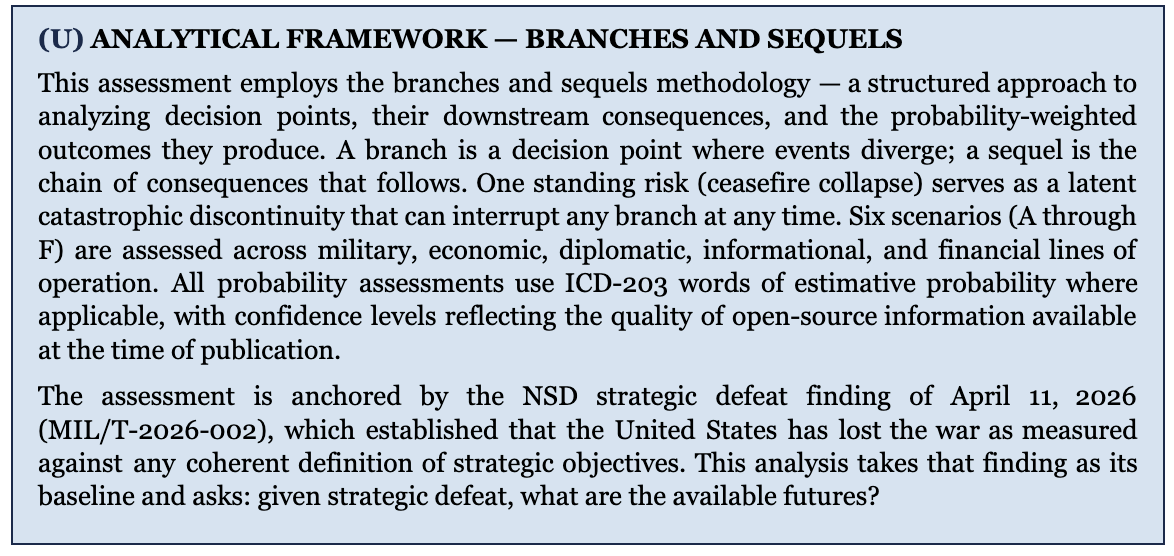
Overnight, a series of developments have taken place that require assessment. In some cases, the information publicly available consists of a social media post that is open-ended and thus lacking the specificity needed to make a direct series of assumptions, analysis, and conclusions. Accordingly, NSD is applying its branches and sequels methodology — the structured analysis of decision points, their downstream consequences, and the probability-weighted outcomes they produce — to assess the full range of plausible futures emerging from the Hormuz crisis.
There is one pathway to turning strategic defeat around — at least with respect to control of the Strait — but it is not what is currently on offer. No government agency, no think tank, no member of the national security establishment has proposed it. It is an NSD innovation — an original analytical product of the National Security Desk, using the situation as it stands at the point of publication. It is our contribution to the effort to pull this war back from strategic defeat to, at best, a draw. We say “at best” because even the optimal outcome is worse than the status quo ante — a Strait that was open and free before the first bomb fell.[3]
Under extreme economic pressure he did not anticipate, Trump — painted into a corner by his own mistakes — issued a threat of genocide and extermination against the same 93 million people he claimed to be liberating when he launched the war 41 days earlier. The arc from “seize control of your destiny” on Day 1 to “your whole civilization will die” on Day 41 is without precedent in American history. This disaster was fully analyzed by NSD: https://nukes.substack.com/p/president-threatens-genocide. Hours after the extermination threat, he accepted a ceasefire on terms favorable to Tehran.
(U) SECTION II — WHAT HAPPENED OVERNIGHT
April 11, 2026 — The DDG Transit. USS Frank E. Peterson and USS Michael Murphy, both Arleigh Burke-class guided-missile destroyers, transited the Strait of Hormuz for the first time since the war began on February 28. CENTCOM stated the ships were “setting conditions for clearing mines.” The USS Michael Murphy activated its Automatic Identification System (AIS) during transit, breaking standard Navy protocol of sailing with AIS off. Maritime historian Salvatore Mercogliano (Campbell University): “You just don’t throw AIS on by accident on a Navy ship. This is purposeful. They wanted to turn this on on the far side of the Strait of Hormuz to demonstrate that they have sailed through.”
The IRGC challenged the destroyers during transit:
IRGC: “This is the last warning. This is the last warning.”
U.S. ship: “Passage in accordance with international law. No challenge is intended to you, and I intend to abide by rules of our government’s ceasefire.”
Iranian media claimed the destroyers turned around after being confronted and that the IRGC launched a drone in their direction.
CENTCOM says additional U.S. forces, including underwater drones, will join the clearance effort in coming days. Axios reports the transit was not coordinated with Tehran.
This was an audacious act of considerable courage. In the tradition of NSD’s key operational hero John Paul Jones — who sailed directly into the enemy’s home waters when conventional wisdom demanded caution — the crews of the Peterson and Murphy drove two 9,000-ton warships through a mined, contested, 21-mile-wide chokepoint, broadcast their position to the world, and responded to hostile challenges with the calm professionalism that defines the best of the U.S. Navy. The ships were exposed, outgunned by coastal batteries on both sides, and sailing over an unmapped minefield that even Iran has lost track of. This was not routine. This was valor.
For the lay reader: these destroyers are not mine clearance vessels. They carry no mine-hunting sonar, no mine neutralization systems, and no capability to detect or destroy naval mines. What they are is the most capable air defense platforms afloat — each carrying roughly 90 VLS cells loaded with missiles that can engage dozens of airborne threats simultaneously. Their purpose in the Strait is not to sweep mines but to provide a defensive shield for future mine clearance operations, and to establish that the Strait is transitable without putting boots on the ground. This act, in and of itself, is a very big deal. It had the potential to go somewhere new and strategically interesting — a non-amphibious pathway to taking back control of the key center of gravity of the war.
April 11-12, 2026 — Islamabad Talks. Trilateral negotiations lasted more than 21 hours. Iran’s delegation comprised 71 people — negotiators, experts, media, security — led by Parliamentary Speaker Mohammad Bagher Ghalibaf and Foreign Minister Abbas Araghchi. The U.S. delegation: Vice President JD Vance, Special Envoy Steve Witkoff, Jared Kushner. Iran’s Foreign Ministry spokesperson stated discussions covered the Strait of Hormuz, the nuclear issue, war reparations, sanctions relief, and the complete end to the war. Turkish media reports negotiations over Strait management were so tense that Araghchi and Witkoff nearly came to blows. No agreement was reached. Vance departed, stating Iran “chose not to accept our terms.” Ghalibaf blamed the U.S. for the failure, saying U.S. officials “failed to gain the trust of the Iranian delegation.” Iran’s Deputy Parliament Speaker Ali Nikzad: “In the 40 days of war, the U.S. has learned that the victorious side is determined by the will of nations and superiority on the battlefield, not by rhetoric on social media.”
April 12, 2026 — The Blockade Announcement. Hours after talks collapsed, Trump posted on Truth Social: “Effective immediately, the United States Navy, the Finest in the World, will begin the process of BLOCKADING any and all Ships trying to enter, or leave, the Strait of Hormuz.” He added: “I have also instructed our Navy to seek and interdict every vessel in International Waters that has paid a toll to Iran. No one who pays an illegal toll will have safe passage on the high seas.”
NSD notes that as stated, this is not a regional interdiction order limited to the Strait of Hormuz or its approaches. “Every vessel in International Waters” is a global directive. The president of the United States has ordered the U.S. Navy to board, search, and potentially seize the vessels of sovereign nations anywhere on the world’s oceans based on a financial transaction with a third party. Under UNCLOS, a merchant vessel on the high seas falls under its flag state’s jurisdiction and cannot be boarded except in cases of piracy, statelessness, or UN Security Council authorization — none of which apply here. As stated, this order threatens piracy against the world.
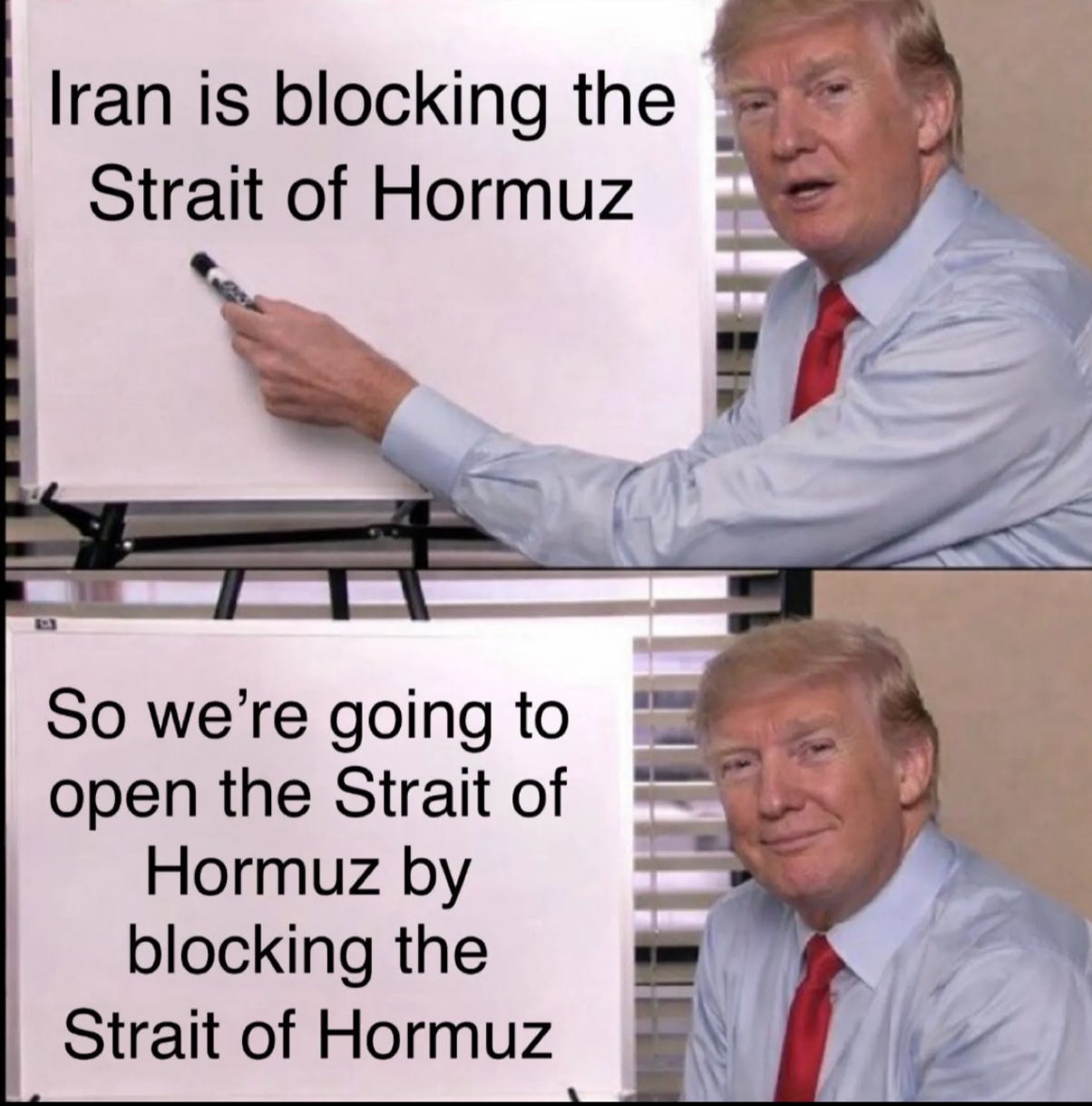
In a separate post, Trump accused Iran of blocking the Strait while simultaneously announcing his own blockade: “As they promised, they better begin the process of getting this INTERNATIONAL WATERWAY OPEN AND FAST! Every Law in the book is being violated by them.” He also claimed all of Iran’s mine-laying boats are “lying at the bottom of the sea” and that the U.S. has “minesweepers” in the Strait. Iran denies both claims. Trump stated other countries would be involved in the blockade. He threatened: “Any Iranian who fires at us, or at peaceful vessels, will be BLOWN TO HELL!”
(U) SECTION III — WHAT THE DESTROYERS CAN AND CANNOT DO
Before assessing scenarios, a baseline capability assessment is necessary. The public framing — “destroyers demining the Strait” — is misleading in ways that matter for every downstream branch.
What Arleigh Burke DDGs are. The Flight IIA Arleigh Burke is among the most capable multi-mission surface combatants afloat. Each carries approximately 90-96 Mk 41 Vertical Launch System (VLS) cells loaded with a mix of SM-2 (area air defense), SM-6 (extended range air defense and terminal ballistic missile defense), ESSM (point defense, quad-packed — four missiles per cell), and Tomahawk (land attack cruise missiles). Its AN/SPY-1D radar and Aegis combat system can track hundreds of contacts simultaneously and engage dozens. It is a supreme air defense platform.
What Arleigh Burke DDGs are not. They are not mine countermeasure vessels. They carry no mine hunting sonar, no mine neutralization systems, no towed mine countermeasure arrays, and no organic mine warfare capability. They cannot detect, sweep, or neutralize mines. Even if embarking UUV platforms (Razorback, Barracuda, or similar), these are route survey tools — they detect and map, they do not neutralize. The kill chain for a moored mine still requires explosive ordnance disposal divers or a dedicated MCM system.
The MCM capability gap — a self-inflicted wound. The United States retired its dedicated Avenger-class minesweepers from the Persian Gulf in September 2025. USS Devastator, USS Dextrous, USS Gladiator, and USS Sentry — the four MCMs that had been forward-deployed to Bahrain for over a decade, providing the exact capability now desperately needed — were decommissioned and physically loaded onto the heavy-lift vessel M/V Seaway Hawk in January 2026 for shipment back to the United States for scrapping. They left Bahrain five weeks before the war started. The decision to remove the only dedicated mine countermeasure ships from the Persian Gulf — the body of water where the United States has faced mine threats in every conflict since the Iran-Iraq War, where the cruiser USS Princeton was mined in 1991 — weeks before launching a war against the country most likely to mine it, is a planning failure of historic proportions. It demonstrates that the war was launched on a whim, without the basic operational preparation that any competent military planner would have demanded.
The remaining four Avenger-class ships are forward-deployed at Sasebo, Japan — roughly 4,500 nautical miles from the Strait. At the Avenger’s maximum speed of 14 knots, that is approximately 13-14 days of transit time, assuming they could sustain the voyage without support. The Navy has stated it has “no plans to recommission any Avenger-class Mine Countermeasures Ships.”
The replacement: Independence-class Littoral Combat Ships (LCS) equipped with the Mine Countermeasure Mission Package. Three LCS with MCM packages were stationed in Bahrain as of late 2025 — USS Canberra, USS Santa Barbara, and USS Tulsa. Two of these three were redeployed to Singapore in March 2026, during the war. The sail time from Singapore back to Bahrain is approximately 3,000 nautical miles — 7 to 10 days at LCS cruising speeds of 14-18 knots, assuming the class’s well-documented reliability problems don’t intervene. The LCS MCM mission package has never been used in combat. More bad planning compounding catastrophic planning.
CENTCOM’s announcement that “underwater drones” would join the clearance effort “in the coming days” is aspirational. The gap between the announced mission (mine clearance) and the available capability (close to zero dedicated MCM assets in theater) cannot be bridged by DDG presence alone.
Additional DDGs. The Peterson and Murphy are not the only destroyers available. Seven other guided-missile destroyers are operating in the Arabian Sea according to USNI News’ fleet tracker. One, the USS Spruance, is traveling as part of the USS Abraham Lincoln’s carrier strike group. Additional DDGs could be surged into the Strait, but doing so draws escorts away from the Lincoln — exposing the carrier to greater danger from submarine, missile, and drone threats. This is the force allocation tradeoff: every DDG sent into the Strait is a DDG not protecting the carrier. British Type 45 air defense destroyers and the Queen Elizabeth-class carriers — among the most capable surface combatants in the world outside the U.S. Navy — would have been enormously valuable here. Shame that this administration spent the months before the war insulting the allies who operate them, saying in the same breath that we wanted their support and then that we didn’t need it. This is the level of incompetence that gets superpowers into deep, deep trouble. It also goes to the pattern that will recur in Scenario E: if Trump will insult the allies he needs for the war, he will certainly punish the Gulf states he perceives as disloyal after it.
VLS replenishment — the logistics problem nobody is discussing. When a DDG shoots its magazine dry in the Strait, where does it go to reload? VLS cells cannot be replenished at sea — this is not a temporary limitation but a fundamental design constraint of every Aegis-equipped surface combatant in the U.S. fleet. The ship must go pierside at a facility with the right crane equipment and pre-positioned munitions. The nearest such facility is NSA Bahrain, headquarters of the U.S. Fifth Fleet, approximately 200 nautical miles inside the Gulf from the Strait — meaning a DDG must sail deeper into potentially hostile waters, past Iranian coastal batteries, to reach it. The reload process takes several days. If Bahrain is assessed as too exposed, the next option is Jebel Ali (Dubai, UAE) at roughly similar distance. If the DDG must withdraw entirely from the Gulf for safety, the nearest major facility is Diego Garcia — approximately 2,500 nautical miles south, a transit of 5-6 days at speed. A DDG that empties its magazine in the Strait is out of the fight for a week at minimum, potentially two weeks if it must withdraw to Diego Garcia. During that time, the corridor is undefended. This is the structural weakness NSD has been warning about for years: the U.S. surface fleet was designed around the assumption that VLS reload would occur in permissive port environments between deployments, not in the middle of a contested chokepoint battle.
A realistic defensive loadout for Strait operations might include 60-70 interceptors per ship, giving two DDGs roughly 120-140 air defense missiles total. Iran’s coastal defense inventory facing the Strait includes hundreds of anti-ship cruise missiles (Chinese-derived C-802, indigenous Noor and Qader variants) in hardened and mobile positions along both coastlines, plus fast attack craft, drone swarms, and three Kilo-class diesel submarines. In a saturation attack, each major engagement burns 30-50% of available interceptors. Two DDGs can sustain perhaps 2-3 major engagements before the quiver is empty.
The adversary’s optimal strategy is not one overwhelming salvo but sequential attacks spaced to drain the magazine, then strike hard when the interceptor inventory is depleted. Iran’s coastal defense doctrine has been designed around exactly this attritional concept for decades.
The “expose launchers” logic cuts both ways. The argument that IRGC firing on DDGs exposes launch sites to carrier air and loitering munitions is valid in a set-piece engagement. But Iran has spent decades distributing ASCM launchers in hardened and mobile positions using shoot-and-scoot TELs along hundreds of kilometers of coastline, coordinated to saturate from multiple azimuths simultaneously. The question is not whether the U.S. can pick off launchers — it is whether it can pick off enough before cumulative leakers overwhelm magazine depth.
The mine drift problem. A declared safe corridor is only safe at the moment it is surveyed. The New York Times, citing U.S. officials, reported on April 9 that Iran has lost track of some of the mines it laid — meaning drifting contact mines are re-seeding the waterway continuously. Nobody — not the U.S., not Iran — has a reliable picture of the minefield. A single mine strike in the “safe corridor” collapses the entire logic chain.
The naval transit vs. commercial transit distinction. For the general reader: a 9,000-ton DDG transiting the Strait at speed under combat conditions is a fundamentally different proposition than a 300,000-ton VLCC loaded with 2 million barrels of crude making the same passage at 12 knots. The DDG is fast, maneuverable, and has active countermeasures. The tanker is slow, cannot maneuver in confined waters, and is defenseless. Military transits establish a data point. They do not establish that the Strait is safe for commercial shipping. The conversion from military transit to commercial traffic flow is the critical step — and it depends on the insurance market, not CENTCOM.
(U) SECTION IV — STANDING RISK AND SIX SCENARIOS
The standing risk that frames every scenario below. This is not a deliberate strategic choice — it is the consequence of placing high-value assets in a confined, contested waterway where mines drift unpredictably, coastal batteries are pre-sighted, and a single mechanical or human failure can trigger a chain of events that no commander planned for and no scenario anticipated.
The blockade announcement arguably breaches ceasefire terms. The IRGC has threatened “strong response” to military vessels. Both sides have grounds to declare the ceasefire violated.
If shooting restarts, the Peterson and Murphy are inside the kill zone — 21 miles from Iranian coastal batteries, within range of hundreds of ASCMs, surrounded by drifting mines they cannot detect, and within torpedo range of Kilo-class submarines.
Iran’s first priority once hostilities resume — if it has the capacity, which is different from capability — is to damage or sink a U.S. DDG. The U.S. has not lost a major warship to enemy action since World War II. A DDG loss would be a strategic shock of the first order. It would halt commercial traffic, dominate the domestic news cycle, crystallize opposition, and validate Iran’s thesis that it can impose costs the American system cannot absorb.
The downstream: boots on the ground. An amphibious response to recover or avenge — Marines going in reactively. The ground war the air campaign was supposed to prevent, in the worst terrain, at the worst time, with depleted munitions, no allies, and 33% approval.
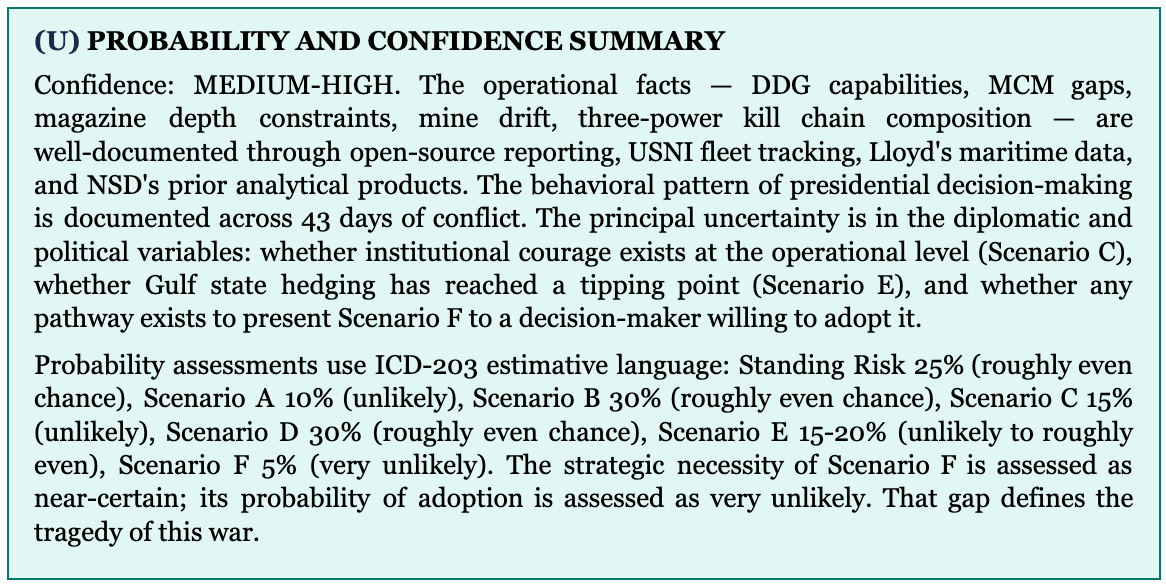
Probability: 25%. Elevated from an initial 15-20% because the blockade announcement and failed talks have materially increased the likelihood of ceasefire collapse. The standing risk exists as a latent threat inside every scenario that follows — A through F can all convert to hot war if a mine detonates, an ASCM finds its target, or a Kilo gets lucky.
Every scenario assessed below is read through this lens: at any moment, a mine detonates, an ASCM finds its target, a Kilo-class submarine gets lucky, and the decision tree collapses into the single worst branch. The scenarios that follow are choices. This is the risk that shadows all of them.
SCENARIO A — CORRIDOR SUCCESS
The original concept. The smartest idea on the table before the blockade announcement changed the trajectory.
The DDG transit of April 11 was the most significant U.S. naval operation of the war — not because of what the ships did, but because of what their presence proved. Two DDGs sailed through a mined, contested chokepoint, broadcast their position, responded to IRGC challenges with calm legalisms, and emerged into the Arabian Gulf. The message: the Strait is not completely physically closed. Iran’s chokehold is both a physical reality — the mines are real, the coastal batteries are real, the attacks on merchant shipping have been real — and a political construct. The DDG transit revealed something important: the physical closure is incomplete. Warships can get through. The political closure — the fear, the insurance costs, the IRGC warnings, the absence of any vessel willing to test the passage — is what has made the blockade functionally total. That distinction matters for everything that follows.
The operational sequence:
Step 1 — DDGs establish presence. Every day the Peterson and Murphy operate in the Gulf without incident degrades Iran’s deterrent credibility. Each successful transit is a data point. But — and this must be clear — a data point for warships, not for commercial traffic. The insurance market that governs tanker movements does not take CENTCOM press releases as actuarial evidence.
Step 2 — MCM assets arrive and begin corridor clearance. UUVs conduct route survey. If the LCS mine countermeasure mission modules can be redeployed from Singapore (7-10 days sailing time, reliability permitting), actual mine neutralization begins. The corridor doesn’t need to be fully clear — it needs to be surveyed well enough to declare a recommended transit route with acceptable risk.
Step 3 — The IRGC does not attack during the ceasefire. If Iran holds fire, the U.S. progressively builds combat power in the Strait. Every additional ship that transits without incident shifts the correlation of forces.
Step 4 — Once hostilities resume, DDGs defend against saturation attack. ESSM quad-packing gives each VLS cell four interceptors against small targets. If the DDGs survive 2-3 major engagement cycles, Iranian launch capacity in the immediate Strait area degrades as mobile launchers are killed by counter-battery from carrier air and loitering munitions.
Step 5 — Commercial shipping follows military traffic. This is the critical conversion from operational to strategic success. The shipping industry needs: a declared safe corridor with published coordinates, war risk insurance at commercially viable premiums (currently 1-2% of hull value — $2.5-5M per transit for a VLCC), evidence of sustained incident-free military transits measured in weeks, and preferably allied naval participation.
Step 6 — Sustainment. The escort mission must be sustained for months. This requires rotating DDGs and cruisers (VLS cannot be reloaded at sea — a strategic weakness NSD has been highlighting for years as fundamentally incompatible with sustained operations in contested waters), maintaining persistent MCM survey (mines drift daily), and keeping carrier air on station.
The Kharg Island end state. If the corridor holds and Iranian coastal defenses are degraded, Kharg Island (approximately 90% of Iranian crude exports, 250nm inside the Gulf) enters the calculus. But the escalation from corridor to Kharg skips several rungs: sustained air superiority over the northern Gulf, suppression of Iran’s entire coastal defense network, and some form of seizure force. NSD has separately assessed that an amphibious assault on Kharg would be extremely high-risk. The Scenario A path to Kharg is through economic strangulation via blockade, not kinetic seizure.
If a DDG is lost. The U.S. has not lost a major warship to enemy action since World War II. A DDG sinking — from mine, ASCM salvo, torpedo, or coordinated drone swarm — would be a strategic shock of the first order. It would halt all commercial traffic immediately, dominate the domestic news cycle for weeks, crystallize opposition, and potentially trigger an amphibious response — boots on the ground in exactly the scenario everyone has tried to avoid.
NET ASSESSMENT — SCENARIO A
The operational logic is sound. This was the right concept before April 12. It put the U.S. on the right side of international law (UNCLOS transit passage), the right side of the global economy (reopening trade), and the right side of the narrative (defender of freedom of navigation against Iranian aggression). Its weaknesses are real — MCM capability gap, magazine depth constraints, mine drift, insurance market inertia — but they are manageable weaknesses, not fatal ones. The blockade announcement moves the trajectory away from Scenario A. This is the road not taken, and it was the better road.
Probability: 10%. Downgraded from an initial assessment of 20-25% because the blockade announcement forecloses this pathway unless rescinded.
SCENARIO B — ATTRITIONAL STALEMATE (RED TEAM)
The grind.
Scenario B is built from the systematic identification of every structural constraint, capability gap, and adversary adaptation that degrades the Scenario A concept into protracted, costly, inconclusive operations.
The MCM capability gap is real and self-inflicted. As detailed in Section II, the Avenger-class MCMs were decommissioned from Bahrain in September 2025 and physically removed in January 2026 — five weeks before the war. The LCS replacements are either in Singapore (two of three, 7-10 days sail time back to Bahrain assuming they can sustain the transit — more bad planning) or in Bahrain with an untested MCM mission package that has never been used in combat. The actual MCM capability available for Hormuz operations is close to zero.
Magazine depth constrains everything. As assessed in Section II: 120-140 interceptors across two DDGs, 2-3 major engagements before empty quiver, no underway reloading. Iran knows this.
Mine drift continuously re-seeds the corridor. Any declared safe passage is only safe at the moment surveyed. Without near-real-time UUV survey capability at the required scale, the corridor concept becomes a daily gamble.
The three-power kill chain multiplies Iranian effectiveness. NSD’s MIL/I-2026-002 assessed: Chinese commercial ISR providing near-real-time DDG tracking (the Liaowang-1 with its 6,000km sensor bubble, plus commercial satellite constellations), Russian EW degrading Aegis radar and communications (NSD assessed up to 80% Starlink degradation via ground-based Ku-band jamming six weeks before Epic Fury), and Iranian fires closing the kill chain. These are not theoretical. The Chinese assets are in theater. The Russian systems are deployed. The intelligence-sharing pathways are active. The magazine depth problem is compounded by a sensor degradation problem.
Insurance and shipping: the real veto. War risk premiums at 1-2% of hull value. Lloyd’s requires months of incident-free transits, verified mine clearance, and assessed cessation of hostilities. The 230+ loaded tankers trapped inside the Gulf represent $30-50 billion in stranded cargo.
Iran’s attritional counter-strategy. Continuous re-mining via fishing dhows and fast boats at night from pre-positioned stockpiles on Iranian islands (Qeshm, Hormuz, Larak). The U.S. cannot interdict every small vessel. Every new mine invalidates the previous survey. This is sea-based insurgency — and America’s track record with insurgencies is not encouraging. Sequential saturation attacks on DDGs designed to drain VLS magazines over multiple cycles. Submarine threat from three Kilo-class diesel boats — extremely quiet in shallow Gulf waters.
End state. Protracted, costly, inconclusive. The Afghanistan model applied to maritime operations. Not losing per se, but not winning, with the clock running against the U.S. The war doesn’t end. It just becomes permanent.
Probability: 30%.
Red team counter-reading: The trap
There is a darker reading of the DDG transit that Scenario B must address. What if Iran is not failing to stop the DDGs — what if it is letting them in? The Maoist revolutionary principle applies: let the enemy advance its forces deep into your territory, extend its supply lines, commit its prestige to holding the ground — and then cut it off and attack. Iran permits U.S. naval assets to enter the Gulf during the ceasefire, allows them to begin MCM operations — and the U.S., being the U.S., does what it always does: it sends more. More DDGs, more support vessels, more commitment, more prestige invested in holding the position. Then, when the ceasefire expires or a provocation can be manufactured, Iran springs the trap. The DDGs are inside a contested 21-mile channel with Iranian coastal batteries on both sides, drifting mines underneath, and Kilo-class submarines in the shallows. The supply line runs back through the Strait itself — the very chokepoint Iran controls.
This is a maritime Dien Bien Phu. The parallel is precise and the historical echo is chilling. In 1954, the French advanced into a fortified valley, committed their prestige to holding it, and were surrounded and destroyed by an enemy that controlled the high ground on every side. The Strait of Hormuz is the valley. The Iranian coastline on both flanks is the high ground. And the historical footnote that should keep every planner awake at night: when Dien Bien Phu was falling, the United States — not yet a combatant — seriously considered using nuclear weapons to save the French garrison. Operation Vulture proposed tactical nuclear strikes on Viet Minh positions surrounding the base. Eisenhower ultimately rejected it. But the fact that nuclear weapons entered the decision calculus of a nation that wasn’t even fighting the war tells you everything about where a maritime Dien Bien Phu leads. Yet again, another scenario where the escalation spiral returns to the nuclear threshold. This is sea-based counter-insurgency in reverse — and it is entirely consistent with IRGC doctrine, which has war-gamed Strait closure scenarios for decades.
SCENARIO C — SMART SELECTIVE ENFORCEMENT
Careful operational interpretation of strategic intent.
There is a version of the blockade announcement that works — if the implementation is narrower than the rhetoric. This is the CENTCOM commander’s scenario. Admiral Brad Cooper and his naval staff would interpret the president’s order not as total closure but as the establishment of a U.S.-managed corridor with selective enforcement against Iranian-linked traffic.
The historical precedent is instructive. When General MacArthur was ordered to put the Japanese emperor on trial, the communiqué was misplaced for a few months — long enough for MacArthur to establish the emperor as the cornerstone of Japan’s postwar reconstruction. Military commanders have historically translated broad political directives into operationally feasible outcomes that serve the strategic interest better than the directive as written.
The concept. Compliant traffic — allied vessels, non-toll-payers, commercially insured shipping — gets escorted through a verified route under DDG air defense cover. Iranian revenue traffic and vessels that paid tolls to the IRGC are selectively interdicted. The U.S. replaces Iranian control with American management of a safe passage.
What this requires. Allied MCM participation — the UK has announced similar demining intentions. Gulf state port cooperation. A framework that producers (Saudi, UAE, Qatar) endorse publicly. Rules of engagement that distinguish between commercial and Iranian-linked traffic.
The critical question. Can Cooper and his team operationalize this more carefully than the Truth Social post describes? The answer depends on whether there is anyone left in the chain with both the authority and the willingness to interpret the order narrowly. The New York Times reported that senior advisors have backed off from seriously putting their foot down with the president on any issue related to the war. If that reporting is accurate, the institutional space for Scenario C may not exist.
Probability: 15%. Requires institutional courage at the operational level to compensate for strategic incoherence at the political level.
SCENARIO D — FACE VALUE BLOCKADE / CUBAN MISSILE CRISIS FOR DUMMIES
Total closure. Universal interdiction. Great power confrontation. The most dangerous scenario — and the one most likely to be chosen.
Trump’s announcement taken at face value: “BLOCKADING any and all Ships” entering or leaving the Strait. Plus global interdiction of toll-paying vessels. This is not just about the Strait of Hormuz. As stated, this is the U.S. Navy claiming the right to board foreign-flagged vessels anywhere on the world’s oceans based on a financial transaction with Iran.
The legal incoherence. Under the San Remo Manual (1994), a lawful blockade must be: formally declared and notified, effectively enforced, applied impartially to all vessels, and must not bar access to neutral ports. Trump’s announcement fails multiple tests. The Strait of Hormuz is not an enemy coast — it is an international waterway bordered by Iran and Oman. Blocking “any and all ships” bars access to Saudi, Emirati, Qatari, Kuwaiti, and Iraqi ports. The toll-payment interdiction extends enforcement globally without legal basis under UNCLOS or any other framework.
The China confrontation. Lloyd’s List data shows approximately 80% of wartime Strait traffic was Iranian-connected and 13% Chinese-owned. Chinese vessels are the primary toll-paying traffic. Interdicting Chinese-flagged vessels is a direct challenge to Chinese flag-state sovereignty.
China already has combat power in theater: a Type 055 cruiser (13,000 tons, peer-level to a Burke), a Type 052D destroyer, and the Liaowang-1 SIGINT ship. Resupply at Salalah, Oman and Djibouti. China will almost certainly surge additional naval forces — not necessarily to use them militarily, but to back its diplomacy as it moves to negotiate around the blockade. The question is not if China surges but how much. It would be very interesting to see the scale of the deployment; it would serve as a real-time indicator of how seriously Beijing takes this threat to its core energy security interests.
The confrontation scenario: China sails tanker convoys under PLAN escort through the Strait, exercising freedom of navigation. The U.S. must either board a Chinese vessel (act of war with a nuclear power), fire on a PLAN escort (the same), or let the convoy pass (blockade dead on day one).
Why this is CMC for dummies. The Cuban Missile Crisis succeeded because Kennedy had a clear limited objective (remove the missiles), proportional response (quarantine, not strikes — Kennedy specifically rejected the word “blockade”), selective enforcement (offensive weapons only, food and fuel passed through), a secret back-channel (Turkey missiles swap), and off-ramps for both sides. Trump’s blockade fails all five: no clear objective, maximum escalation (”any and all ships”), no selectivity, no back-channel (Islamabad just collapsed), and no off-ramp for Iran.
Kennedy also understood: you don’t blockade a waterway your allies depend on more than you do. The U.S. doesn’t import oil through Hormuz. China receives a third of its oil via the Strait. 84% of crude through Hormuz goes to Asian markets. Europe receives 12-14% of its LNG from Qatar through the Strait.
The economic consequences — not just Monday’s market opening. Iran was blocking the Strait. Now the U.S. is also blocking the Strait. The 230+ loaded tankers are still trapped. Oil, already at $96 futures and $124.68 spot, goes higher. But the damage is not limited to Monday’s market open. Every day this plays out without resolution, the costs compound. Energy futures curve steepens. Supply contracts get renegotiated. Downstream industries — petrochemicals, fertilizer, plastics, shipping — reprice everything. Strategic petroleum reserves get drawn down faster. Inflation expectations un-anchor. This is not a one-day market event. It is a rolling economic catastrophe that deepens with every 24-hour cycle of irresolution.
The Strait of Hormuz is the center of gravity for both sides. For Iran, control of the Strait is its primary strategic achievement — more valuable than any weapon in its arsenal. For the United States, reopening the Strait is the only outcome that makes the war retroactively justifiable to the domestic audience and the global economy. A face-value blockade that closes the Strait further does not advance the U.S. center of gravity. It advances Iran’s. Every day of closure is a day that plays to Iranian advantage.
Why Trump will probably choose this option. It is the most childlike, the most confrontational, the most immediately satisfying to a personality that processes strategic failure as personal humiliation. No one in his advising circle is going to dissuade him — and if they try, based on the documented pattern and the New York Times reporting that senior advisors have stopped seriously challenging the president on war decisions, he will not listen. The kinetic ratchet from NSD’s strategic defeat assessment continues to operate: failed force generates political commitments that can only be sustained by more force, which fails again, generating deeper commitments requiring still more force.
Probability: 30%. The most dangerous scenario and the one most consistent with the documented behavioral pattern.
SCENARIO E — GULF STATE BREAKAWAY AND THE UNIVERSAL THREAT SPIRAL
Alliance disintegration. The U.S. becomes the common threat. China arrives as a global superpower.
Phase 1: The trigger. The Gulf states have been harmed by both belligerents. Iran bombed Ras Laffan, hit refineries and desalination plants. The United States has blockaded their export route. The Abraham Accords are dead.
Phase 2: The hedge. The Gulf states don’t flip to Iran — Iran bombed them. They hedge economically toward Beijing. Yuan-denominated oil contracts. Chinese infrastructure investment. PLAN port access at Jebel Ali or Duqm. Qatar negotiates independently with Iran for LNG tanker passage using their shared South Pars/North Dome gas field relationship — not alignment, commercial survival.
This is particularly compelling when you consider what comes next: reconstruction. The Gulf states face a three-to-five-year rebuild — gas processing plants, refineries, desalination facilities, power infrastructure. The United States is not going to help them rebuild. It started the war that caused the damage and is now blockading their exports. China would be delighted to rebuild it. Beijing sees what it would gain: construction contracts worth tens of billions, long-term energy access agreements, deep political influence inside every Gulf capital, and the gratitude of nations that America abandoned.
Phase 3: Trump’s reaction. Independence is betrayal. Betrayal is punished. The groundwork for this rupture was already laid: Trump publicly boasted that MBS was “kissing his ass” — a remark that appalled the Saudi leadership and the Gulf diplomatic establishment. When you have already humiliated the crown prince of your most important Gulf partner for domestic political entertainment, further stress on the relationship is not hypothetical. It is preloaded. Public threats against Saudi Arabia will follow. Demands for increased production — impossible when their oil is blockaded by his own Navy. Punitive measures: weapons sale freezes, Patriot/THAAD withdrawal threats, expanded interdiction against Gulf-flagged vessels. The protector becomes the threat to everyone.
Phase 4: Chinese naval escort. Gulf states accept Chinese freedom of passage through the Gulf side of the Strait — the Oman side, through waters where China has established port relationships at Salalah. PLAN combatants already in theater begin escorting Gulf-flagged and Chinese-flagged tankers.
Iran cannot fire on Chinese escorts. China and Russia are its only strategic partners — satellite ISR, EW systems, BeiDou, diplomatic cover, sanctions evasion. Firing on a Chinese warship severs the only relationship keeping the theocratic regime from total isolation.
The U.S. faces Chinese warships escorting Gulf oil through the Strait America claims to blockade. The U.S. cannot interdict without fighting China. Iran can’t stop it without losing its only ally. The blockade is bypassed by diplomatic geometry.
Phase 5: The new order. This is not merely a regional realignment. If China successfully brokers Gulf security, rebuilds Gulf infrastructure, guarantees Gulf energy exports, and establishes a permanent naval presence in the Persian Gulf — all of which the United States has either abandoned or actively undermined — then this is China’s arrival on the global stage as a superpower to rival, and in practical terms to eclipse, American influence in the most strategically important region on earth. The petrodollar framework erodes. Saudi Aramco accepts yuan. The 40-year Gulf security architecture is replaced by a Chinese-mediated system.
Not only would this give China extraordinary influence inside the Gulf, it would represent a strategic gain of unprecedented proportions in modern history. America would have handed Beijing — through its own incompetence, belligerence, and failure to understand that allies are assets, not vassals — the single greatest transfer of geopolitical influence since the collapse of the Soviet Union. And it would have done so not because China defeated it, but because America defeated itself.
The implications extend beyond the Gulf. A China that successfully controls or guarantees passage through the Strait of Hormuz would inevitably extend its influence to other critical maritime chokepoints — in particular the Strait of Malacca, through which 80% of China’s oil imports currently transit and where it has long sought to reduce its vulnerability to U.S. interdiction. A China that has demonstrated it can guarantee energy security in the Persian Gulf will apply the same model to Southeast Asian waters. The domino effect is not theoretical — it is the logical extension of the precedent being set at Hormuz.
Iran survives. Shattered, economically devastated, but diplomatically rehabilitated through Chinese mediation. The Gulf states end up in a framework that includes Iranian accommodation — giving Tehran indirect rehabilitation it could never have achieved on its own.
Probability: 15-20%. Rises fast if Scenario D materializes. The critical variable is Trump’s reaction to Gulf independence.
SCENARIO F — OPEN STRAIT FOR ALL
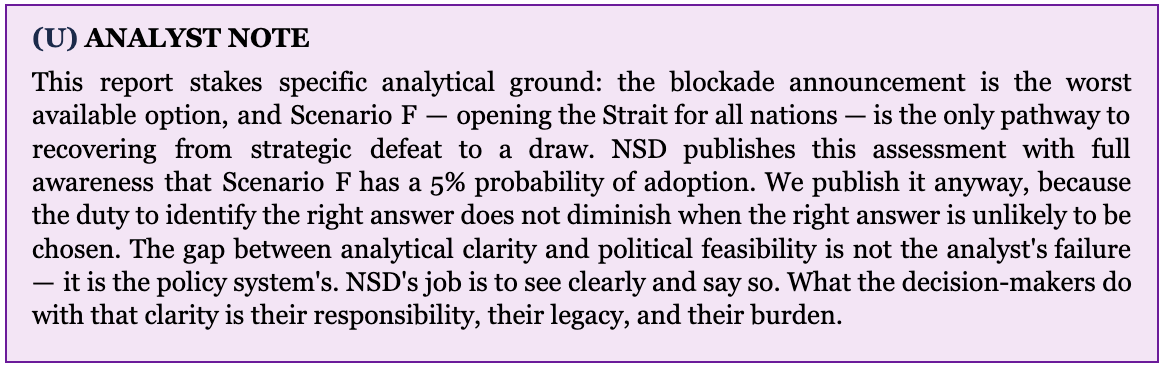
The only pathway to reversing the strategic defeat. This is NSD’s contribution. No government agency has proposed it. No think tank has produced it. No member of the president’s national security team has articulated it. The National Security Desk produces it here, in open source, because no one else has — and because the duty to be useful demands it.
The United States abandons the blockade framing. DDGs protect MCM operations. The corridor is cleared and opened for everyone — Chinese, Indian, European, Gulf state, all traffic. America liberates the world’s oil supply. Free passage guaranteed by U.S. Navy under UNCLOS.
Why F is qualitatively different. Every other scenario operates within the same competitive frame: the Strait is contested and somebody controls it. F flips the frame. The U.S. doesn’t control the Strait. The U.S. liberates it. For everyone. Including the nations currently aligned against it.
What F does across the five lines of operation:
Economic — actually fixes it. Oil flows. All oil. The 230+ trapped tankers start moving. Oil prices drop. The fertilizer supply chain restarts, easing the projected 45 million additional people pushed into acute hunger by 2027. This is the only scenario where the economic line moves from “producing blowback” to “producing benefit.”
Diplomatic — potentially reverses the collapse. China’s calculus flips. Instead of “the U.S. is threatening our energy supply,” it becomes “the U.S. is guaranteeing our energy supply while Iran was the one who cut it off.” That is leverage — the structural kind that produces alignment. Washington tells Beijing: we’re keeping this open for you; now help us pressure Tehran on the nuclear file. China has influence over Iran the U.S. doesn’t — satellite ISR, BeiDou navigation, diplomatic cover, sanctions evasion. If China’s energy security is guaranteed by Washington rather than threatened by it, the incentive structure for intelligence-sharing with Tehran inverts.
The same extends to India (five warships escorting Indian vessels under Operation Urja Suraksha), South Korea (26 vessels stranded, 70% of crude imports through Hormuz), Japan, France, Germany. Coalition-building through shared interest rather than arm-twisting.
Informational — completely reframes the narrative. “America liberated the world’s oil supply from Iranian extortion” is the story this war needed from day one. The only narrative that makes the kinetic campaign retroactively coherent.
Financial — creates conditions for stabilization. Dollar-denominated energy trade resumes. The structural de-dollarization incentive — that American economic power is wielded destructively — reverses if the U.S. is providing a global public good.
The China-specific dynamics. The three-power kill chain — Chinese ISR, Russian EW, Iranian fires — is the force multiplier that makes every other scenario more dangerous. Under D, China escalates. Under F, the U.S. dissolves China’s reason for opposing it. Beijing isn’t going to risk confrontation to defend Iran’s toll racket if the U.S. is guaranteeing Chinese oil flows. The kill chain doesn’t get defeated militarily — it gets dissolved diplomatically.
The Iran problem under F. Iran’s Strait leverage evaporates without anything in return. Iran cannot credibly attack commercial shipping under U.S. and multinational escort without turning every consumer nation against it — including China. If Iran fires on a Chinese tanker transiting under U.S. escort, it has attacked the interests of the two most powerful nations simultaneously. Iran’s options narrow to: accept the fait accompli and negotiate from a weakened but survivable position, or resume attacks and lose China. That is a genuine strategic dilemma — and the only scenario that creates one.
What F does not solve. The nuclear file. The theocratic oppression of a people seeking a new form of government. Domestic will (eased but not restored). Operational risks (mines, magazine depth, DDG vulnerability). And the Strait must be kept open — potentially for years. That sustained presence is expensive. When you consider the status quo ante — a Strait that was open and free before the first bomb fell — the best F achieves is a draw, not a win. America pays the long-term cost of maintaining a force to guarantee what it had for free before it started the war. That is a loss relative to the pre-war baseline. But it is the best available outcome from the worst available starting position.
The binding constraint. F requires the most strategic sophistication from leadership that has demonstrated the least. The president who threatened extermination of a civilization on Day 41, announced a total blockade on Day 43, and treats every independent action by any actor as betrayal is not the president who opens the Strait for China’s benefit to dissolve a three-power kill chain. F is the right answer being offered to the wrong decision-maker.
Probability: 5%. The logic is strongest of any scenario. The leadership variable makes it the least likely to be chosen. And yet it is the only one that offers even the possibility of reversing the strategic defeat. The tragedy of this war is contained in that gap between 5% probability and 100% strategic necessity.
(U) SECTION VI — NET ASSESSMENT
The Strait of Hormuz is the center of gravity for all sides. For Iran, control of the Strait is its primary strategic achievement — more valuable in practical and political terms than any weapon in its arsenal, including the nuclear program that nominally triggered the war. For the United States, reopening the Strait is the only outcome that produces anything other than total strategic loss — not because it justifies the war, which nothing can justify, but because a closed Strait guarantees the war’s consequences compound indefinitely while an open Strait at least stabilizes the damage. For China, uninterrupted oil flow through the Strait is a core national interest. For the Gulf states, the Strait is their economic lifeline. For the global economy, 20% of seaborne oil trade and critical fertilizer supply chains transit this 21-mile channel.
Beyond the immediate crisis, there is a longer-term principle at stake that extends far beyond this war. The conversion of a free and clear international waterway into a toll gate — an economic weapon or instrument of coercion — is a precedent-setting disaster, not just for the Strait of Hormuz but for the global maritime order. If a nation can close an international strait and charge tolls for passage, and the international community cannot or will not reverse it, then every maritime chokepoint on earth becomes a potential future flashpoint: Malacca, Bab el-Mandeb, the Turkish Straits, the Danish Straits, the Suez and Panama Canals. The principle of free transit on international sea lanes — the foundation of global commerce since the age of sail — is at stake. If it is lost here, second- and third-order consequences will arise in locations and scenarios we cannot predict, for decades to come. The open seas become contested territory. Yet another consequence of a war launched without thought to what it would break.
Every scenario assessed in this analysis is ultimately about who controls the Strait and under what terms.
The strategic defeat assessment holds. NSD’s judgment that the United States has lost the war is confirmed by the overnight developments. The Islamabad talks failed. The blockade announcement deepens every failing line of operation. The ceasefire is in jeopardy. The DDGs are in the kill zone. The one move that might reverse the trajectory — Scenario F — has a 5% probability of being chosen.
Scenario F is the only option that offers the possibility of reversing the defeat — and even F achieves a draw, not a win. Opening the Strait for everyone, dissolving the three-power kill chain diplomatically, turning China from adversary to stakeholder, rebuilding alliances through shared benefit rather than coercion — this addresses the economic, diplomatic, informational, and financial lines simultaneously. No other scenario does this.
But even under F, the best achievable outcome is a draw. The Strait was open before the war. Getting it back to open, at enormous cost, with a sustained military presence required indefinitely, while the nuclear material remains unsecured and the Iranian people remain under theocratic oppression — that is not victory. It is damage limitation. The status quo ante was free passage. The best-case future is expensive passage. The difference is the cost of the war.
Scenario F is an NSD product. The entire American national security establishment — the Pentagon, the NSC, the intelligence community, the diplomatic corps — has failed to produce this option. The institutions designed and funded to generate strategic alternatives for the president of the United States have not generated this one. NSD produces it here, in open source, because the duty to be useful extends beyond the duty to be safe, and because the alternative futures — D sliding into E, with the standing risk of ceasefire collapse as the ever-present catastrophic discontinuity — lead to outcomes worse for America, worse for the Gulf, worse for the global economy, and worse for the 45 million people who will go hungry because this war disrupted the fertilizer supply chains that feed them.
The United States should pursue Scenario F immediately. It should abandon the blockade framing, open the Strait for all nations, and convert its military presence from a tool of coercion into a guarantee of global energy security. This is not generosity. It is the hardest form of strategic self-interest: giving something away in order to gain everything that matters.
The war is lost. This might get us to a draw. Nothing else on the table offers even that.
(U) KNOWN UNKNOWNS
The following questions bear directly on the trajectory of outcomes but cannot be answered from open-source reporting at the time of publication:
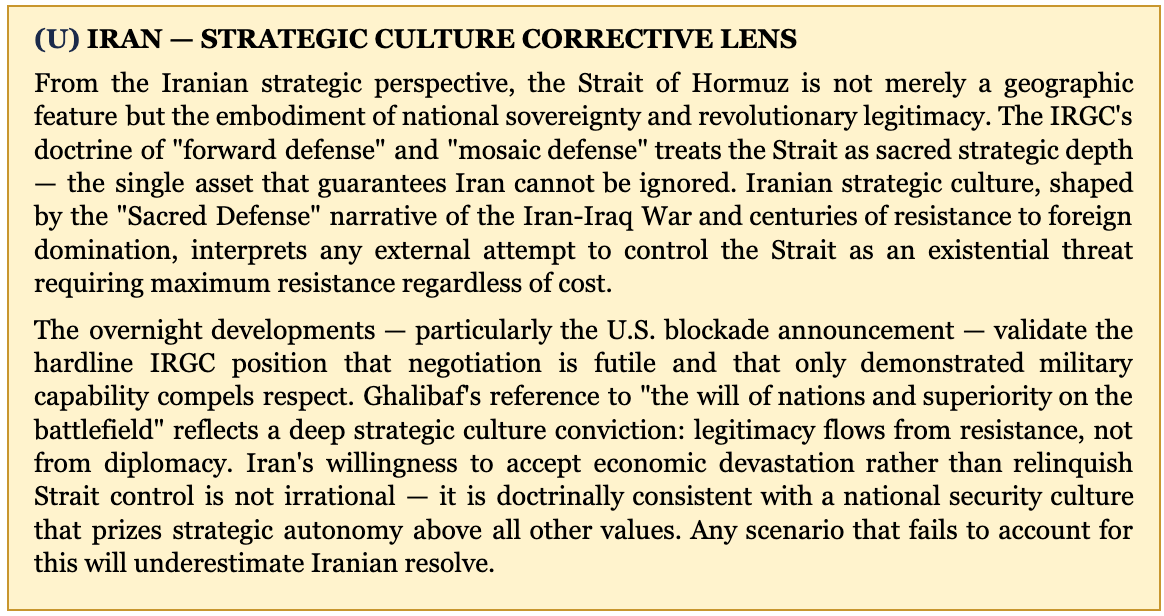
• What is the actual remaining inventory of Iranian anti-ship cruise missiles, naval mines, and one-way attack drones? Pentagon claims of 90% degradation are not credible. The true number determines how many engagement cycles the standing risk can sustain.
• What is the operational status and location of Iran’s three Kilo-class submarines? A single successful torpedo attack on a DDG in the Strait would constitute the most significant naval loss since World War II.
• Has China communicated a red line to Washington regarding interdiction of Chinese-flagged vessels? The existence or absence of such communication determines whether Scenario D triggers great-power confrontation.
• What is the current state of Russian electronic warfare deployment in the Gulf region? The degree of Aegis radar degradation directly affects DDG survivability in every scenario.
• Are there back-channel communications between Washington and Tehran that survived the Islamabad collapse? The complete absence of diplomatic contact raises the probability of the standing risk to its highest assessed level.
• What is the actual mine count and distribution in the Strait? Iran has lost track of some of its own mines. The unmapped minefield is the single greatest physical threat to every scenario involving maritime transit.
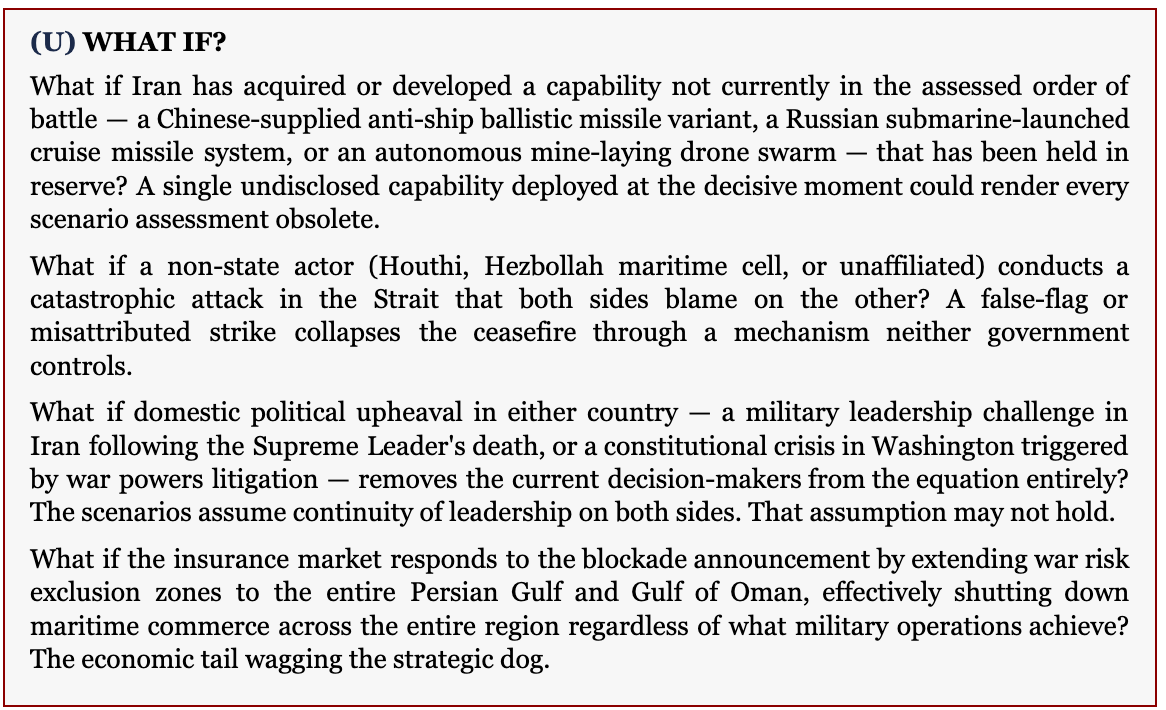
The following scenarios lie outside the assessed probability space but could fundamentally alter the trajectory:
The National Security Desk offers these posts freely, but your support is necessary and appreciated. Please subscribe, paid if you’re able, or leave a tip.
Thank you

(U) ENDNOTES — HISTORICAL OPERATIONAL CONTEXT
The following chronology provides the full operational context for the April 11-12 developments assessed in this analysis. It is presented as an endnote to preserve the BLUF structure of the main assessment while ensuring the complete factual record is available for reference.
February 28, 2026: The United States and Israel launch Operation Epic Fury. Supreme Leader Ali Khamenei is killed on Day 1. Iran retaliates with missile and drone strikes against Israel, U.S. bases, and Gulf infrastructure. The IRGC closes the Strait of Hormuz.
Early March 2026: IRGC announces the Strait closed to U.S., Israeli, and Western allied shipping (March 5, confirmed March 8). Chinese, Indian, Turkish vessels permitted selectively. On March 7, the Chinese-owned-and-operated Sino Ocean broadcasts its Chinese status to transit — establishing the precedent of Chinese sovereign commercial passage. Iran begins mining the Strait (confirmed by U.S. intelligence March 10). U.S. claims 16 minelayers destroyed. Multiple merchant vessel attacks: at least 16 reported attacks and four suspicious incidents by March 12. Lloyd’s List reports 600+ vessels stranded in the Gulf.
NSD pre-war finding (six weeks before Epic Fury): Iran demonstrated up to 80% Starlink degradation via Russian EW ground-based jamming (”jamming dome”). Ku-band LEO SATCOM not survivable in contested Gulf EW environment.
Chinese force positioning (February-March 2026): PLAN deploys Liaowang-1 (30,000-ton SIGINT ship, 6,000km sensor range), Type 055 cruiser, and Type 052D destroyer to the Gulf of Oman. Chinese satellite constellation (500+ satellites) providing real-time ISR to Iranian command structures. BeiDou navigation shared with Tehran after U.S. jammed GPS during 2025 Israeli-Iranian conflict. Maritime Security Belt 2026 exercises conducted with Russia and Iran in the Strait of Hormuz region in February.
March 10-25, 2026: G7 agrees to explore convoy escort. India launches Operation Urja Suraksha (five warships escorting Indian vessels in Gulf of Oman). Pakistan deploys JF-17 Block III fighters to Saudi Arabia. Two of three LCS with MCM packages redeployed from Bahrain to Singapore.
March 22, 2026: NSD publishes “Predictable Pearl Harbor” MILab report identifying drone vulnerability at Barksdale, Fort McNair, and production yards. Nine days later, Hegseth announces bunkers as “theater priority.”
March 23, 2026: NSD SITREP publishes “Dual Culmination” callout box assessing both sides approaching munitions culmination with asymmetric cost curves.
Late March 2026: NSD publishes MIL/I-2026-003 “The Floor Problem” — approximately half of Iran’s missile/drone arsenal intact, contradicting Pentagon 90% claims. Reuters confirms ~30% degradation nine days later.
April 1, 2026: NSD publishes NSD/NUKES-2026-004 on Iranian uranium/HEU disposition and CWMD feasibility.
April 3, 2026: A French vessel crosses the Strait of Hormuz.
April 7-8, 2026: Two-week ceasefire brokered by Pakistan. Terms: U.S. halts strikes, Iran reopens Strait. Trump calls Iran’s 10-point proposal “a workable basis on which to negotiate.” Iran’s conditions: continued Strait control, sanctions relief, war reparations, enrichment rights. Multiple versions of the plan circulate with discrepancies between Persian and English texts.
April 9, 2026: No sign of Strait reopening. Iran re-blocks traffic. UAE oil chief Sultan Al Jaber: Strait “still not open — access is being restricted, conditioned, and controlled.” 230+ loaded tankers waiting inside the Gulf. NYT reports Iran has lost track of some mines — drifters re-seeding the waterway. Week of March 30-April 5: 72 vessels transited (busiest since war, still 90% below normal). 80% Iranian-connected, 13% Chinese-owned.
September 25, 2025: USS Devastator decommissioning ceremony in Bahrain — the last Avenger-class MCM in the Middle East. USS Dextrous, USS Gladiator, and USS Sentry had been decommissioned earlier. All four loaded onto M/V Seaway Hawk in January 2026 and shipped to the U.S. for scrapping. Five weeks later, the war began. Four Avenger-class MCMs remain in service at Sasebo, Japan.
The National Security Desk offers these assessments freely in service of the public interest. This analysis represents NSD’s independent judgment, produced without access to classified information, using open-source methods and the analytical frameworks documented in NSD’s published methodology.
NSD’s value proposition is anticipatory intelligence — publishing before confirmation, with fully articulated reasoning chains, because the duty to be useful is a moral obligation, not merely a commercial one. The options assessed here are not being produced by the institutions responsible for producing them. That gap — between what the national security system should be doing and what it is doing — is why NSD exists.
Scenario F is an NSD product. The national security establishment has not produced it. We have.
NSD | THE NATIONAL SECURITY DESK
(U) REFERENCES
[1] NSD MILab, 11 April 2026, “THE US HAS LOST THE WAR.” https://milab.substack.com/p/the-us-has-lost-the-war
[2] Trump refuses to acknowledge Russian assistance to Iran and thus yet again favors Russia over U.S. forces. Russia’s provision of EW systems, targeting data, and electronic warfare expertise to Iran has directly contributed to the lethality of Iranian fires against American assets. The president’s silence on this point — driven by his unwillingness to criticize Moscow under any circumstances — constitutes a de facto decision to accept increased risk to U.S. service members rather than confront a patron. NSD has documented this pattern across the entire conflict.
[3] The status quo ante point is critical to honest assessment. Before February 28, 2026, any vessel of any flag could transit the Strait of Hormuz freely under international maritime law. The best achievable outcome of Scenario F is a Strait kept open by sustained U.S. military presence at enormous cost, while the nuclear material remains unsecured and the Iranian people — who desire freedom from their oppressive theocratic regime — will remain oppressed. That is not victory. It is damage limitation. The difference between the pre-war baseline and the best-case future is the true cost of the war — measured not in dollars or munitions but in the permanent degradation of a strategic position that American policy had maintained, at negligible marginal cost, for forty years.
The National Security Desk offers these posts freely, but your support is necessary and appreciated. Please subscribe, paid if you’re able, or leave a tip.
Thank you
It will be selectively enforced. In fact, it may not be enforced at all. Ships to China will be left alone, ships to Japan or India might face token interdictions. Europe will dutifully comply and become completely dependent on US LNG.
Or there were never any mines to begin with and they just wanted more of our fleet there for other nefarious reasons.