

US GLOBAL SANCTUARY IS OVER
The Diego Garcia IRBM, the Fuel Farms, and the Announcement Nobody Wants to Read

WASHINGTON DC 23MAR2026
(U) EXECUTIVE SUMMARY
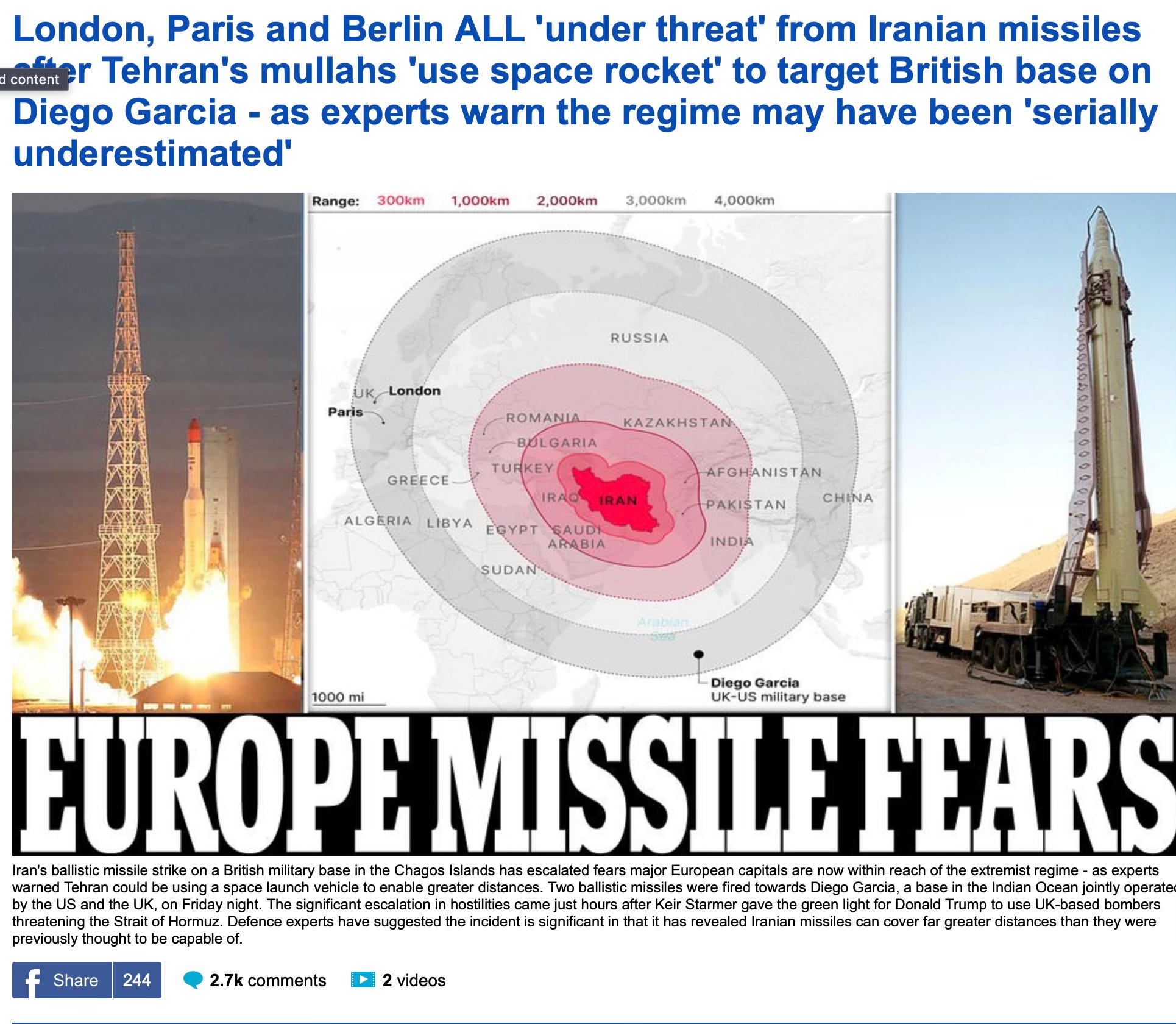
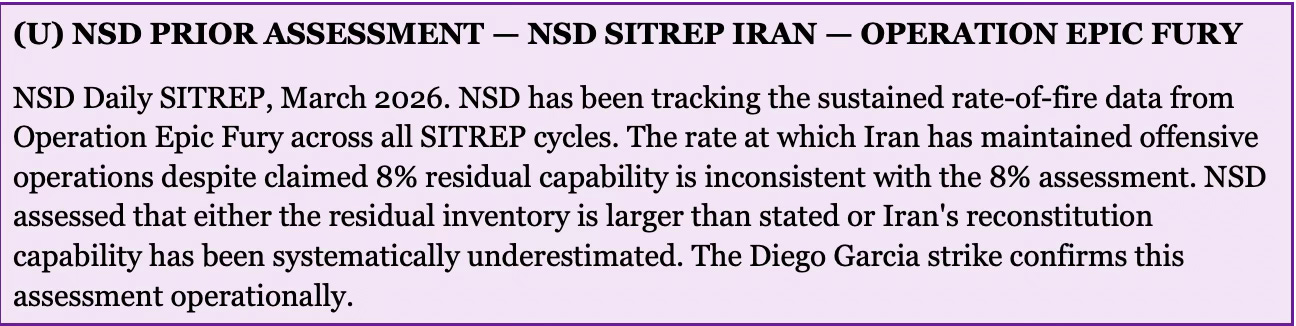
On approximately 20 March 2026, Iran launched one or more ballistic missiles at Diego Garcia — the joint US-UK base in the British Indian Ocean Territory, approximately 3,800 to 4,000 kilometers from Iranian launch sites. Neither weapon struck the base. The attack was confirmed by senior UK MoD officials and widely reported across major Western outlets including AFP, Reuters, BBC, CNN, and ITV.
The commentary that followed focused on what the missiles missed. NSD’s analysis focuses on what the missiles found.
They found the fuel farms.
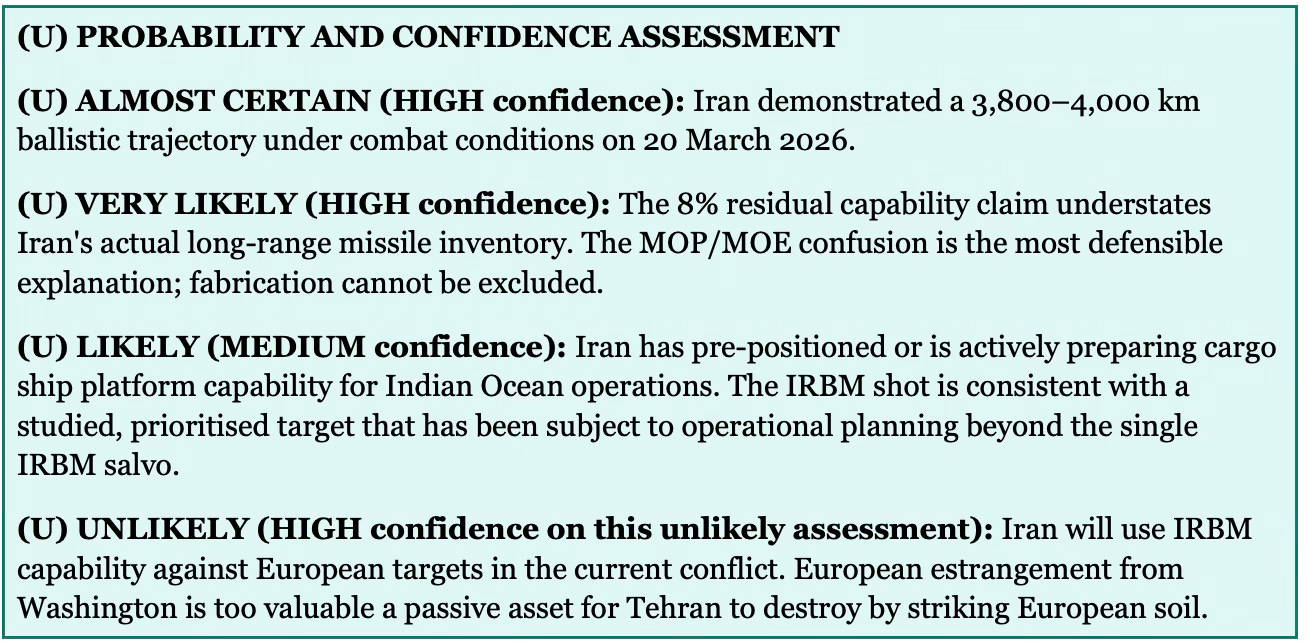
Not metaphorically. Literally. The targeting logic of a ballistic strike against a deep-rear logistics hub — far from the front line, far from the immediate theatre, previously treated as a sanctuary — is not about destroying the runway. Runways can be repaired in weeks. It is about demonstrating reach to the infrastructure that makes everything on and from that runway possible. The fuel. The Maritime Pre-Positioning Ships in the anchorage. The logistics concentration that sustains US power projection across two combatant commands simultaneously. Japan understood this logic in 1941. Iran understands it in 2026. The question is whether the United States does.
This piece examines the Diego Garcia strike in its full operational and strategic context: what the intelligence record shows, where the assessments failed, what the real target was, and what the IRGC’s actual strategic logic is — because it is not what most of the commentary has claimed.
(U) I. THE EVENT: WHAT THE INTELLIGENCE RECORD ACTUALLY SHOWS
The factual core is confirmed at high confidence. The interpretive layer contains three unresolved disputes that must be named before analysis proceeds.
What is confirmed
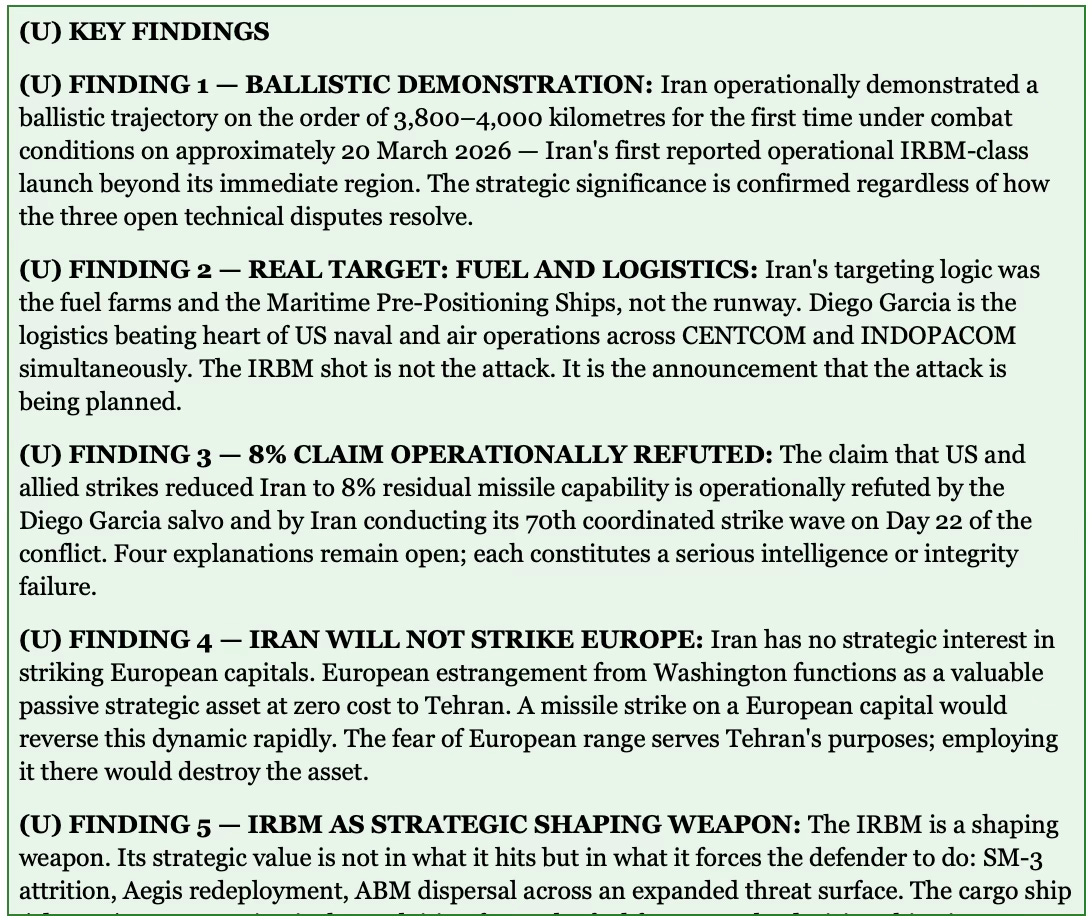
Iran launched one or more ballistic weapons toward Diego Garcia on approximately 20 March 2026. Neither weapon struck the base. UK MoD confirmed the attack, describing it as “unsuccessful targeting” with force protection at “highest levels.” Eighteen or more independent Tier 2 sources across five continents corroborate the event. A US warship reportedly fired an SM-3-class interceptor at one of the missiles; open sources differ on whether the interceptor achieved a successful engagement.[3a] The attack appears to be Iran’s longest-range ballistic missile launch reported to date and Iran’s first operational IRBM-class launch beyond its immediate region (Bloomberg, 2026; The Indian Express, 2026).
The strategic significance is confirmed regardless of how the three open disputes resolve: Iran operationally demonstrated a ballistic trajectory on the order of 3,800–4,000 kilometres for the first time under combat conditions (Euronews, 2026; Bloomberg, 2026). Key NATO bases such as Ramstein, Lakenheath, and Incirlik fall within a notional 3,800–4,000 km ring from Iran, as do Indian Ocean basing nodes including Diego Garcia itself.
The under-appreciated implication for Asia is that the demonstrated envelope compresses the distinction between ‘front-line’ and ‘rear’ in the Indian Ocean–Western Pacific system. Basing architectures that treat Diego Garcia as a deep sanctuary and Asian hubs such as Guam or Darwin as ‘outer bastions’ now sit on a continuum of vulnerability rather than in discrete categories. For regional planners in Japan, Australia, and India, the Diego Garcia shot is less about whether a single base can be hit and more about how quickly long-range strike geometry can be re-targeted or transferred across theatres. An Indian Ocean node that can be held at risk from Iran becomes a conceptual template for how peer or near-peer adversaries might hold Indo-Pacific logistics networks at risk from unexpected azimuths, complicating both allied deterrence messaging and practical force-flow to Asia.
Three unresolved disputes
Dispute One — Classification: US officials say IRBM (3,000–5,500 km); IDF CofS Zamir said “two-stage intercontinental ballistic missile with a range of 4,000 kilometres” — a statement that is either strategic messaging inflation or reflects undisclosed IDF technical intelligence that the system’s true ceiling exceeds 5,500 km.[1]
Dispute Two — System identity: US assessment favours Khorramshahr-4; RUSI’s Justin Bronk and Jeffrey Lewis (Middlebury) have named the solid-fuelled, two-stage Zoljanah SLV as a credible alternative with an estimated 4,000–5,000 km ballistic range — a finding that, if confirmed, places this event on the ICBM development pathway rather than the IRBM shelf.[2]
Dispute Three — One object or two: US officials described two separate missiles, one of which failed; one partially corroborated source contends the event was a single two-stage weapon whose separated booster was tracked as a second object — which would mean no SM-3 intercept occurred and Iran successfully tested a two-stage system under combat conditions, a result more alarming than the two-missile account.[3]
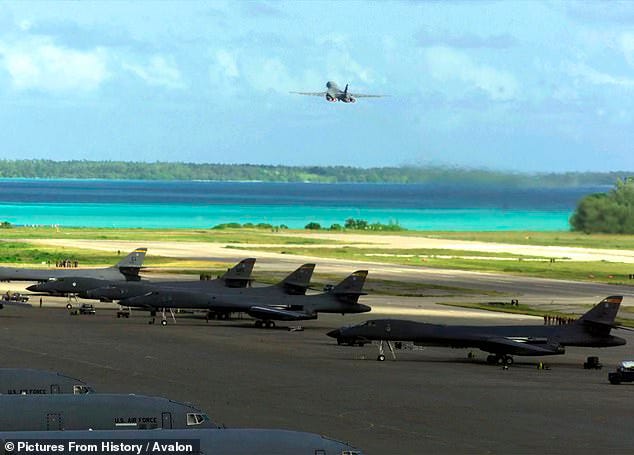
NSD cannot publish a definitive system identification until these disputes are resolved. The strategic analysis that follows does not depend on their resolution. The 4,000 km ballistic envelope is demonstrated. The targeting logic is clear. The failure mode is the same regardless of which system delivered it.
(U) II. THE INTELLIGENCE FAILURE: THE 8% PROBLEM
Before the Diego Garcia strike, US and Israeli briefers and think-tank assessments had suggested that sustained allied strikes had reduced Iran’s residual missile capability to roughly 10% or less of pre-war capacity — a figure that circulated widely as evidence that Epic Fury had substantially disarmed Iran.[4] That claim was the analytical foundation for the operational narrative that Iran’s long-range strike capacity had been neutralised.
The Diego Garcia salvo operationally refuted it. The throughput data makes the refutation mathematical, not merely rhetorical.
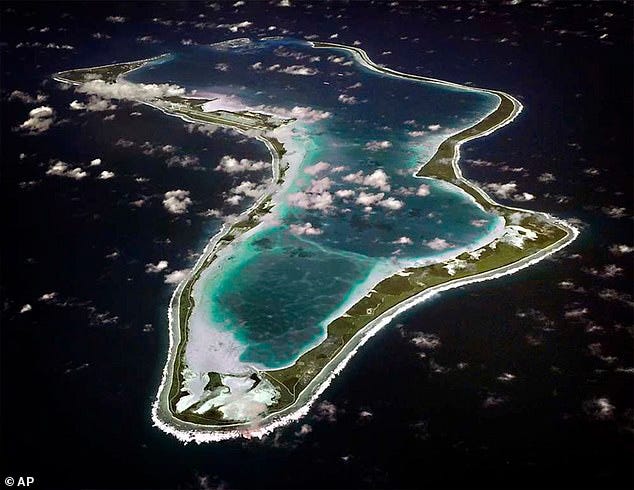
Iran entered Operation Epic Fury on 28 February 2026 with an estimated 2,000 medium-range ballistic missiles and a short-range ballistic missile stockpile of 6,000 to 8,000 weapons — a total inventory rebuilt from approximately 1,500 surviving missiles after the June 2025 Twelve-Day War through active production at rates US officials estimated at between 50 and 100+ missiles per month.[5] On Day 1 alone, Iran launched approximately 480 ballistic missiles. By Day 10, approximately 2,410 missiles and 3,560 drones had been expended — vastly exceeding the entirety of the June 2025 war in ten days.[6] The daily launch rate then fell approximately 92% from peak. The White House cited this rate decline as evidence of the 8% residual capability claim.
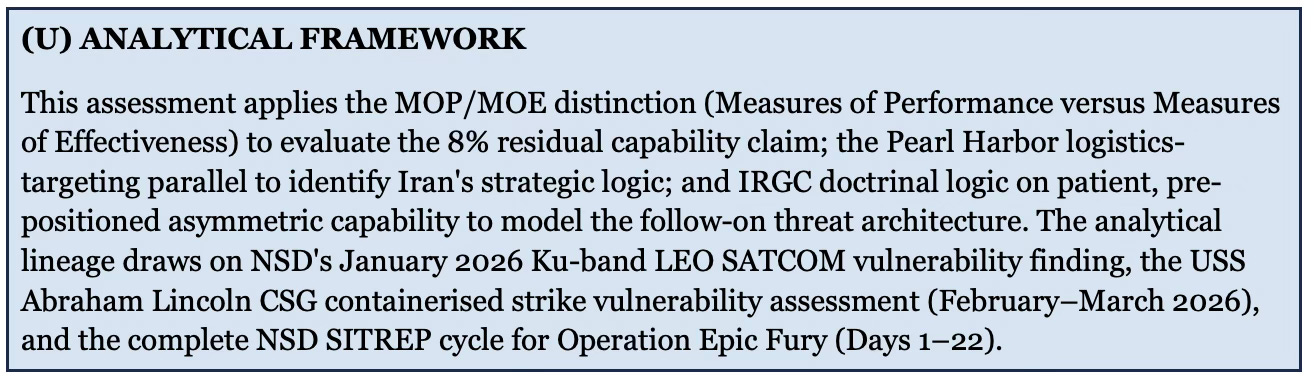
This is a textbook MOP/MOE confusion: measuring output rate and calling it inventory. A declining launch rate in a conflict against US and Israeli strike packages is consistent with two entirely different explanations — depleted inventory, or deliberate rationing for a longer campaign. NSD assessed across its Day 5 through Day 17 SITREP cycles that the pattern was consistent with rationing, not depletion. The evidence: Iran’s strikes continued to reach new geographic targets, maintained qualitative improvements in weapons employed, and on Day 22 the IRGC announced its 70th wave of Operation True Promise 4, striking over 55 US and Israeli locations simultaneously.[7] You do not conduct your 70th coordinated strike wave from 8% residual capability.
The structural reason the 8% claim was always analytically implausible is Iran’s underground “missile city” basing architecture — facilities at depths of up to 500 metres, some of which were described pre-conflict as containing missiles ‘in all provinces and cities throughout the country.’ Surface strikes, however precise, do not reliably destroy weapons stored at those depths. The SHIG missile production facility and Shahroud test site were both reported as ‘damaged’ in June 2025 strikes — with operational status described as ‘unknown.’ Unknown is not destroyed. Iran imported solid-rocket propellant precursors from China in sufficient quantities for several hundred additional medium-range missiles in the months preceding Epic Fury.[8] On 20 March 2026 — the day of the Diego Garcia strike — the IRGC spokesperson stated publicly that there was ‘no concern’ over Iran’s missile industry or its stockpiles, and that production was continuing under wartime conditions.[9]
Four possible explanations for the 8% failure remain open, each serious. First: the claim was fabricated or politically inflated to declare operational success. Second: the BDA methodology was flawed, overcounting kills by attributing destroyed decoys, empty launchers, or damaged-but-repairable systems as eliminated capability. Third: Iran reconstituted faster than assessed, drawing on the pre-positioned propellant stocks and Chinese-supplied components that US ISR did not fully track. Fourth — and most consequential: the 8% referred accurately to short-range and medium-range surface systems while long-range IRBM-class capability survived substantially intact in underground facilities that were never the primary target of the strike packages. The Diego Garcia shot was drawn from that preserved deep inventory. It never appeared in a surface bomb-damage assessment because it was never in a surface facility.
Any of these explanations requires a serious accounting. If US ISR and strike dominance were sufficient to degrade Iran to 8% residual capability, they were sufficient to detect a cargo ship undergoing conversion for containerised strike operations in the Indian Ocean. The fact that the IRBM shot apparently came as a strategic surprise to the base’s force protection posture suggests the ISR confidence underpinning the 8% claim was misplaced across the board — not just on the long-range missile question.
For Asian defence establishments, the 8% problem is not a narrow Iran-specific embarrassment; it is a live test of whether US campaign assessments in a politically charged environment can be treated as hard inputs for their own planning. If a flagship US-Israeli suppression effort against a relatively modest adversary yields public narratives that diverge this sharply from subsequent operational reality, partners in Tokyo, Seoul, Canberra, and New Delhi must assume a comparable risk of optimism bias in any future crisis briefings about Chinese or North Korean degradation. The practical consequence is that Asian planners will increasingly weight worst-case residual capabilities and independent national collection over allied assurances, even while publicly praising US ISR dominance. That shift quietly erodes the epistemic foundation of coalition operations: the assumption that one side’s damage assessment can be safely imported into another’s force-protection calculus.

(U) III. THE PEARL HARBOR PARALLEL: JAPAN ATTACKED THE BATTLESHIPS
On 7 December 1941, the Imperial Japanese Navy attacked Pearl Harbor. The raid sank or damaged eighteen naval vessels, killed 2,403 Americans, and achieved one of the most complete tactical surprises in military history. It also failed strategically in a way that shaped the entire Pacific War — because Japan attacked the battleships and left the fuel.
Admiral Chester Nimitz assessed after the war that if Japan had destroyed the fuel storage at Pearl Harbor — approximately 4.5 million barrels concentrated in above-ground tank farms on the base — US Pacific operations could have been set back by up to two years; Admiral Nimitz is frequently cited as making this assessment (Prange, 1981; Parshall & Tully, 2005).[10] The battleships were obsolete. The carriers were at sea and survived. The fuel was irreplaceable in any timeframe relevant to the operational situation. Japan’s targeting priorities were wrong, and the war’s outcome reflected that error.
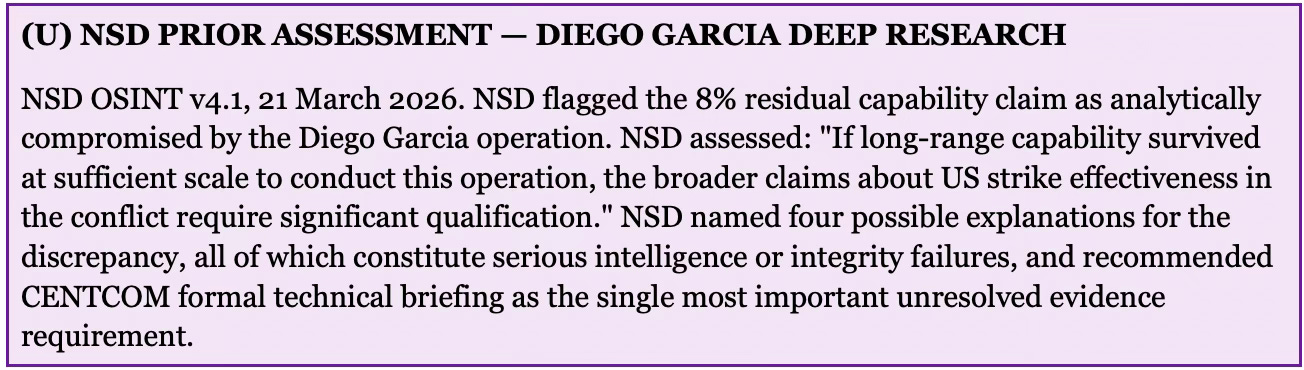
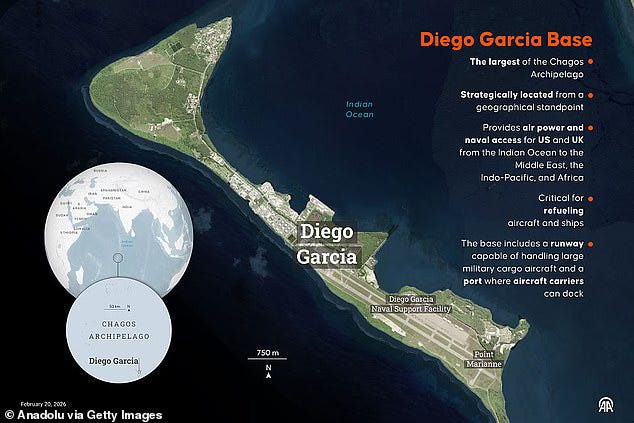
Diego Garcia is a major bulk fuel storage hub for US operations in the Indian Ocean region — precise capacity figures are not in open source, but the operational logic is clear: Diego Garcia is not a symbolic target. It is the logistics beating heart of US naval and air operations across the CENTCOM and INDOPACOM areas of responsibility simultaneously. Carriers draw from it. B-52s staging through it require it. The Maritime Pre-Positioning Ships in the anchorage carry combat equipment and thirty days of supplies for a Marine Expeditionary Brigade — approximately 16,500 Marines, fully equipped with vehicles, weapons, ammunition, and fuel — pre-positioned precisely because the alternative is waiting weeks for sealift from CONUS.[11] Without Diego Garcia’s fuel and logistics infrastructure, US operational tempo in the Indian Ocean and Gulf is not reduced. It is fundamentally constrained.
Iran’s targeting logic for the March 2026 strike was not the runway — a point already made in this piece’s opening paragraph and worth restating here because US planning appears not to have internalised it. The targeting logic was the fuel farms and the MPS ships. A follow-on drone and USV campaign — Iran’s proven, cheap, asymmetric toolset — arriving on different axes and timelines after the IRBM has repositioned ABM coverage and saturated C2 bandwidth, could achieve against Diego Garcia what Japan failed to achieve at Pearl Harbor: the destruction of the logistics infrastructure that makes the platform operations possible.
The runway survives. The fuel is gone. The MPS ships are on the bottom. The B-52s have nowhere to tank. The carriers have nothing to draw from. The Marine Expeditionary Brigade’s equipment is at the bottom of the anchorage. The recovery timeline is not weeks. It is years. And there is no backstop. The backup capacity that would theoretically allow reconstitution through European basing — Rota, Lakenheath, Fairford — now exists in a political context that the current US administration has spent three years actively degrading. Trump’s diplomacy of sanctioning Spain, insulting Britain, and threatening NATO allies has not merely strained relationships. It has compromised the operational resilience of the very power projection architecture that Diego Garcia anchors. The sanctuary has no redundancy. The redundancy has been politically torched by the country that depends on it most.
Japan’s mistake at Pearl Harbor was the same mistake US planners may be making about Diego Garcia right now: focusing on the platforms while missing the infrastructure that makes the platforms operate. The IRBM shot is not the attack. The IRBM shot is the announcement that the attack is being planned.
(U) IV. THE CARGO SHIP PROBLEM
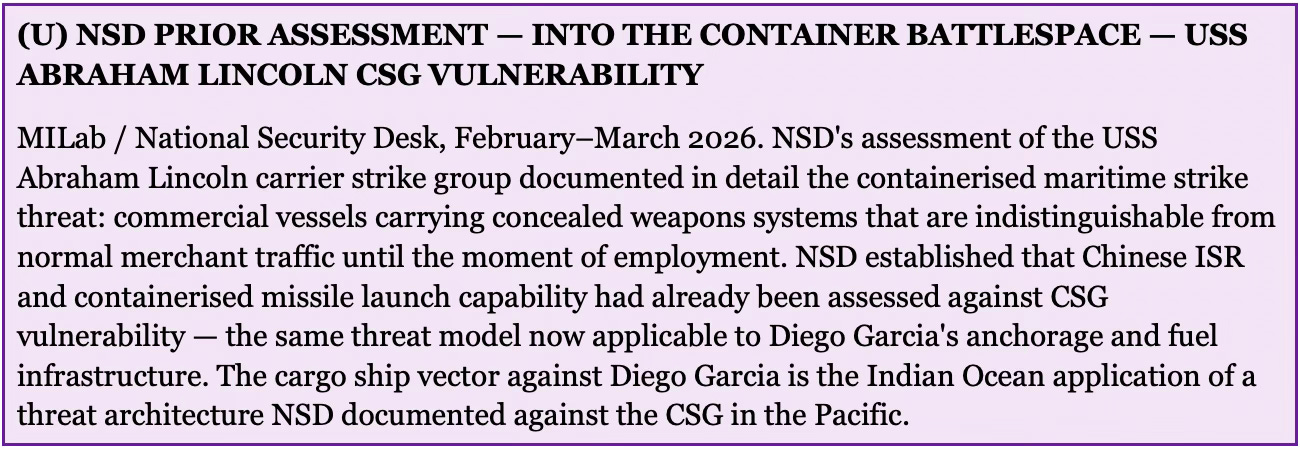

The IRBM salvo established reach. The follow-on threat is more dangerous and far less discussed.
Iran has had years to plan this. The Diego Garcia strike tells us the base is a studied, prioritised target. The IRGC’s entire operational doctrine is built on patient, pre-positioned, asymmetric capability — containerised weapons systems that look like commercial assets until they don’t. The Houthi campaign in the Red Sea has likely provided Iran with significant operational data on drone and USV effectiveness against defended naval targets (Kasapoğlu, 2026). The containerised Shahed derivative, the USV swarm, the coordinated multi-domain salvo — these are not theoretical capabilities. They are proven in the Red Sea and adaptable to the Indian Ocean with modest modification.
A cargo vessel carrying containerised loitering munitions assessed in some variants to approach 1,500–2,000 km range under optimal conditions (Kasapoğlu, 2026), USVs, and sub-surface UUVs can position itself in the Indian Ocean at commercial shipping lanes — indistinguishable from the hundreds of other cargo vessels in that ocean on any given day — and execute a coordinated multi-domain attack on Diego Garcia’s fuel farms and anchorage without the vessel ever entering a defensive perimeter.
The attack sequence that a serious IRGC planner would model:
T-0: The IRBM forces Aegis repositioning. Every destroyer on station goes to full BMD alert. C2 bandwidth is saturated tracking the ballistic threat. The SM-3 inventory is committed.
T+30 minutes: Air drone wave launches from cargo vessel positioned 400 to 600 kilometres from Diego Garcia. Fifty to one hundred Shahed derivatives, multiple axes, low altitude, low signature. Terminal defence — designed for a different threat baseline — faces saturation.
T+60 minutes: USV surface attack on the harbour entrance, the MPS ship anchorage, and the fuel pier. Cheap. Numerous. Coordinated with the air wave to split terminal defences across domains.
T+90 minutes: UUV terminal attack on the fuel pier and offshore mooring buoys. Sub-surface. Below the radar picture. Aimed at the infrastructure the air and surface waves have not yet reached.
The fuel farms are above ground. The MPS ships are at anchor at known coordinates. The pier infrastructure is fixed. Diego Garcia’s legacy defensive concept has treated the base largely as a sanctuary, and current disclosed capabilities may not be optimised for a simultaneous, multi-domain saturation attack of this character.
For Asia, the cargo-ship construct should be read not as a Diego Garcia one-off but as a modular concept scalable to the Malacca–Lombok–Sunda corridor and to chokepoints around Japan and Taiwan. Containerised strike packages that can masquerade as commercial shipping for most of their profile directly intersect with the region’s dependence on unimpeded sea-lines of communication and on just-in-time energy flows from the Gulf. An actor willing to export doctrine and hardware — whether Tehran itself or a future aligned partner — could in principle give proxies or aligned governments the ability to threaten Asian energy infrastructure and naval logistics from outside traditional theatre boundaries, blurring the line between Gulf contingencies and Indo-Pacific stability. The strategic risk for Asian capitals is that suppressing such threats may require forms of pre-emptive maritime interdiction that collide with peacetime legal and economic norms on which their own prosperity rests.
The corollary that Western commentary has largely avoided stating plainly: Australia and its allies should be considering this doctrine for their own use. The containerised strike concept that Iran has pioneered — cheap, deniable, scalable, indistinguishable from commercial traffic until the moment of employment — is not an Iranian proprietary. It is a template. Applied against Chinese maritime power projection through the archipelago, containerised long-range strike systems positioned in Indonesian, Philippine, or Australian-proximate waters would impose precisely the cordon and ISR burden on the PLAN that Iran is now imposing on the US Navy. The asymmetry works in both directions. The actor that first institutionalises this doctrine at scale, rather than merely defending against it, holds the initiative.
The question is not whether Iran has developed this capability. The question is how many such vessels exist and where they are right now. The analytical posture should be: assume the capability exists until proven otherwise, not assume it doesn’t exist until proven. The IRBM shot tells us Iran has been thinking about Diego Garcia seriously. The IRGC’s history of patient pre-positioning tells us that serious targeting is followed by serious preparation.
(U) V. THE CORDON PROBLEM
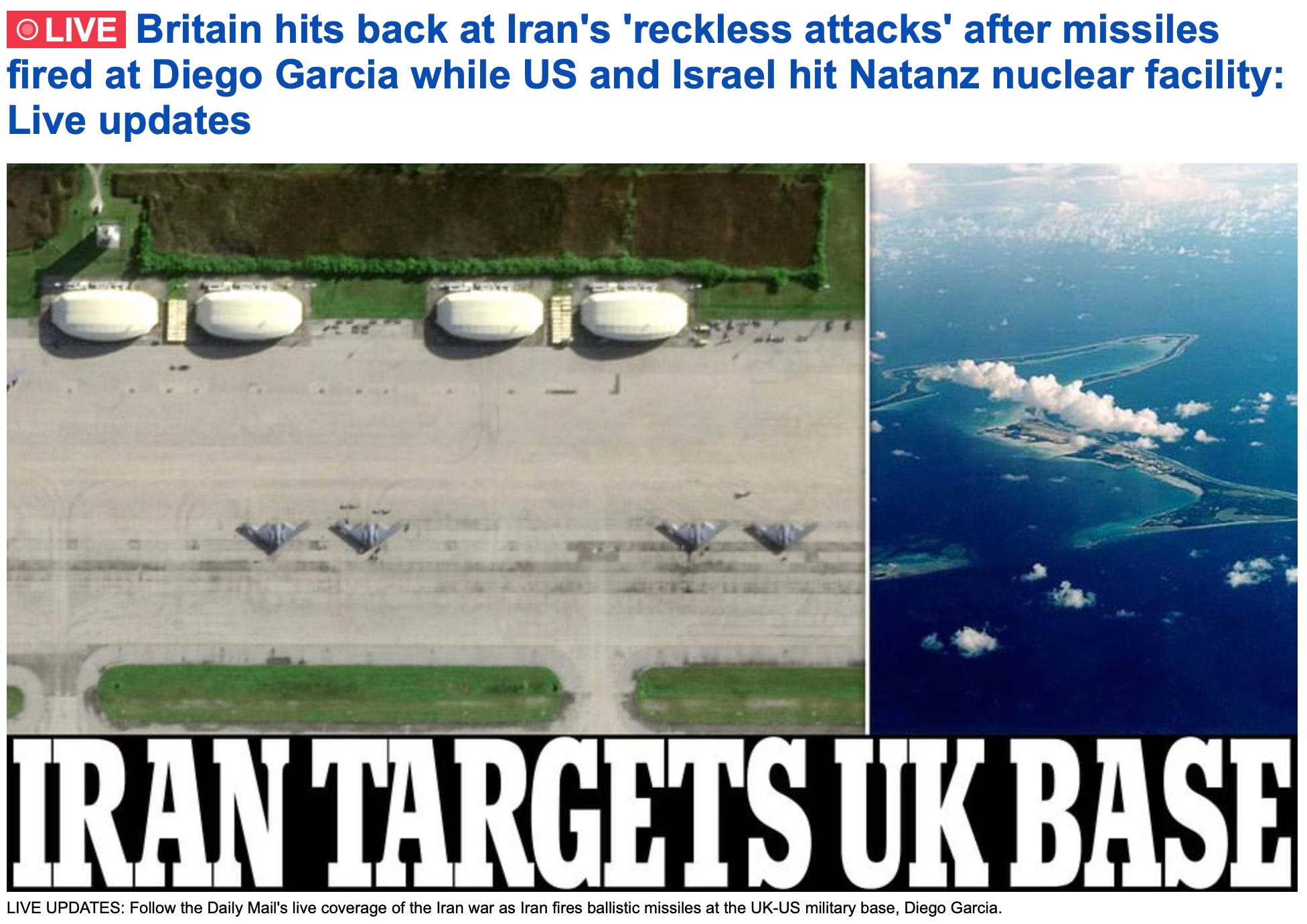
The instinctive response to the cargo ship threat is a defensive cordon around Diego Garcia. Establish a sanitised perimeter. Screen every vessel within a defined radius. Deny access to potential platforms.
Against a conventional military surface threat — a known IRGC vessel, a fast attack craft with an identifiable military profile — a 300-nautical-mile defensive perimeter is theoretically workable. Demanding but executable with available maritime patrol and P-8 coverage.
Against the cargo ship problem it is essentially meaningless. The air drone range of 1,500 to 2,000 kilometres means the vessel can launch from beyond any practically enforceable cordon. To have confidence that no air-launched drone threat can reach Diego Garcia, the sanitised radius would need to be approximately 1,000 nautical miles. That is an area of roughly three million square nautical miles in an ocean of twenty-eight million square nautical miles. The US does not have the maritime patrol assets to maintain that cordon while simultaneously running a carrier strike group and amphibious ready group in the Strait of Hormuz and Gulf, defending Arabian Gulf nodes, and covering Strait commitments.
The cargo ship problem cannot be solved by a physical cordon. It can only be solved by intelligence-led interdiction — identifying the vessel before it sails, not after it launches. Which brings the 8% residual capability claim back into operational focus. If US ISR was good enough to degrade Iran to 8% residual missile capability through targeting, it should be good enough to identify a cargo ship undergoing conversion for containerised strike capability. The fact that the IRBM shot apparently came as a strategic surprise suggests the ISR confidence was misplaced — and the cargo ship problem may already be further advanced than the current intelligence picture reflects.
(U) VI. THE ABM DILUTION STRATEGY
Every SM-3 Block IIA interceptor expended on an IRBM track over the Indian Ocean is a $30 million asset removed from a finite, slow-to-replenish inventory. Production rates are constrained. The stockpile is not deep. Every Aegis destroyer repositioned to provide ballistic missile defence coverage over Diego Garcia is a hull removed from the carrier strike group screen in the Gulf. Every THAAD battery that must now model European base coverage is a system with a finite interceptor magazine, a finite radar coverage arc, and an operational team with finite capacity for continuous high-alert posture.
Iran does not need to hit anything. It needs to keep launching. Force enough intercept attempts and response postures across an expanded threat surface — Diego Garcia, Arabian Gulf nodes, the CSG screen, potential European infrastructure — and the inventory exhausts faster than it replenishes. Iranian ballistic missile production costs are believed to be substantially lower than US unit costs for high-end interceptors such as the SM-3, generating a cost-exchange ratio that favours the attacker in a sustained campaign (CSIS, 2026; Kasapoğlu, 2026).
The ABM dilution strategy scales. Begin with Diego Garcia. Establish the precedent that deep-rear infrastructure is within reach. Force defensive posture changes and ABM repositioning across the expanded threat surface. As the ABM inventory thins and the defensive geometry becomes stretched, the follow-on drone and USV campaign — cheap, numerous, multi-axis — strikes at the fuel farms and logistics nodes that the thinned defences can no longer fully protect.
This mirrors the operational logic demonstrated in the Houthi Red Sea campaign, where relatively cheap drones and missiles forced sustained high-end defensive expenditures — a cost-exchange dynamic that analysts have described as operationally unsustainable over time (CSIS, 2026; Kasapoğlu, 2026). The IRBM extends that logic from the Red Sea to the Indian Ocean and beyond. It is cheap for Tehran whether or not it hits anything. It is expensive for Washington regardless.
Asian missile-defence planners already live inside a similar cost-exchange trap, and the Diego Garcia demonstration underscores how quickly an opportunistic secondary actor can exacerbate it. Japan’s and South Korea’s layered defences against North Korean salvos, and Australia’s emerging interest in Aegis and theatre-level interceptors, all depend on magazine depth and reload timelines vulnerable to sustained, geographically distributed probes. An Iran-driven dilution of SM-3 and THAAD inventories earmarked for Europe and the Gulf inevitably reverberates in Indo-Pacific resourcing cycles, forcing hard choices between continental US, European, and Asian coverage. Seen from Tokyo or Canberra, the IRBM shot is thus a reminder that any future high-tempo confrontation with China or North Korea may begin with thinned magazines, compressed production buffers, and an adversary well aware of the cross-theatre arithmetic.

(U) VII. WHY IRAN WILL NOT SHOOT AT EUROPE
The commentary that has followed the Diego Garcia strike has been dominated by one observation: if Iran can reach Diego Garcia at 4,000 kilometres, it can reach European capitals. The range maps have been widely circulated. The IDF’s Chief of Staff named Berlin, Paris, and Rome explicitly. Deutsche Welle ran the Ramstein debate. The implication — variously stated and unstated — is that the IRBM demonstration has created a new and acute threat to European security.
NSD assesses this framing as analytically incorrect in its most important dimension. The question everyone is asking is: can Iran hit Europe? The answer is theoretically yes. The more important question is: does Iran have any strategic interest in doing so? The answer is clearly and unambiguously no. And the reasoning exposes something that the commentary has almost entirely missed.
From Tehran’s perspective, NSD assesses that European estrangement from Washington functions as a valuable passive strategic asset. It costs Tehran nothing. It constrains US coalition-building, basing access, and operational freedom of action across the theatre. A NATO ally that declines to permit offensive operations from its soil is an ally not available to extend the reach and depth of Epic Fury. Every European government that maintains distance from Washington’s Iran policy is a constraint on the coalition that Tehran does not have to fight to impose.
A missile strike on a European capital would be likely to rapidly reverse this dynamic. Segments of European public opinion that currently view US policy as more destabilising than Tehran’s, and governments currently resisting coalition pressure, would face overwhelming domestic pressure to align (Pew Research Center, 2020; Deutsche Welle, 2026). The political space that currently exists for European governments to maintain distance from the conflict would likely collapse.
Iran does not need to hit Europe. It needs Europe to stay estranged from America. Those are opposite requirements. The IRBM demonstration creates the fear of European range without any Iranian intent to use it there — and the fear alone serves Tehran’s purposes by generating the Ramstein debates, the host-nation consent anxieties, and the domestic political pressures that constrain European governments from deepening cooperation with Washington.
And the person doing the most to maintain European estrangement from the US — ensuring that Tehran’s optimal strategic environment in Europe is maintained at no cost to Iran — is Donald Trump. The trade embargo on Spain. The Starmer-Churchill insult. The Greenland threats. The SACEUR abandonment attempt. Every action that pushes European publics toward classifying the US as a competitor or an enemy rather than an ally is an action that preserves the political space Tehran needs. Iran is getting this service for free.
From an Asian strategic perspective, the more uncomfortable implication is that Iran has discovered a form of ‘outsourced shaping power’ in the behaviour of a major Western leader. When presidential rhetoric and policy systematically alienate European allies, undercut NATO cohesion, and inject uncertainty into US alliance guarantees, Tehran acquires — at zero marginal cost — a strategic environment more permissive than anything its own diplomacy or covert action could likely secure. In Asia, where alliance credibility is the central organising principle of regional security, this pattern raises the question of how much weight to place on US extended deterrence commitments when domestic political cycles in Washington can intermittently align de facto with adversary objectives. For Tokyo, Seoul, and Taipei, the Diego Garcia episode is therefore not just about Iranian missiles to the west; it is about the durability of US-led coalition structures in the face of political actors willing to spend alliance capital for short-term domestic gain.
NSD assesses that current US presidential behaviour — trade sanctions on Spain (reported, March 2026), the publicly reported SACEUR review, the Greenland threats against a NATO ally, and the sustained contempt for European leadership — is functioning in the European theatre in ways that align with Iranian strategic interests, regardless of intent.
(U) VIII. THE IRGC PLANNER’S LOGIC: THE LADDER
Think like a hard-edged IRGC strategic planner assessing the Diego Garcia strike not as a tactical event but as the opening move of a sustained strategic campaign.
The objective is not to destroy Diego Garcia. The objective is to demonstrate, repeatedly and at low cost, that nothing is out of reach — and to harvest the compounding strategic costs that flow from that demonstration without expending the inventory required for a decisive kinetic attack.
The IRBM as a standing option holds a global ladder of US and allied bases and logistics nodes at risk, forcing the US to defend or reconsider assets that strategic planners had long considered immune from direct attack. Every rung of that ladder that can be threatened without being hit generates leverage without expenditure. Diego Garcia is the first rung demonstrated under combat conditions. Ramstein, Lakenheath, Incirlik, the Indian Ocean sea lanes, the Arabian Gulf pre-positioning sites — all sit on rungs of the same ladder that the Diego Garcia precedent has now made theoretically credible.
The compounding operational costs to Washington from this strategy are real and accumulating. SM-3 attrition forces expenditure of a high-end, limited-inventory interceptor regardless of whether the intercept succeeds. Naval redeployment to sustain Aegis BMD coverage in the central Indian Ocean diverts surface combatants from the Gulf theatre where the kinetic fight is happening. ABM planning complexity across the expanded threat surface consumes staff bandwidth and intelligence resources that would otherwise be focused on the immediate operational environment.
Iran does not need to achieve a decisive kinetic result to win this phase of the campaign. It needs to impose persistent crisis management costs on Washington across an expanding threat surface while its own operational capacity in the Gulf and Strait is protected by the defensive resources the US has redirected to cover the extended threat. The IRBM is a shaping weapon. The drone and USV campaign is the exploiting force. The fuel farms are the decisive objective.
Japan understood this logic in reverse in 1941. The carrier was the shaping weapon — fix the battleships at anchor, draw the defensive response, create the conditions for exploitation. Japan’s error was that it identified the wrong decisive objective. Iran, in 2026, has identified the right one.
The Diego Garcia shot was not a military operation. It was an announcement.
(U) KNOWN UNKNOWNS
The following factual gaps are unresolved as of the assessment date and represent the primary evidence requirements for refining this analysis:
• Definitive missile system identification — CENTCOM radar track data and SM-3 engagement logs are the only sources that can definitively resolve the Khorramshahr-4 / Zoljanah dispute and the one-object / two-object question.
• SM-3 intercept outcome — Whether a successful intercept occurred or the second radar track was the separated booster stage remains unresolved.
• True Iranian IRBM / long-range missile residual inventory — Underground basing and the BDA methodology problems make this the single most consequential intelligence gap.
• Cargo ship platform conversion status and current locations — Whether Iran has pre-positioned Indian Ocean cargo ship platforms is the most operationally urgent open question for Diego Garcia force protection.
The following scenarios are not assessed as likely but cannot be confidently excluded and would, if realised, require significant revision of the analytical framework:
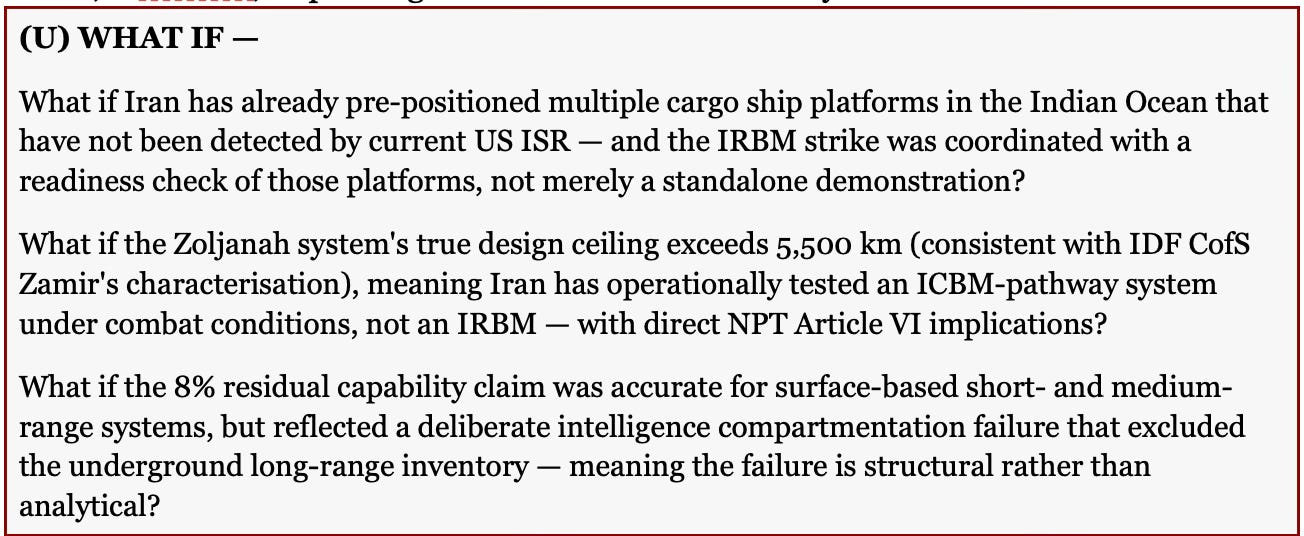
(U) ANALYTICAL JUDGMENT
Iran’s IRBM strike on Diego Garcia was not a tactical military operation. It was an announcement that the sanctuary era for deep-rear US logistics infrastructure is over. The Pearl Harbor parallel inverts: Japan destroyed the obsolete and left the decisive. Iran targeted the decisive. Whether the fuel farms survived this engagement is less significant than the fact that Iran has demonstrated it understands which nodes matter — and has modelled the follow-on campaign to destroy them.
The strategic question for US planners is not whether they can defend Diego Garcia against the IRBM. It is whether they can defend the fuel farms against what comes after. The IRBM repositions the ABM architecture, thins the interceptor inventory, and saturates the C2 bandwidth. The cargo ship follows. The drone wave follows. The USV follows. The UUV follows. Each wave arrives on a different axis, at a different altitude, against a defence that was designed for a sanctuary that no longer exists.
The political architecture that would provide redundancy and reconstitution — European basing, allied diplomatic cooperation, host-nation consent — is being actively dismantled by the country that depends on it most. Iran is not causing the degradation of the American defensive posture. It is timing its operations to exploit a degradation already in progress.
The National Security Desk offers these posts freely, but your support is necessary and appreciated. Please subscribe, paid if you’re able, or leave a tip.
Thank you

(U) ENDNOTES
[1] Zamir’s statement was reported in the Times of Israel liveblog, 21 March 2026. The technical definition of ICBM ≥ 5,500 km is established by the INF Treaty framework and is standard in US, NATO, and IISS usage. A system with a demonstrated range of 4,000 km is an IRBM by every published definition. Zamir’s characterisation is therefore either: (a) deliberate strategic messaging to maximise the perceived threat to European capitals, serving Israeli interest in sustaining Western allied engagement; or (b) a reflection of IDF technical intelligence — possibly from signals intercepts of Iranian telemetry or human intelligence on programme specifications — that the system’s design ceiling exceeds 5,500 km and the Diego Garcia shot was conducted at reduced range to manage payload mass, guidance accuracy, or as a range-limited test under operational conditions. Option (b) would mean the system is technically an ICBM operated as an IRBM — with direct implications for European threat modelling. The IDF has not published the technical basis for Zamir’s characterisation. NSD treats both options as open.
[2] Justin Bronk (RUSI) told Military.com/AP: “The attempt may have involved improvised use of Iran’s Simorgh space launch rocket, which could offer greater range as a ballistic missile, though at the cost of reduced accuracy.” Jeffrey Lewis (Middlebury Institute) was quoted in Spokesman-Review/Bloomberg: “Iran has a number of space launch vehicles that could be used as intermediate range ballistic missiles. We previously estimated that the Zoljanah solid-propellant SLV might have a range of 4,000–5,000 kilometers as a two-stage missile.” The Zoljanah is solid-fuelled and explicitly two-stage, consistent with Zamir’s “two-stage” characterisation and inconsistent with the single-stage liquid-fuel Khorramshahr-4. If confirmed by post-event debris analysis or signals intelligence, the Zoljanah hypothesis means that Iran’s civil space programme has been used as cover for ICBM-pathway development — a finding with direct NPT Article VI implications warranting NSD issuing a WMD AMBER flag. The Shahroud Missile Test Site, from which SLVs including the Noor series have been launched, was reported as damaged in June 2025 strikes but with operational status unknown — consistent with the underground basing survivability pattern discussed in Section II.
[3] The one-object hypothesis was carried by a low-tier but internally coherent source with an update notation. Its internal logic is consistent with all three candidate systems. If the event was a single two-stage missile whose booster separated and appeared as a second radar track: (a) the US official two-missile account is incorrect; (b) no SM-3 intercept occurred — the “second object” was the discarded booster on its own ballistic arc; (c) Zamir’s “two-stage” description is the accurate technical characterisation; (d) Iran conducted a successful two-stage system test under combat conditions, obtaining live performance data on a platform structurally closer to an ICBM than a single-stage IRBM. The CENTCOM radar track record and SM-3 engagement logs are the only sources that can definitively resolve this. NSD has not confirmed either account and will not publish a settled characterisation until that data is available.
[4] The 8% figure was attributed to US and Israeli officials across multiple outlets in the first three weeks of Epic Fury. The White House cited supporting evidence in the form of a 90% reduction in missile attack rates and a 95% reduction in drone attack rates from Day 1 peak. The Congressional Research Service (IN12665, 2026) noted: “The effect of the strikes on Iran’s inventory of ballistic missiles and production capacity is unclear.” This is the CRS’s careful formulation for: we cannot confirm the claim. NSD assessed across its SITREP cycle that the rate decline was consistent with rationing strategy, not inventory exhaustion, and flagged the MOP/MOE confusion explicitly in multiple products. The Diego Garcia strike confirms that assessment.
[5] Inventory and production rate data: IDF assessed Iran at approximately 2,500 ballistic missiles entering February 2026, having rebuilt from approximately 1,500 surviving the June 2025 Twelve-Day War (Times of Israel, 21 March 2026; IranWatch, accessed March 2026). Production rate estimates diverged sharply between briefers: US officials stated pre-June 2025 rate was 50 missiles/month; on March 1 the IDF estimated “dozens per month”; on March 2 Secretary Rubio stated “over 100” per month (CRS IN12665). The divergence is analytically significant: if Rubio’s 100+/month figure is accurate, Iran could reconstitute approximately 800–1,000 missiles in the eight months between the end of the June 2025 war and the start of Epic Fury — consistent with the IDF’s 2,500 estimate. An October 2025 media report citing European intelligence sources stated Iran had accepted shipments of sodium perchlorate (solid rocket propellant precursor) from China in quantities sufficient for several hundred additional medium-range missiles (Hudson Institute / MENA Defense Intelligence Digest, citing maritime intelligence tracking).
[6] Day-by-day throughput: Jerusalem Post, citing IDF and CENTCOM data, reported Iran fired approximately 480 ballistic missiles on Day 1 (28 February 2026) and approximately 2,410 total missiles plus 3,560 drones by Day 10. NSD’s Day 5 SITREP (5 March 2026) recorded over 500 ballistic and naval missiles and nearly 2,000 drones from Day 1 through Day 5, consistent with the JPost trajectory. The JPost Day 10 figure of 2,410 total missiles would represent approximately 24–30% of the estimated 8,000–10,000 total ballistic missile inventory (MRBM + SRBM), leaving substantial residual capacity even before accounting for production during the conflict period. The 92% rate decline from Day 1 peak to Day 10 — from ~480 launches/day to ~40 launches/day — is the figure the White House converted into an 8% residual inventory claim. The conversion is analytically unsupported.
[7] The IRGC announced its 70th wave of Operation True Promise 4 on 21 March 2026 (Day 22), striking over 55 US and Israeli locations using Qiam and Emad missile systems alongside drones, targeting Al-Kharj, Al-Dhafra, Ali Al-Salem, and US Fifth Fleet assets. Source: NSD Day 22 SITREP, 21 March 2026, citing IRGC-linked media and CENTCOM acknowledgements. The operational significance is arithmetical: 70 distinct announced strike waves in 22 days averages more than three coordinated multi-target operations per day throughout the conflict. This tempo is incompatible with 8% residual capability. It is compatible with a rationing strategy in which Iran fires sufficient weapons to maintain operational pressure and demonstrate continued capability while preserving its most valuable long-range and precision assets for strategic signalling operations — of which Diego Garcia is the clearest example.
[8] Underground basing and reconstitution: Iran’s “missile cities” are described in Iranian state media and by Western analysts as multi-level underground complexes at depths up to 500 metres, distributed across all 31 provinces, with the most sensitive assets at the deepest levels. The SHIG (Shahid Hemmat Industrial Group) facility — the primary production centre for liquid-fuel ballistic missiles including the Khorramshahr series — was described as ‘damaged’ in June 2025 strikes with operational status ‘unknown.’ Chinese propellant precursor shipments: an October 2025 media report cited by the Hudson Institute’s MENA Defense Intelligence Digest identified ‘tons of sodium perchlorate, likely from China, through the port at Bandar Abbas.’ A small fleet of cargo vessels repeatedly plying China-Iran routes with concealment measures was tracked by maritime intelligence. These supplies are sufficient for solid-fuel motor production for ‘several hundred medium-range ballistic missiles.’
[9] IRGC spokesperson Brigadier General Ali Mohammad Naeini, statement reported by Al Mayadeen, 20 March 2026: “There should be no concern over Iran’s missile industry or its stockpiles.” Naeini described Iran’s retaliation as becoming “more remarkable and increasingly complex,” and stated production was continuing under wartime conditions. This statement was made the same day as the Diego Garcia IRBM launch. Iranian state media simultaneously denied the Diego Garcia strike occurred, consistent with Iranian strategic ambiguity doctrine: demonstrate capability while preserving deniability and escalation space.
[10] The Nimitz fuel assessment is documented in multiple post-war accounts and is widely cited in naval logistics and strategic studies literature. The precise wording varies across sources but the analytical conclusion — that the fuel farms were the decisive vulnerability Japan failed to exploit — is consistent across authoritative accounts including Clay Blair’s Nimitz biography and Samuel Eliot Morison’s official naval history of World War II. The Pearl Harbor tank farm held approximately 4.5 million barrels of fuel oil. Had it been destroyed, the Pacific Fleet would have been forced to withdraw to the US West Coast, extending the war’s timeline by an estimated eighteen months to two years.
[11] Maritime Pre-Positioning Ships at Diego Garcia: MPS Squadron Two, homeported at Diego Garcia, typically consists of three to five vessels carrying the equipment and thirty-day sustainment for a Marine Expeditionary Brigade — the USMC’s primary combined-arms task force at brigade scale, organised around approximately 16,500 Marines. Equipment includes armoured vehicles, artillery, aviation assets, ammunition, fuel, food, water, and medical supplies. The MPS concept was developed specifically to enable rapid force projection without requiring the weeks-long sealift from CONUS that conventional logistics would require. Diego Garcia is the only MPS squadron homeport in the Indian Ocean. Loss of MPS Squadron Two’s equipment would eliminate the capability to rapidly equip a Marine Expeditionary Brigade for Indian Ocean contingencies for the duration of any resupply timeline, conservatively estimated at two to five years for full reconstitution.
Assessment valid as of 22 March 2026. Re-evaluation triggers: CENTCOM formal statement on missile type and SM-3 outcome; independent OSINT on object count; second IRBM-class strike beyond 3,000 km establishing operational pattern; Trump 48-hour Hormuz deadline outcome.
(U) REFERENCES
AFP. (2026, March 21). Iran ‘unsuccessfully’ targeted Diego Garcia base. Al-Arabiya English.
Bloomberg News. (2026, March 21). Iran’s strike attempt on Diego Garcia reveals missile range. https://bloomberg.com
Center for Strategic and International Studies. (2026, March 4). Epic Fury: The campaign against Iran’s missile and nuclear infrastructure. https://csis.org
Congressional Research Service. (2017). Diego Garcia: Strategic roles and legal status. US Library of Congress.
Congressional Research Service. (2026). US military operations against Iran’s missile and nuclear programs (IN12665). US Library of Congress. https://congress.gov/crs-product/IN12665
Deutsche Welle. (2026). Ramstein under scrutiny amid Iran conflict. https://dw.com
Euronews. (2026, March 21). Iran attack on the Diego Garcia base: Its location and strategic role. https://euronews.com
ITV News. (2026, March 21). Missiles fired at Diego Garcia after UK lets US use bases. https://itv.com
Jewish Institute for National Security of America. (2026, March 16). Operations Epic Fury and Roaring Lion update [PDF]. https://jinsa.org
Jewish Institute for National Security of America. (2026, March 5). Iran’s missile firepower has almost run out [PDF]. https://jinsa.org
Kasapoğlu, C. (2026, March 10). Tehran reloads: Examining the current and future threat of Iran’s missile programs. MENA Defense Intelligence Digest, Hudson Institute. https://hudson.org
National Security Desk. (2026, March 21). NSD OSINT v4.1: Diego Garcia deep research. NSD Internal Assessment.
National Security Desk. (2026, March 5–21). Operation Epic Fury SITREP cycle, Issues 1–19. NSD Daily SITREP. https://nsdsitrep.substack.com
Parshall, J., & Tully, A. (2005). Shattered sword: The untold story of the Battle of Midway. Potomac Books.
Pew Research Center. (2020). NATO seen favorably across member states, but views of the US vary. https://pewresearch.org
Prange, G. W. (1981). At dawn we slept: The untold story of Pearl Harbor. McGraw-Hill.
The Indian Express. (2026, March 22). Tehran’s longest-range missile attack yet: Why Diego Garcia matters. https://indianexpress.com
Times of Israel. (2026, March 21). IDF CofS Zamir: Iran launched two-stage ICBM; Berlin, Paris, Rome in range. https://timesofisrael.com
US Navy. (2019). Maritime Prepositioning Force fact sheet. Department of the Navy. https://navy.mil
Ynetnews. (2026, March 20). Berlin, Paris, Rome at risk: IDF chief warns Iran’s missiles threaten Europe. https://ynetnews.com
Iran denied having launched missiles at Diego Garcia. They have repeatedly said their missiles maximum ranges were 3,000 km, not 4,000. Iran has had their several space satellites launched by Russian Federation on RF launch vehicles, not on their own vehicles.
British claim "it happened but didn't hit anything". British aren't telling any unnecessary truths during wars they are supporting.
USA claims "it happened but we shot one down". USA is lying about nearly everything in this war and has invented enemies & fictional casus beli as needed to justify our attacks to US population/rest of theworld regularly over the last 75 years.
I see no reason to believe that any Iranian 4,000 km missile launches aimed at Diego Garcia have actually happened without a few uninvolved parties corroboration, which isn't forthcoming.